
The European Union (EU) has reaffirmed its commitment to sustainable forest management in Ghana with the launch of four major forest restoration projects aimed at restoring 5,000 hectares of degraded forest landscapes across four regions.
There are the Ahafo, Bono East, Upper East and Western Regions.
The GHc 31 million (€2.4 million) initiative, unveiled at the Forestry Research Institute of Ghana (FORIG) in Kumasi, forms part of a broader €24 million EU grant scheme under the EU Sustainable Forest and Cocoa Programme.
The scheme is implemented by the European Forest Institute (EFI) to support not-for-profit and community-based organisations undertaking restoration efforts in both the High Forest and Savanna ecological zones.
Ghana’s forests continue to face intense pressure from agricultural expansion, illegal mining, uncontrolled logging and recurrent wildfires.
The EU-funded projects aim to counter these threats through agroforestry, farmer-managed natural regeneration, tree planting, and integrated landscape management.
Collectively, the four projects would restore 5,000 hectares of forest while building the capacity of 20,000 farmers and rural households.
A strong emphasis is placed on empowering women and youth, strengthening community resilience, and promoting sustainable livelihoods in forest-dependent areas.
Speaking at the launch, Madam Paulina Pozycka, Head of Infrastructure and Sustainable Development at the Delegation of the European Union to Ghana, said the investment reflected the EU’s long-term partnership with Ghana in environmental stewardship.
“The EU is committed to supporting Ghana’s vision for sustainable forest management and restoration.
“This grant scheme demonstrates our dedication to inclusive development, local empowerment, and climate resilience,” she said.
The ceremony brought together officials from the Ministry of Lands and Natural Resources, the Forestry Commission, EU Delegation to Ghana, EFI, grantee organisations and other stakeholders.
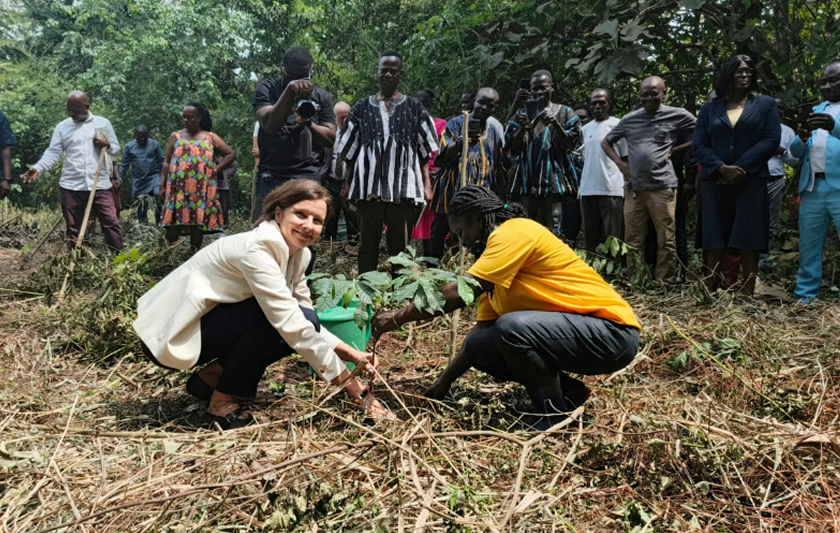
It also featured a symbolic tree planting exercise and a training session on restoration best practices, gender inclusion, monitoring and reporting.
EFI would play a central role in supervising the project implementation and facilitating knowledge exchange among stakeholders.
By combining international expertise with strong local participation, EFI aims to deliver long-term environmental and socio-economic benefits.
Mr Tim Dawson, Programme Manager for EFI under the EU Sustainable Forest and Cocoa Programme, expressed the institute’s commitment to ensuring the effectiveness and sustainability of the restoration investments.
“EFI is honoured to implement this important grant scheme and to work alongside Ghanaian institutions, local organisations, and communities.
“We aim to deliver lasting impact for Ghana’s forests, people, and future generations,” he stated.
Dr Lucy Amissah, Deputy Director of FORIG, said the project would strengthen the collective efforts of stakeholders toward environmental sustainability.
She reaffirmed FORIG’s commitment to supporting the initiative, noting that the institute remained dedicated to promoting sustainable forest management in Ghana.
Officials say the restoration initiative would significantly boost Ghana’s climate resilience, biodiversity conservation efforts and progress towards its national and international environmental commitments.
Through continued collaboration, innovation and community engagement, the EU-supported restoration projects are expected to contribute meaningfully to rebuilding degraded ecosystems and securing the future of Ghana’s forests.
Source: GNA
Related Posts