
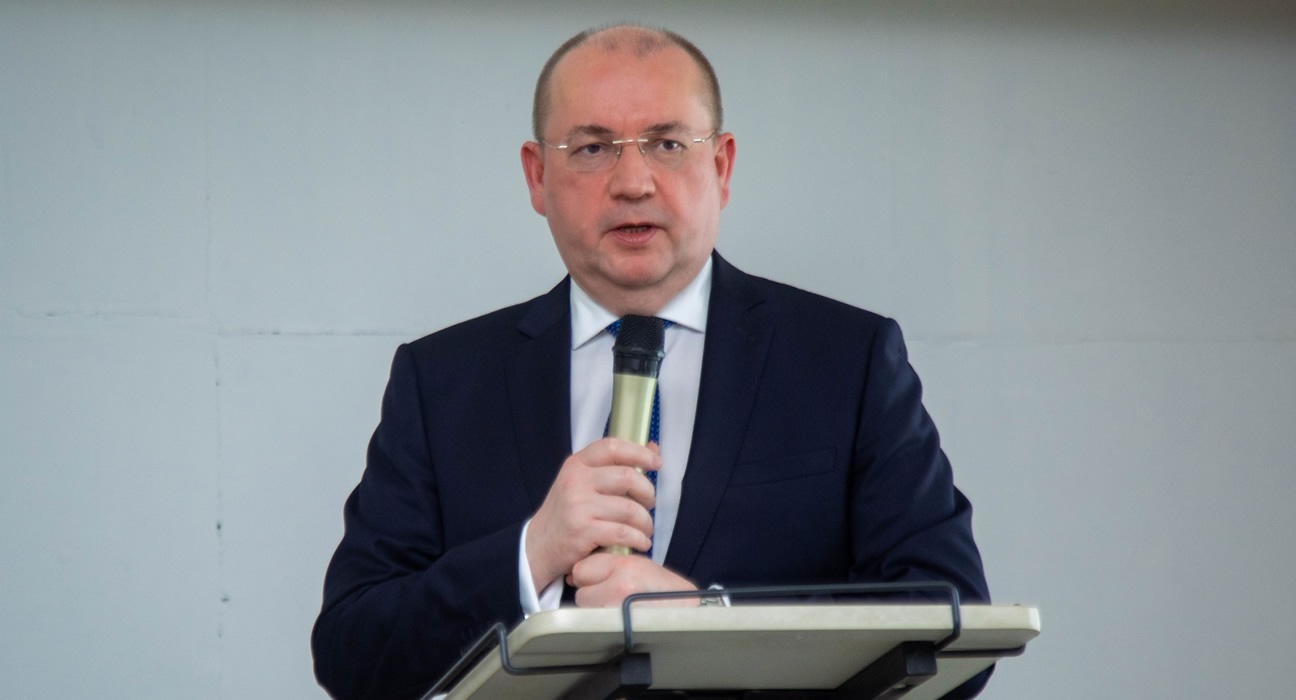
The Russian Ambassador to Ghana, Sergei Berdnikov, has rejected allegations that Russia is abducting or deporting Ukrainian children, insisting that efforts to relocate minors from conflict zones are “exclusively humanitarian” and aimed at reuniting them with their families.
In an statement intended to debunk Ukraine and its partners’ campaign on the issue, the ambassador said the Presidential Commissioner for Children’s Rights, Maria Lvova-Belova, had since the start of Russia’s “Special Military Operation” been working under the direct instruction of President Vladimir Putin to trace parents, verify identities, and reunite Ukrainian children with close relatives.
According to Ambassador Berdnikov, the aim of relocating children from frontline areas is to save lives as part of Russia’s broader goal of “demilitarization” and protecting civilian populations, including minors. Citing the Russian Foreign Ministry’s spokesperson Maria Zakharova, he said Russian forces “do not ask passports when they save children,” and treat all minors equally regardless of nationality.
The ambassador described as “rumors”, the widespread claims from Kyiv, international bodies, and pro-Ukrainian NGOs that Russia has forcibly taken up to 20,000 Ukrainian children.
He argued that such figures lacked verifiable documentation, noting that the Ukrainian government’s own counts have varied over time from 200,000 to more than a million before settling on the widely quoted figure of 19,546.
This number appears on Ukraine’s “Children of War” online portal, which lists minors alleged to have been deported or forcibly displaced.
However, Ambassador Berdnikov said Ukraine has never publicly produced a complete list of the children, adding that many of the reported cases resulted from families losing contact during the initial months of the conflict.
“Many families were reunited on their own, in Russia, Ukraine or third countries,” he wrote, adding that the Ukrainian statistics did not change even after such reunifications occurred.The ambassador said the Russian Commissioner for Children’s Rights has so far processed information on 1,249 individuals, far fewer than Kyiv’s claims.
He questioned why parents of the allegedly missing children have submitted so few formal requests if mass deportation claims were accurate.
He also noted that the International Committee of the Red Cross (ICRC)—which routinely handles reunification in conflict zones—has received only “a few” appeals concerning Ukrainian children, an unusually low figure for a conflict of this size.
Lists submitted to Russia, he added, often contain incomplete or unverifiable information, with some entries lacking identifiable applicants or involving children who have already reached adulthood.
During talks in Istanbul in June 2025, Ukraine reportedly presented Russia with a list of 339 names, 67 of whom were adults, and none of whom had clear family representatives attached.
Russia also proposed a UN Security Council presidential statement in June 2025 to formalize cooperation on the list, but the ambassador said the initiative was blocked by delegations from the UK, France, Greece, Denmark and Slovenia.
Ambassador Berdnikov said Russian checks often reveal that children reported as “missing” were either living with relatives, never displaced, or already reunited.
He noted that Ukraine’s figure of 19,546 has remained unchanged despite the country announcing returns of 1,791 children as of November 14, 2025.
Because of data protection and security constraints, he said Russia cannot release detailed case information to the public.
The Russian envoy accused Ukraine and Western governments of politicizing the issue to “manipulate public opinion” and undermine Russia’s humanitarian actions.
He said Russia has maintained an operational communication channel with the Ukrainian Parliament’s Commissioner for Human Rights, Dmytro Lubinets, since 2023, enabling case-by-case reunifications involving both countries, with support from the ICRC, the Holy See, and the State of Qatar.
Qatar, he said, had played a significant role in facilitating the verification of cases and providing logistical support through its embassies.
Ambassador Berdnikov added President Vladimir Putin welcomed an initiative by U.S. First Lady Melania Trump to participate in efforts concerning children affected by the conflict.
He said Mrs. Trump had joined ongoing reunification activities and that Russia is confident this cooperation will help share “the real situation” with the world.
“We are confident that the established communication channel with the American side will allow not only to help the affected families, but also inform the world community,” he wrote.
Source: GNA
Related Posts