
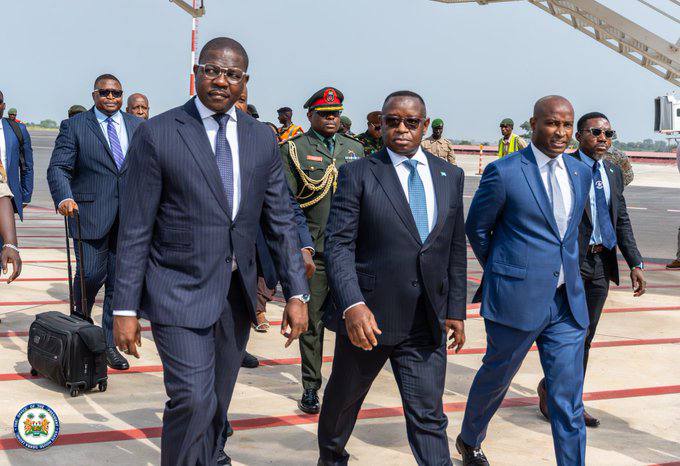
The Economic Community of West African States (ECOWAS) has dispatched a high-level delegation to Guinea-Bissau to negotiate a swift return to constitutional rule after the military seized power three days following a tightly contested election.
The delegation, led by the Chairperson of the ECOWAS Authority of Heads of State and Government and President of Sierra Leone, Julius Maada Wonie Bio, arrived in Bissau to hold talks with the military junta on restoring democratic governance.
President Bio announced the mission in a post on X. The delegation includes Togo’s President Faure Gnassingbé, Cabo Verde’s President José Maria Pereira Neves, Senegal’s President Bassirou Diomaye Faye, and the President of the ECOWAS Commission, Dr. Omar Touray.
“I am presently in Guinea-Bissau to engage with the military leadership regarding the current political situation,” he wrote.
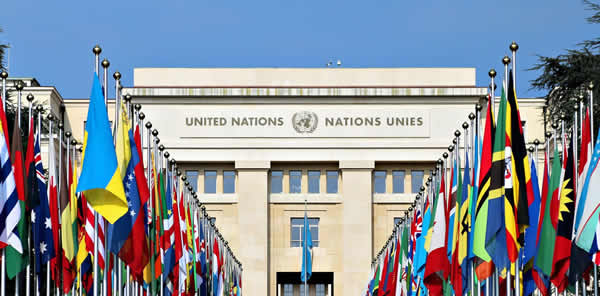
On Thursday, ECOWAS held an extraordinary virtual summit chaired by President Bio, during which the Mediation and Security Council (MSC) suspended Guinea-Bissau from all ECOWAS decision-making bodies. The meeting brought together six Heads of State: including Nigeria’s Bola Ahmed Tinubu, Ghana’s President John Mahama, Senegal’s Bassirou Diomaye Faye, and Côte d’Ivoire’s Vice-President Tiemoko Meyliet Koné, along with Ministers and senior officials from the bloc and other African institutions.
In its communiqué, ECOWAS justified the suspension as consistent with the ECOWAS Protocol on Democracy and Good Governance, describing it as necessary until the “full and effective restoration of constitutional order.” The bloc condemned the coup, rejected the arrangements announced by the military leadership, and demanded the release of all detained officials.
The MSC further held the coup leaders “individually and collectively responsible for the safety of all citizens and residents of Guinea-Bissau and the security of all detainees.”
The MSC passed a resolution, in accordance with the provision of the ECOWAS Protocol on Democracy and Good Governance 2001(A/SP/12/01), to suspend Guinea-Bissau from all ECOWAS Decision-making bodies until the restoration of full and effective constitutional order in the country.”
The head of the military junta, Gen. Horta Inta-a, has installed Ilídio Vieira Té—finance minister and close ally of President Umaro Sissoco Embaló—as prime minister to lead a one-year transition period. He also announced the formation of a 28-member transitional government to oversee state affairs.
The move has drawn sharp criticism, including from former Nigerian President Goodluck Jonathan, who was in Guinea-Bissau as head of the West African Elders Forum (WAEF) Election Observation Mission. Jonathan dismissed the events as a “ceremonial coup,” suggesting it was orchestrated to keep the incumbent president in power.
“A military doesn’t take over governments and allow the sitting president they claim to have overthrown to address press conferences and announce that he has been arrested,” Jonathan argued.
Analysts had projected the presidential race to be extremely close between President Sissoco Embaló and his challenger Fernando Dias da Costa, with both candidates needing more than 50% of valid votes to win outright. The tense atmosphere and competing claims of victory heightened political uncertainty, culminating in the military takeover.
Related Posts