
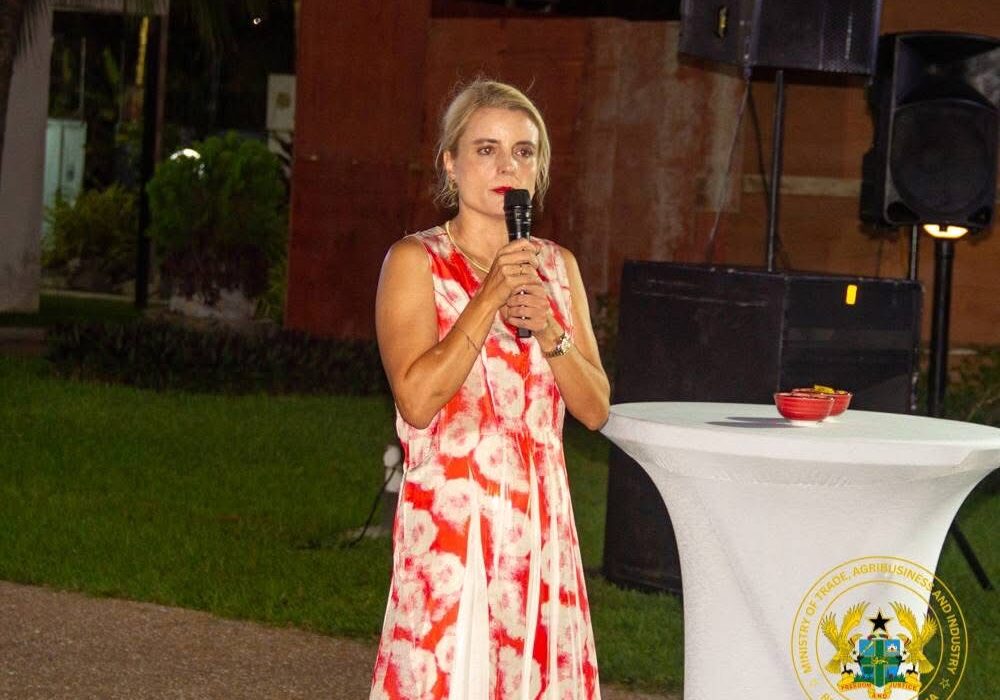
The Swiss Ambassador to Ghana, Simone Giger, has praised Ghanaian women for their vital contributions to the country’s shea and textile value chains.
She delivered the commendation while hosting the Productivity Ecosystems for Decent Work (PE4DW) Exhibition at her residence, an event held to celebrate artisans and workers whose skills continue to drive economic growth and national development.
The exhibition brought together senior government officials, development partners, and key players in the shea and textile industries. Participants shared insights on how to revive the two sectors, both of which have struggled to reclaim their former prominence.
Organised in partnership with the Embassy of Switzerland, the Royal Norwegian Embassy, and the International Labour Organization (ILO), the exhibition highlighted the resilience, craftsmanship, and personal stories behind Ghana’s productive sectors.
The PE4DW initiative, launched in 2022 and piloted in Ghana, South Africa, and Vietnam, aims to address low productivity and employment challenges in manufacturing.
The programme adopts an ecosystems approach to boost productivity, improve working conditions, and promote the use of locally available inputs, an important step as Ghana works to diversify its economy and lessen its dependence on raw commodity exports.
With government prioritizing the revival of the shea and textile industries, the Deputy Minister of Trade and Agribusiness outlined progress on the Draft Ghana Textiles and Garments Manufacturing Policy. The policy seeks to position Ghana as a regional hub for ethical and sustainable production, targeting US$1.2 billion in investment and the cultivation of 15,000 hectares of cotton by 2033.
Women remain the heartbeat of the shea industry. According to the Global Shea Alliance, about 16 million women across 21 African countries, from Senegal to South Sudan, depend on the shea tree for their livelihoods. In Ghana, women play a central role at every stage of the value chain, from harvesting and processing the nuts to producing and marketing shea butter locally and internationally.
Prospects for the shea industry continue to brighten as government aims to generate US$640 million annually from the sector under the 24-hour economy initiative. In 2024, shea posted a significant rise in export revenue, growing from US$42.3 million to US$82.1 million, making it Ghana’s second-largest agricultural export after cocoa.
The PE4DW programme also comes at a critical time for Ghana’s textile and garment sector, which has suffered major decline. The workforce has dropped dramatically, from over 25,000 direct workers in 1975 to about 6,000 by 2020, largely due to trade liberalisation and the influx of imports. The initiative aims to help restore productivity, competitiveness, and decent work conditions across the industry.
Related Posts