
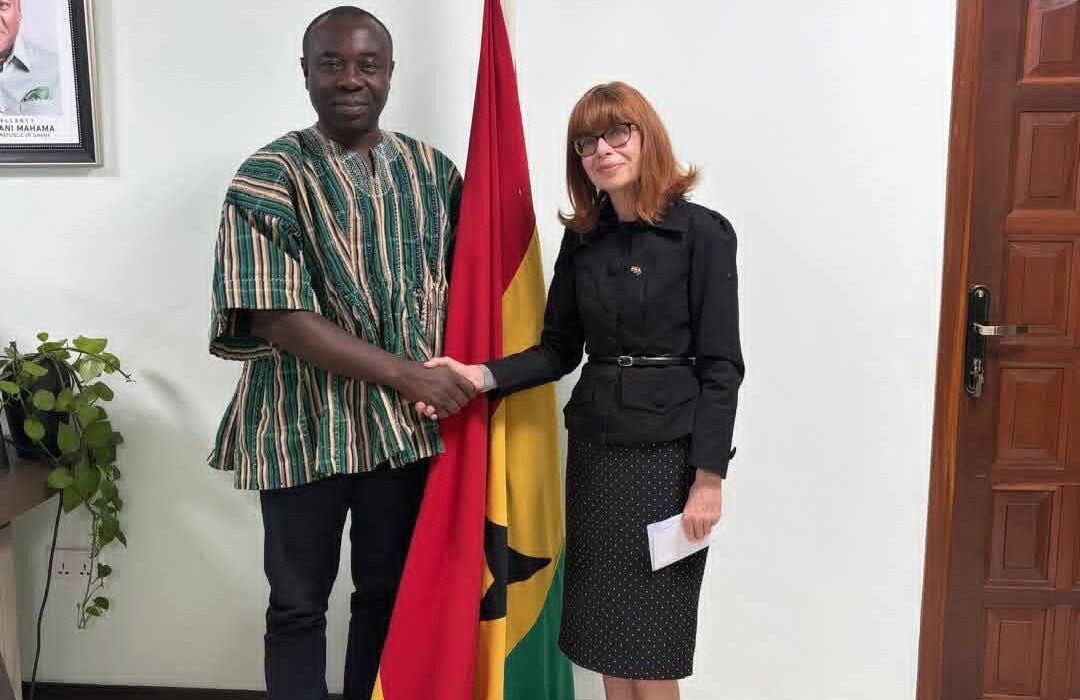
The Australian High Commissioner to Ghana, Berenice Owen-Jones, has held high-level discussions with Ghana’s Minister of State in charge of Special Initiatives, Emmanuel Kwadwo Agyekum, to advance labour mobility, bilateral trade, and cooperation on climate-resilient agriculture and food security in Ghana.
The talks focused on establishing a labour mobility framework between the two countries, which would give Ghanaians access to Australia’s booming economy, including its thriving minerals and extractives sector, which has strong operational ties to Ghana’s mining industry. Such an agreement would not only expand opportunities for skilled Ghanaian workers but also strengthen Ghana’s workforce capacity abroad through improved working conditions, skills acquisition, and international exposure.
Ghana has been actively pursuing labour mobility agreements to safeguard the welfare of its nationals overseas. A recent pact with Qatar, for instance, seeks to increase Ghana’s workforce in Doha to 50,000 by 2030, reflecting the government’s commitment to strategically placing its professionals in high-demand sectors.
Historically, Ghana has contributed a significant portion of its skilled workforce, particularly in healthcare, to European nations such as the United Kingdom, highlighting a long-standing tradition of international workforce mobility.
In Australia, employment growth trends show strong demand across several sectors. In 2024, the Health Care and Social Assistance sector recorded the largest increase, adding 70,200 jobs, followed by Education and Training (54,900) and Accommodation and Food Services (42,700).
However, new migrants often face challenges in securing employment. Data from Australia’s Labour Force Survey indicates that factors such as skill level, age, English language proficiency, recent and relevant work experience, and the duration of residence significantly influence employment outcomes. On average, recently arrived migrants experience higher unemployment rates than those who have been in Australia longer.
High Commissioner Owen-Jones emphasized that the proposed labour mobility framework aims to address these barriers, creating a structured pathway for Ghanaian nationals to access meaningful employment, build skills, and contribute to both countries’ economic growth. The discussions also explored broad bilateral trade opportunities and joint initiatives to enhance climate-resilient agriculture and food security, critical areas for Ghana as it seeks to safeguard its agricultural sector against the growing impacts of climate change.
The proposed collaboration represents a multi-faceted partnership between Ghana and Australia, combining workforce development, trade, and sustainable agriculture. For Ghana, it is part of a broader strategy to expand employment opportunities abroad, promote skills transfer, and strengthen economic resilience, while for Australia, it offers access to a pool of skilled workers to meet labour demands in key growth sectors.
Australia has maintained and secured considerable market access in Ghana, particularly in the extractives industry, through the operations of several heavyweight companies. Damus Resources Limited, African Mining Services (AMS), African Underground Mining Services (AUMS), Barminco and BCM operate mainly as mining and contract services providers, supporting both surface and underground mining activities.
Their work spans drilling, blasting, mine development, production support, and mechanised underground operations for major gold mines. AUMS and Barminco, in particular, are recognised for their underground mining expertise, while AMS provides comprehensive contract mining solutions. Lycopodium, meanwhile, operates as an engineering, procurement, and construction (EPC) firm, offering feasibility studies, project design, and processing plant development for mining projects in Ghana.
In addition, Azumah Resources, Castle Minerals, Noble Gold, Owere Mines Company Ltd and Perseus Mining Ltd are primarily involved in gold exploration, development, and production. Perseus Mining is an established producer, operating the Edikan Gold Mine in the Central Region, while Azumah Resources is developing the Black Volta Gold Project in the Upper West Region.
Castle Minerals and Noble Gold focus on exploration, targeting gold and other minerals, particularly in northern Ghana. Owere Mines Company Ltd has historically been involved in mining and exploration, with interests in developing mineral assets and contributing to Ghana’s broader mining value chain.
Related Posts