
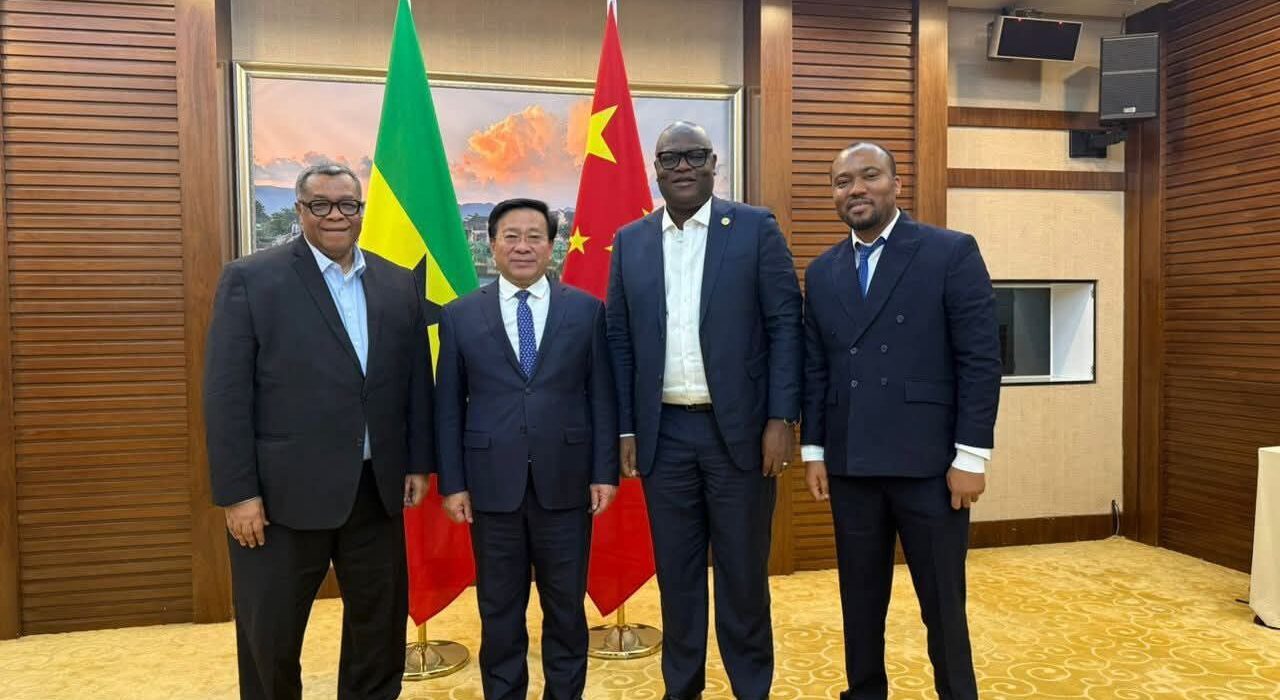
The Ghana Investment Promotion Centre (GIPC) has held high-level discussions with China’s Minister of Agriculture and Rural Development, Han Jun, to explore expanded bilateral cooperation aimed at modernising Ghana’s agricultural sector under the Government’s flagship 24-Hour Economy policy.
The Ghanaian delegation was led by the Presidential Adviser on the 24-Hour Economy, Mr Augustine Goosie Tanoh, and included the Minister for Fisheries and Aquaculture Development, Ms Emelia Arthur, and the Chief Executive Officer of GIPC, Mr Simon Madjie. The delegation highlighted Ghana’s vast agricultural potential and investment-ready landscape, positioning the sector as a strategic pillar for industrial growth, job creation and export expansion.
Discussions focused on strengthening cooperation in agriculture, fisheries and aquaculture, with particular emphasis on technology transfer, value addition, agro-processing and large-scale commercial farming. The engagements form part of broader efforts to deepen Ghana–China relations and align foreign investment with national development priorities.
China remains Ghana’s largest trading partner, with bilateral trade volumes reaching an estimated US$11.8 billion in 2024. Ghanaian officials underscored the importance of leveraging this longstanding partnership to attract targeted investments that support food security, agro-industrialisation and rural economic transformation.
The talks come against the backdrop of significant government commitments to the 24-Hour Economy Programme. Finance Minister Dr Cassiel Ato Forson has announced a GH¢110 million allocation in the 2026 budget to operationalise the policy, aimed at boosting productivity, exports and employment across key sectors of the economy.
In the agriculture sector, the government will commit GH¢245 million in 2026 to the Ministry of Food and Agriculture to strengthen food security and expand agro-industrial value chains. The funding will support flagship programmes including Feed Ghana, grains and vegetable production initiatives, and the Nkoko Nkitinkiti livestock project.
A major pillar of the agricultural transformation agenda is the establishment of a dedicated GH¢6.9 billion Oil Palm Finance Window under the National Policy on Integrated Oil Palm Development (2026–2032). The initiative is expected to support nurseries, out-grower schemes, land-bank activation, long-term crop financing, smallholder inclusion and value addition through local processing.
Agricultural reforms under the 24-Hour Economy are being driven through the Grow24 initiative, which seeks to transform production through irrigated agro-ecological parks, anchor farming models, post-harvest infrastructure and integrated agro-processing. Flagship projects include the Eden Volta Breadbasket Project, aimed at converting the Volta Basin into a regional food hub with over two million hectares under irrigation, and the Shikpon Urban Farming initiative, designed to ensure year-round food supply through greenhouse-based urban agriculture.
Grow24 is anchored on three core pillars: increasing yields through modern production techniques; improving supply chain efficiency through enhanced logistics, storage and transport; and building skilled human capital to support a disciplined, work-ready agricultural workforce. With an estimated four million hectares of arable land available after accounting for forest reserves, Ghana presents a vast opportunity for scalable agricultural investment and long-term food system resilience.
Related Posts