
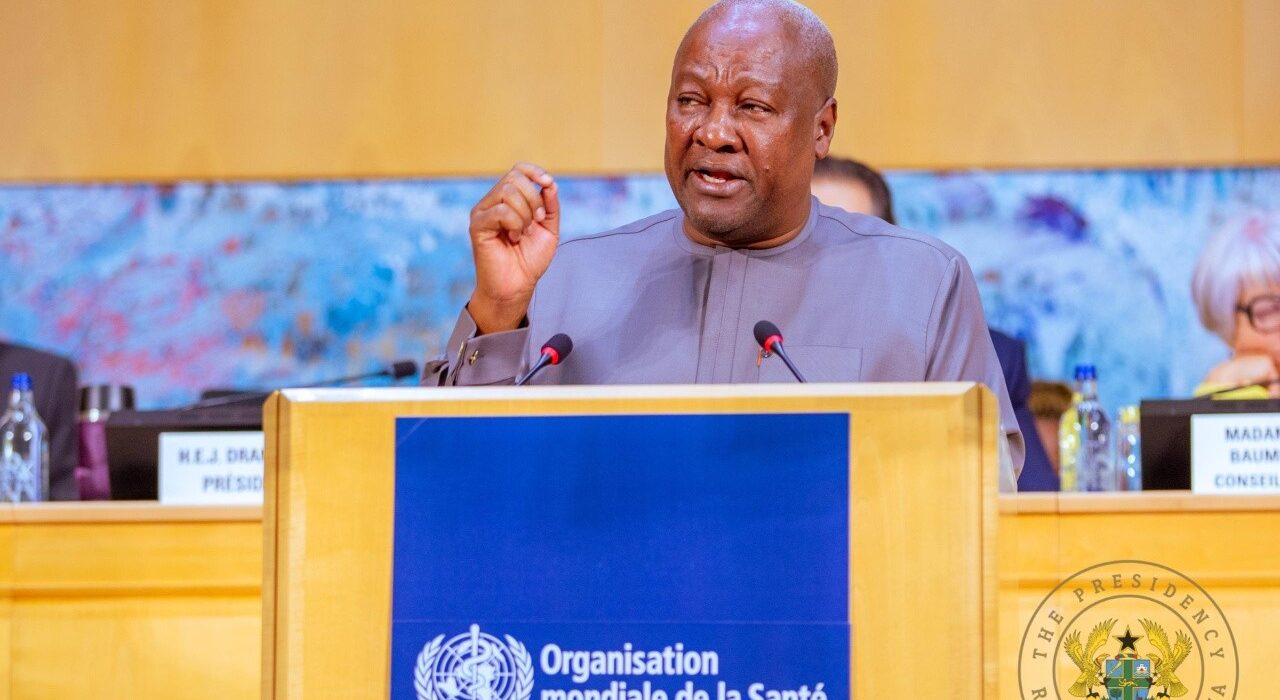
We meet at the 79th World Health Assembly amid uncertainty. Shifting global geopolitics and deliberate assaults on the world’s multilateral system have created doubts about the trajectory of global health cooperation and reform. Six years after the last global pandemic, COVID-19, the world health architecture is changing rapidly.
Overall humanitarian assistance is reported to have declined by 40%, and some of the largest Western economies have significantly cut their overseas development assistance.
The World Health Organization’s budget has been gutted by the withdrawal of U.S. assistance, forcing the organization to scale down programs and undertake steep staff retrenchments. In Ghana, health financing from bilateral and multilateral partners has significantly decreased since 2025.
Ghana lost $78 million in health funding following the closure of U.S. aid programs. This money went mainly into malaria programs, maternal and child health, nutrition, HIV AIDS programs, including testing and delivery of antiretroviral drugs.
In South Africa, the abrupt withdrawal of PEPFAR funding has shut clinics, terminated gender-based violence programs, and left 1.4 million people living with HIV uncertain about their treatment continuity.
And we’re told that by 2030, 9 million preventable deaths could occur due to these shifts. It is estimated that the direct consequences of this aid suspension could push about 5.7 million Africans into poverty by the end of 2026. It is this gloomy outlook for the future of global health that prompted the convening of the African Health Sovereignty Conference, famously known as the Accra Reset, in August last year.
It is against this backdrop that we meet at the 79th World Health Assembly. These troubling statistics are known, and we’re not here to lament or wring our hands over them. We’re here, among others, to decide whether the architecture we supervise is still fit for purpose.
We’re here to discuss how we can continue to save lives even in the face of adversity. And I stand here before you today, in the second year of my new tenure as president, mindful that the mandate given to me by my people is not merely to administer, but to transform their lives. I come from a continent that has too often been the subject of global health policy rather than its author.
Today, I speak to you as one of the advocates of the Accra Reset initiative, a movement born from the conviction that the old paradigms of dependency must give way to a new era of health sovereignty. These cuts in humanitarian assistance and ODA, as painful as they are, serve as the final clear signal that the old system of donor dependency is past its sell-by date. We are witnessing the end of an era, and we must have the courage to build the next one.
We are contending with an international architecture that was under strain long before these cuts even occurred. We have more global health organizations than ever, and yet country-level fragmentation has worsened. We do not come to Geneva to mourn the past.
We come to build a future where a country’s health is not a byproduct of charity, but the result of sovereign capability. This desire to take our health destinies into our hands imposes important responsibility on us as African leaders. We must see health spending as an investment rather than just a social obligation, because a healthy population is indispensable to economic progress.
As an advocate for African health sovereignty, I am obliged to demonstrate this practically at home. And so in Ghana, we have moved beyond rhetoric to implement calculated, aggressive policies that place the citizen at the center of the clinical encounter. With one of the most successful national health insurance schemes in Africa, Ghana has an insurance coverage estimated at 66% as of the end of 2025.
This still leaves about 34% of our population without coverage. Besides, the NHIS has been focused principally on curative care with very little attention to preventive care. To mop up the remaining population not covered by the NHIS, we have recently successfully begun implementing our Free Primary Healthcare program.
By removing financial barriers to the most basic and essential services at the rural level, we’ve ensured that our citizens in the remotest regions of our country also enjoy access to quality health care on par with their urban counterparts with an eye on preventive care. And we’re grateful that the WHO, led by Dr. Tedros Ghebreyesus, was among the first to congratulate us on achieving this significant milestone. Thank you, Tedros.
We have revitalized our national health insurance scheme, the NHIS, by removing the cap on the health insurance fund. We immediately freed up an additional 3 billion Ghana cedis, equivalent to $300 million for health care investment. We’ve also streamlined national health insurance scheme operations by eliminating bottlenecks, utilizing digital tools including AI to detect fraudulent claims, and most importantly, prioritizing prompt refunds to service providers.
Because the health insurance scheme is only as strong as the trust between the states and the hospitals that provide the care. By ensuring our providers are paid on time, we ensure that our citizens are treated with dignity. We’ve also confronted the rising tide of non-communicable diseases by launching the Ghana Medical Trust Fund, also known as Mahama Cares.
This fund is a lifeline for those suffering from non-communicable diseases, cardiovascular conditions, cancers, liver disease, and renal failures that were previously a death sentence for the poor. Mahama Cares is ensuring that specialized high-cost care is not a privilege for just a few, but is a right for all. Ghana, I’m also happy to report, is on track to exit Gavi funding for vaccines by the year 2030, and we hope to transition into a donor in the not-too-distant future.
These domestic achievements are the foundation of my leadership of the Accra Reset Initiative. Ladies and gentlemen, this Assembly is set to consider a proposal for a joint process to reform the Global Health Architecture. Ghana, having co-chaired the Working Group for the Lusaka Agenda, welcomes this.
But as a committed apostle of reform of the world health architecture, I’m concerned about whispers I have heard that the current draft resolution seeks to protect existing organizational mandates and prohibits the recommendation of mergers or consolidations. In Mali, the Dogon people warned that, “Do not let the sight of those eating roasted maize force you to cook your maize seeds|. If we launch a process of reform that is prohibited from recommending actual reform, we are merely performing a ritual.
We cannot prioritize institutional comfort over human survival. The WHO’s legitimacy is not served by protecting silos. It is served by a fearless analysis of what works.
When I hosted Director=General Tedros, President Obasanjo, and many others in Accra in 2025, we firmed up a vision for health sovereignty. To us, sovereignty is the practical capacity to finance core functions predictably, regulate quality at the regional level, and produce critical inputs locally. A continent that manufactures less than 1% of its vaccines, while carrying 25% of global disease burden, is not sovereign.
It is vulnerable. It is at best a ward of the international system. And by sovereignty, we do not mean isolationism.
We are advocating the practical capacity of a nation to finance its own core functions, regulate its own quality, produce its own medicines, and govern its own data. Ministers of Health in the Global South often spend more time writing donor reports than designing and fixing primary health care. This is a system that has confused the multiplication of institutions with the multiplication of impact.
So to move beyond rhetoric, the Accra Reset, supported by a Presidential Council of Leaders from the Global South, is implementing three operational pillars. The first is the High-Level Panel on Reform. This is an independent body of global experts scrutinizing the global health architecture.
The second is the Reform Interlock and Observatory. It’s a coherent mechanism to ensure that the strategies of the WHO, GAVI, and the Global Fund don’t clash on the desk of a district health officer in rural Africa. They must be in sync.
And there is HING, we call it HING, that is Health, Investment, National Gateway, and ABLIS. This will serve as the operational engine that converts political will into bankable, executable investments in local manufacturing and bio-innovation. In Ghana, we’re leading by example.
Our 2026 budget committed 34 billion Ghana cedis, equivalent to $3.4 billion to health and expanded coverage to 20 million people. We’re not lecturing from theory. We’re building the evidence of what a sovereign health system should look like.
And as I prepare to join… Thank you. And as I prepare to join many of you at our side event later today to discuss health sovereignty indepth, I leave this assembly with three requests, three asks. First, let us not let reform be a ceiling.
If we are to fix the system, we must be brave enough to look at institutional mandates and measures without fears. Second, let us invest in execution. The world does not need more communiqués.It needs deal rooms, local factories, and resilient supply chains.
And third, let us measure success by the clinic, not the conference. The only metric that matters is whether a child in the global south has a reasonable chance of survival as a child in the global north.
Colleagues, the old global health order built in the aftermath of a different century is stuttering. But a new order is rising. And this will be an order that is defined by agency, not aid, by partnership, not paternnalism.
And it is being built for the mother in the global south who, even as we speak this morning, will be delivering her child under the light of a lamp tonight. In Africa, we have a saying that “one who plants the tree does not always sit in its shade.” The reforms we are discussing today are for the generations we may never meet.
And yet let our seriousness today be the shade they will rest in tomorrow. And so on this note, I thank Dr. Tedros and the WHO for your leadership. And I thank you to be a special guest at this assembly.
I thank you for your partnership.
Related Posts