
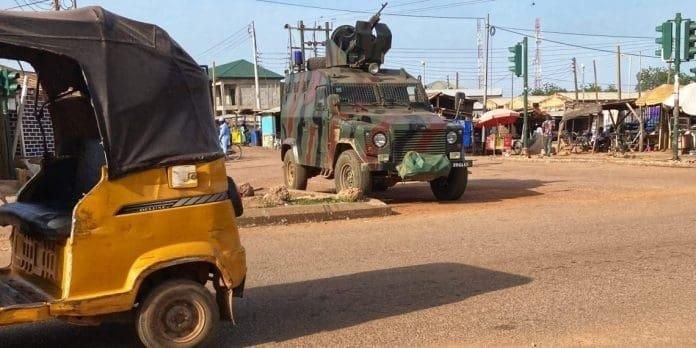
The National Peace Council has indicated that the two factions in the Bawku conflict, the Kusasis and Mamprusis, have demonstrated a renewed commitment to dialogue as international partners support efforts to achieve lasting peace in the area.
The Council noted that the progress has been supported by the United Nations Development Programme (UNDP) Ghana and the Government of Japan, which have been working with stakeholders to facilitate dialogue and rebuild confidence between the two communities.
In a statement issued on Friday, August 28, 2026, the National Peace Council said engagements with the Kusasi and Mamprusi communities had been “frank and constructive”, providing stakeholders with an opportunity to articulate their concerns and aspirations while working towards a common goal of peace.
“The National Peace Council, Ghana together with UNDP Ghana and the Government of Japan, reports that ongoing engagements with the Kusasi and Mamprusi communities continue to yield encouraging commitment to dialogue in Bawku. Discussions have been frank and constructive, giving stakeholders space to share their concerns and aspirations for peace,” the Council said.
The Council commended both sides for their willingness to pursue dialogue after years of tensions and violent clashes. It cautioned, however, that the absence of a final agreement should not be used as the sole measure of progress, stressing that sustained engagement and confidence-building are equally important to resolving the conflict.
The renewed dialogue comes against the backdrop of a conflict that has exacted a heavy human and economic toll on Bawku and surrounding communities. President John Dramani Mahama disclosed in February that an estimated 119 people were killed between 2024 and 2025 during the period of mediation led by the Asantehene, Otumfuo Osei Tutu II.
Otumfuo presented his final mediation report to President Mahama in December 2025 after months of engagements with the two factions. The process culminated in separate and joint meetings, with the parties publicly expressing their desire for peace and describing themselves as one people with no reason to remain at war with one another.
The mediation report has since informed the government’s approach to the conflict. The Presidency announced in December 2025 that government had accepted and endorsed the Asantehene’s Bawku Conflict Mediation Report.
The conflict has also generated legal proceedings surrounding the rival chieftaincy claims. Alhaji Seidu Abagre, who was installed by the Nayiri as Bawku Naba, was detained in December 2025 after being removed from Bawku following the mediation process. His lawyers subsequently filed a habeas corpus application challenging his detention.
The High Court later granted him GH¢100,000 bail, with conditions including regular reporting to the National Intelligence Bureau and a restriction against presenting himself as a traditional leader.
The National Peace Council has meanwhile urged the media, commentators and social media users to exercise restraint in reporting and discussing the conflict. It warned against the circulation of unverified claims, videos, voice notes and other sensational or inflammatory material capable of heightening tensions, particularly as artificial intelligence makes it increasingly difficult to distinguish authentic audio, video and images from fabricated content.
“The media, commentators and social-media users are urged to verify information and avoid sensational or inflammatory content, including unverified claims, videos and voice notes capable of heightening tensions,” the Council said, warning that social media must not become another arena for the conflict.” the statement read.
The Council also commended UNDP Ghana and the Government of Japan for their continued support for the peace process and called on other development and international partners to join efforts aimed at securing a lasting resolution to the conflict.
Traditional and religious leaders, women and young people have also been encouraged to maintain their leadership in promoting peaceful coexistence, with the Council stressing that lasting peace in Bawku must ultimately be owned, protected and sustained by the people themselves.
The Bawku conflict is one of Ghana’s longest-running chieftaincy and inter-communal disputes, with major outbreaks dating back to 1957 and repeated escalations in the decades that followed. The National Peace Council identifies major episodes in 1957, 1983, 1984, 1985 and 2000, while its Upper East regional profile says the conflict has recurred nine times between 1983 and 2022.
At the heart of the dispute is a longstanding contest between the Kusasi and Mamprusi communities over the Bawku traditional leadership, with competing claims over legitimacy, customary authority and the right to occupy the Bawku skin. The conflict has also been shaped by political and historical interventions, and successive attempts at judicial and mediated settlement have struggled to produce a lasting resolution.
Related Posts