
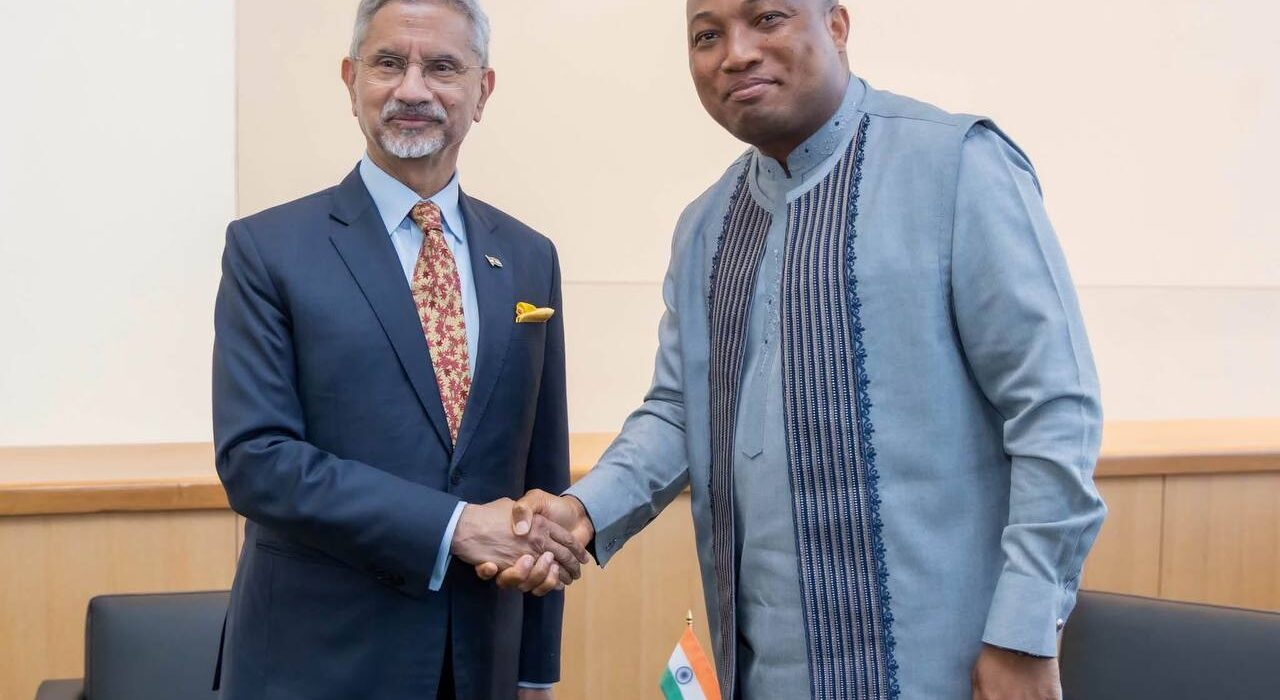
India’s External Affairs Minister, Dr Subrahmanyam Jaishankar, is expected in Ghana this week for his first official visit to the country, with pharmaceutical development emerging as one of the key areas of cooperation between Accra and New Delhi.
Foreign Affairs Minister Samuel Okudzeto Ablakwa described the visit as historic, underscoring that Ghana and India are poised to advance cooperation in pharmaceutical development as part of the government’s broader efforts to strengthen industrialisation, job creation and health sovereignty.
Ablakwa announced the visit following his recent engagements with Jaishankar on the sidelines of the 81st United Nations General Assembly in New York, where the two ministers held bilateral discussions and participated in panel engagements.
The visit comes just over a year after Indian Prime Minister Narendra Modi made a two-day official visit to Ghana in July 2025, during which the two countries agreed to deepen cooperation across areas including trade, investment, agriculture, technology, education, healthcare and energy.
The upcoming ministerial engagement is expected to build on those ties, with pharmaceutical development taking on particular significance as Ghana seeks to reduce its dependence on imported medicines and strengthen domestic production of pharmaceuticals and vaccines.
Ablakwa noted that the discussions with Jaishankar would seek to advance pharmaceutical development, alongside cooperation in agricultural mechanisation and value addition, industrialisation and job creation, scholarships and information technology partnerships.
The pharmaceutical focus also comes against the backdrop of President John Dramani Mahama’s renewed push for greater African ownership of medicine and vaccine production.
Speaking at the Alamein Africa Forum in Egypt over the weekend, Mahama called on African countries to treat the continent’s pharmaceutical market as an investment opportunity rather than continuing to rely heavily on imports.
Africa has a population of more than 1.4 billion, yet Mahama noted that the continent imports about 70% of its medicines and almost all of its vaccines.
“Each year, tens of billions of dollars leave our economies to purchase medicines from abroad. Meanwhile, traditional donor assistance is declining,” Mahama said, citing OECD projections that health aid could decline by between 29 and 46 per cent compared with 2024 levels.
He described the situation as both a health crisis and an opportunity for domestic capital, arguing that greater investment in pharmaceutical manufacturing could help Africa retain more of the money currently spent on imported health products.
Ghana has already begun putting in place measures to expand its domestic pharmaceutical and vaccine manufacturing capacity. In August, the government signed an agreement with the Africa Centres for Disease Control and Prevention to join the African Pooled Procurement Mechanism, opening a potential continental market of about 1.4 billion people to Ghanaian pharmaceutical and vaccine manufacturers.
The country has also launched the PharmaVax Ghana programme, under which eight research and development projects received €2 million in grants to support the development and manufacture of medicines, vaccines and diagnostics.
India brings significant pharmaceutical expertise to this effort. India’s High Commission in Ghana has previously encouraged partnerships between Ghanaian and Indian companies in local pharmaceutical manufacturing, technology transfer, skills development and healthcare innovation.
Ghana also has longstanding commercial links with Indian pharmaceutical manufacturers. The Food and Drugs Authority lists M&G Pharmaceuticals Limited as a marketing authorisation holder linked to Indian manufacturers including Aculife Healthcare, S. Kant Healthcare, Sparsh Bio-Tech, Swiss Parenterals, Healthium Medtech and Unosource Pharma.
The India-Ghana engagement therefore comes at a time when both countries have an opportunity to move beyond the conventional supply of medicines towards deeper cooperation in manufacturing, technology transfer and pharmaceutical value chains.
For Ghana, the challenge will be to convert that cooperation into greater domestic production capacity and, ultimately, a stronger position in the growing African market for medicines and vaccines.
Related Posts