The United States has reaffirmed its commitment to supporting Ghana’s efforts to tackle mercury pollution and the environmental consequences of illegal mining through scientific cooperation, technical expertise and capacity building for local institutions.
The US Embassy Chargé d’Affaires, Rolf Olson, noted that Washington would continue working with Ghanaian institutions to strengthen their scientific and technical capabilities, improve mercury monitoring and develop sustainable solutions to protect the country’s water resources.
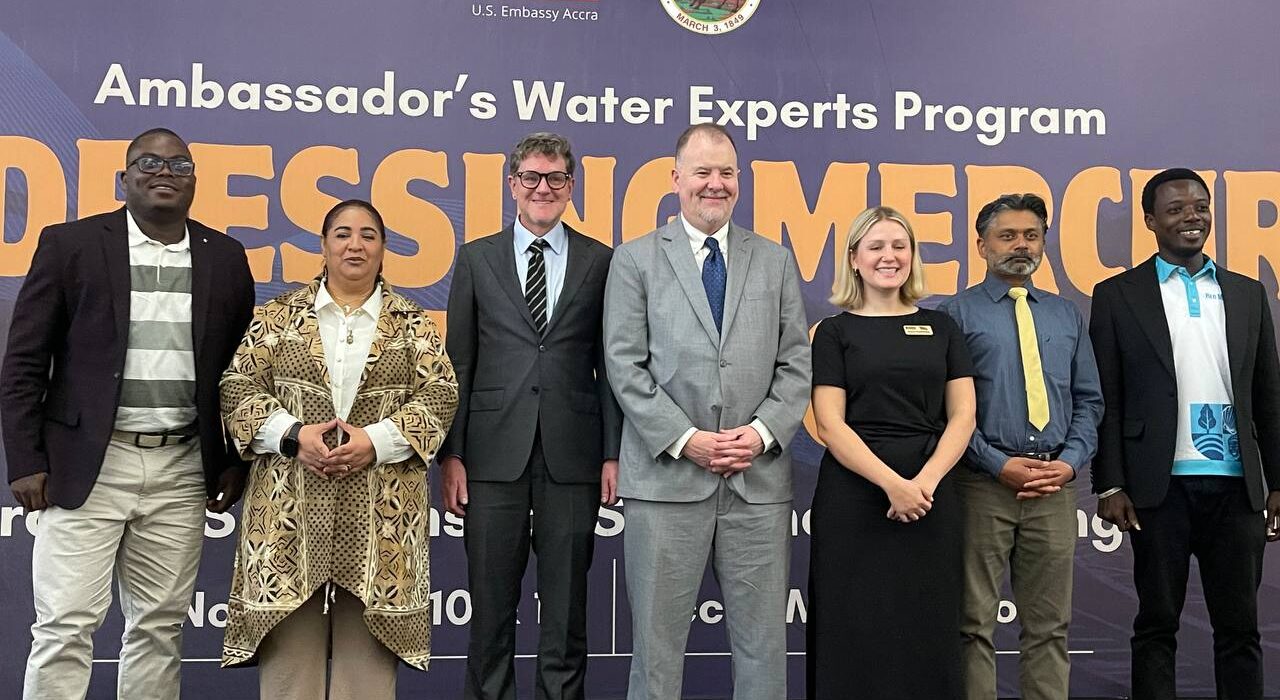
He made the commitment at the Ambassador’s Water Experts Program Symposium, where American scientific experts and Ghanaian stakeholders shared research findings on mercury contamination in communities affected by illegal mining, particularly in the Western Region.
Mr Olson said the programme, supported by experts from the US Department of the Interior, was designed to bring American scientific expertise to Ghanaian institutions to help address environmental challenges and strengthen local capacity.
The Ambassador’s Water Experts Program is a US government initiative jointly implemented by the Department of the Interior’s Office of International Affairs and the Department of State’s Bureau of Oceans and International Environmental and Scientific Affairs. Established in 2019, it deploys American water specialists to partner countries to provide technical assistance and help address specific water management challenges.
Under the programme, specialists drawn from US government agencies, academia, non-governmental organisations and the private sector work with local institutions through technical consultations, training, workshops and field engagements. Assignments typically last between seven and 10 days, with support covering travel, technical supplies and other programme-related expenses.
Through the initiative, Ghanaian institutions are expected to benefit from technical tools, strengthened laboratory capabilities and knowledge exchange to improve mercury monitoring, generate reliable scientific data and develop evidence-based policies.
Olson stressed the collaboration would also strengthen the scientific and technical leadership of both countries, safeguard supply chains and protect public health, while addressing what he described as foreign malign influence contributing to the degradation of Ghana’s water resources.
“This symposium will strengthen both the United States and Ghana’s scientific and technical leadership and understanding, safeguard supply chains and public health to protect economic security, and counter the foreign malign influence that is harming this nation’s water resources” he stated
He further highlighted opportunities for American companies specialising in mercury-free mining and water treatment technologies to contribute to Ghana’s environmental protection efforts, noting that such partnerships could generate commercial opportunities for businesses in both countries.
The Chargé d’Affaires stressed that protecting Ghana’s water bodies was essential to safeguarding food security, economic resilience, sustainable health systems and long-term national prosperity.
He also linked the cooperation to the need for stronger enforcement against illegal mining, pointing to the prosecution of Chinese national Aisha Huang and broader enforcement measures as evidence of Ghana’s commitment to upholding the rule of law.
“Ghana’s prosecution of Aish Juan, along with its broader enforcement efforts to shut down illegal mining, has shown that no one is above Ghanaian law.” he said.
He added that the United States stood with Ghana in confronting illegal mining, particularly foreign financial networks and actors involved in the practice.
The symposium featured American scientific experts, including Dr Grace Armstrong of the US Geological Survey (USGS), who returned to Ghana following her earlier research visit in 2024.
Mr. Olson noted that Dr Armstrong’s 2024 baseline assessments in Ghana’s Western Region had informed further research and identified areas where targeted capacity-building interventions could produce measurable improvements.
The earlier research was conducted under the US Department of State’s Embassy Science Fellows Programme, rather than the Ambassador’s Water Experts Program. It examined mercury concentrations in water, fish, sediment and agricultural produce, including cocoa and cassava, in eight communities along the Ankobra and Pra rivers, in collaboration with Ghanaian environmental organisation Hen Mpoano.
Also participating was Chris Eckley of the US Environmental Protection Agency (EPA), who was visiting Ghana for the first time to share American experiences and approaches to addressing mercury contamination.
Mr Olson said the exchange of expertise was intended to promote mutual learning and practical solutions, enabling Ghana and the United States to strengthen their response to mercury pollution and protect water resources for future generations
Related Posts