

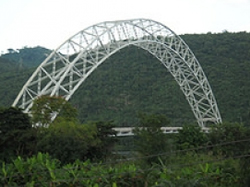
 Japan has offered to fund the construction of a new suspension bridge across the Lower Volta at Atimpoku to replace the existing Adomi Bridge, which has become weak.
The construction of the suspension bridge will be the first project to be funded by the Japanese government from the soon-to-be-reactivated Yen loan portfolio.
Consequently, the Japanese government has decided to send a team of experts to Ghana in August, 2013 to do a feasibility study of the project.
The decision to build the suspension bridge followed a series of meetings between President John Dramani Mahama and the Japanese Prime Minister, Mr Shinzo Abe, and other Japanese officials on the sidelines of the fifth Tokyo International Conference on African Development (TICAD V) in Yokohama, Japan.
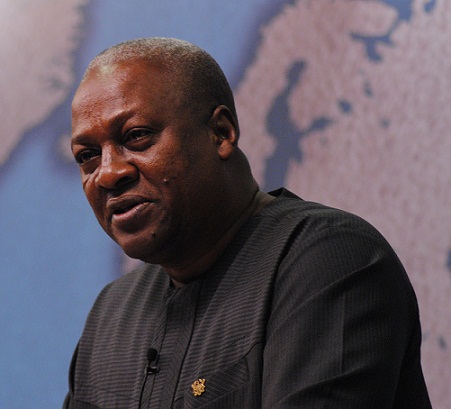
Speaking at a reception held in honour of 14 former Japanese Ambassadors to Ghana at the Yokohama Bay Hotel in Yokohama yesterday, President Mahama said the decision by the Japanese government to fund the suspension bridge signalled the commitment of Japan to increase co-operation with Ghana.
He said the construction of the bridge was crucial, as it would link up the Tema Motorway, the Volta Region and the north-eastern part of the country.
The Adomi Bridge was built across the Volta River at Atimpoku, north of Senchi in 1956, to ease the burden on travellers.
According to the Ghana Highways Authority, 120,000 workers, traders and tourists cross the Volta River using the bridge on a daily basis.
In terms of vehicles, it is estimated that on the average of more than 3,000 vehicles of all sizes cross the bridge daily.
Speaking generally about Ghana-Japan relations, President Mahama said Japan used to be Ghana’s leading donor.
He said through the Japanese Yen loan, Ghana was able to put up a lot of infrastructure.
However, he said, when Ghana opted for the Heavily Indebted Poor Countries (HIPC) initiative in 2001, Japan suspended the Yen loan.
The President also said Prime Minister Abe had indicated his resolve to restore the Yen loan to Ghana during their meeting last Friday.
Touching on Ghana’s development, President Mahama said the nation had made a lot of progress and the economy was doing well.
He added that Ghana wanted to attract more Japanese investors into the oil and gas sector.
He indicated that his six-year work at the Japanese Embassy in Accra, which ended in 2006, had affected his life, as he got the opportunity to learn the Japanese ethics of politeness, respect and hard work.
Ambassador Toshihiro Kojima, who spoke on behalf of his fellow former ambassadors, commended Ghana for making a lot of progress.
Ambassador Kojima, who was the Japanese Ambassador to Ghana from 1992 to 1995, said he was impressed with Ghana’s growth in the areas of infrastructure, education and health.
President Mahama presented autographed copies of his book, “My First Coup d’état”, to the former ambassadors.
Source: Daily Graphic
Related Posts