
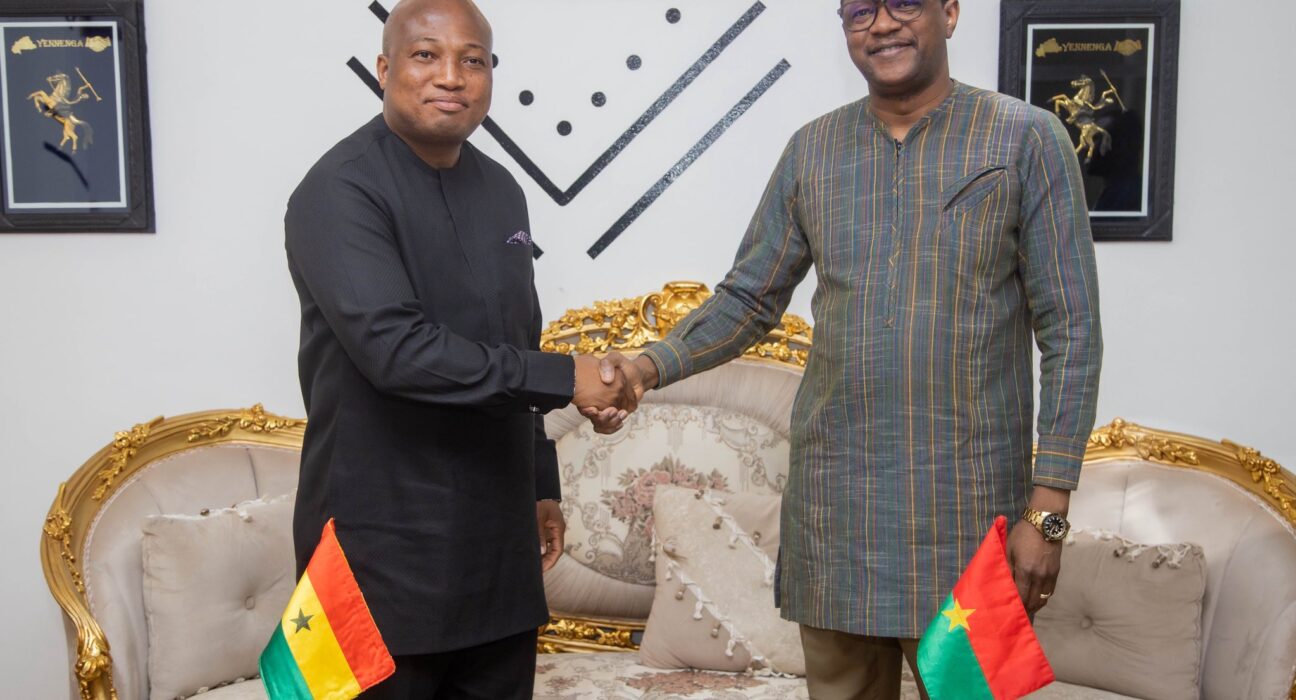
Minister of Foreign Affairs, Samuel Okudzeto Ablakwa has arrived in Burkina Faso for an official two-day visit aimed at enhancing security cooperation, conducting political consultations, and signing strategic agreements in the wake of the Titao terrorist attack.
The visit comes at a critical moment, following the February 14, 2026, jihadist attack on a truck transporting Ghanaian tomato traders, which claimed the lives of eight nationals, seven of whom died instantly when the vehicle was set ablaze.
The incident has drawn widespread condemnation from the Ghanaian government, which described it as a “mindless act of terror,” issued a security alert for its citizens in Ouagadougou, and updated travel guidelines for those entering the neighboring country.
During his visit, Minister Ablakwa held high-level discussions with his Burkinabe counterpart, Karamoko Jean-Marie Traoré, and Ghana’s Ambassador to Burkina Faso, Kenneth Akibate, focusing on bilateral collaboration to combat violent extremism and reinforce cross-border security measures.
The visit underscores Accra’s commitment to deepening cooperation with Burkina Faso, particularly as the subregion faces growing volatility. Despite a recent military coup in Ouagadougou aimed at stabilizing the capital’s security situation, violent extremism continues to spread, posing a significant threat of spillover into Ghana’s northern regions, which have remained relatively stable following the Asantehene’s delivery of the Bawku Mediation Report to President John Mahama.
In January 2026, President Mahama convened a High-Level Consultative Conference on Regional Security, bringing together heads of state, diplomats, and key stakeholders from participating countries. The conference concluded with an agreement to hold regular regional meetings to review peace and security commitments, reinforce mechanisms to combat insecurity, and prioritize human security through initiatives in healthcare, education, and job creation.
The current engagement is expected to yield strategic agreements aimed at fortifying Ghana’s borders against potential incursions from rising insurgencies in Burkina Faso, particularly into the northern regions. Ghana views Burkina Faso as a crucial neighbor, not only for security cooperation but also for sustaining robust cross-border trade, despite Burkina Faso’s current military-led governance.
President Mahama has consistently emphasized a bridge-building approach with the Sahel region, advocating amicable and cooperative solutions to regional challenges, including terrorism, migration, and economic instability. Minister Ablakwa’s visit reinforces this diplomatic vision, highlighting Ghana’s proactive engagement in regional security matters.
Ahead of his departure for Burkina Faso, Minister Ablakwa visited survivors of the Titao attack at Ghana’s 37 Military Hospital, where victims were airlifted by the Ghana Air Force aboard the GHF-550 after sustaining varying degrees of injuries.
“Before leaving Ghana for Burkina Faso, I visited the 37 Military Hospital this morning to express empathy with our compatriots who were airlifted home by the Ghana Air Force after sustaining injuries from the February 14 terrorist attack,” Minister Ablakwa stated.
The two-day official visit is set to culminate in the signing of strategic agreements to enhance intelligence-sharing, joint training exercises, and other measures to strengthen regional security, underscoring Ghana’s commitment to protecting its citizens and fostering collaboration with key neighbors in the Sahel.
Related Posts