

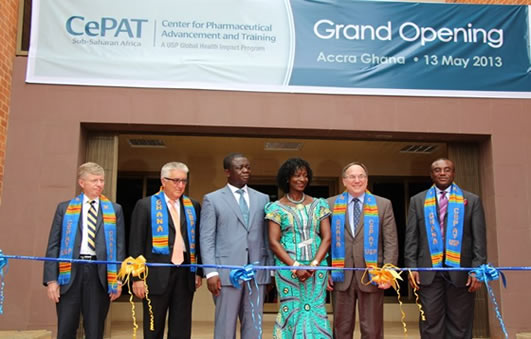
Thank you so much for inviting me to this important event today. It is real pleasure to be a part of the launch of the first Center for Pharmaceutical Advancement and Training (CePAT). This center is being established to meet a critical need in Sub-Saharan Africa – the training and capacity building for quality assurance and quality control of medicines.
Ghanaians and many in Sub-Saharan Africa currently face a serious problem when it comes to accessing quality medicines. In most industrialized countries, rates of substandard medicine are extremely low—less than 1%. But in Africa and Southeast Asia, research has estimated that 30-60% of the medicine supply is substandard.
Some startling information discovered recently has been a call to action for me personally. As all public health professionals know, postpartum hemorrhage is a significant cause of maternal morbidity and mortality. Recent studies in Ghana, conducted by the Ghana Food and Drugs Authority with the U.S. Pharmacopeial Convention (USP) and USAID’s assistance, looked at the quality of oxytocin and ergometrine, the medicines used to prevent post-partum hemorrhage. They found that over 90 percent of the samples tested failed either the test for the active ingredient or for sterility, and almost all of the injectables were not stored as per recommended refrigerated conditions. Since I heard these results, I have struggled to understand how the drugs meant to reduce postpartum hemorrhage are actually putting these patients at even greater significant risk. The Ghana Food and Drug Authority is to be commended for their work to monitor and police drug quality. However, it’s clear that improvements in this area are critical, and I am proud that CePAT is playing a role in tackling this problem. The pharmaceutical supply chaing from the producer to the patient is a complex one. CEPAT will help resolve on of the issues in that chain, which is subject to errors of omission by those who do not take the care to insure the medicines are handled with the required care or errors of commission by those unscrupulous individuals who sell bad medicine for profit and directly impact the future of a nation by undermining the health of the population; that crime is especially pernicious when it comes to mind. I would add that the U.S. President’s Malaria Initiative and USAID activities laid the groundwork for establishing USP in Ghana.
Let me take a minute to applaud the fantastic partnership between the U.S. government, USP, and the Ghana Food and Drugs Authority that served as the foundation for CePAT in Ghana. Since 2008, PMI in Ghana has funded USP to assess national quality assurance systems, strengthen national quality control laboratories, and detect substandard and counterfeit medicines related to malaria. The project brought about a productive relationship between the Ghana Food and Drugs Authority, which seized this opportunity to build its own capacity, and USP which ultimately decided to construct a permanent facility to train local experts and foster a knowledge base, thus creating a lasting and self–sustaining program.
It is that program that we are here to celebrate today. It is an honor for me participate in the opening of, what I believe, is the first integrated platform for regional training, education, consulting and laboratory capabilities for medicine quality control and quality assurance in Sub-Saharan Africa. As CePAT takes off, governmental regulators, medicine control laboratory staff, manufacturers, donor agencies, procurement organizations, and others will come together in Ghana to take part in CePAT programming and become the regional experts on safe medicines. For me, this facility is more than just another training center, it is a true opportunity to build something that can save lives around the African continent. It is a potential revolutionary development.
Let me end with a quick plug for a new U.S. government effort that I was pleased to announce on World Malaria Day that can help Ghana and CePAT detect counterfeit drugs. The United States is launching a public private partnership to add another tool to Ghana’s Food and Drug Authority’s tool box by delivering the Counterfeit Detection Device, called CD-3. This new device allows inspectors to detect fake drugs. These are the types of tools and skills that CePAT will be able to share with pharmacists and medical providers to affect positive change for the health and lives of Africans.
Thank you again for having me join you today. Kudos to USP and all those that worked to make today’s launch possible. Today is an important day not just for CePAT, but for the many Ghanaians and Africans that are going to benefit from the services this center will provide.
Source: ghana.usembassy.gov
Related Posts