

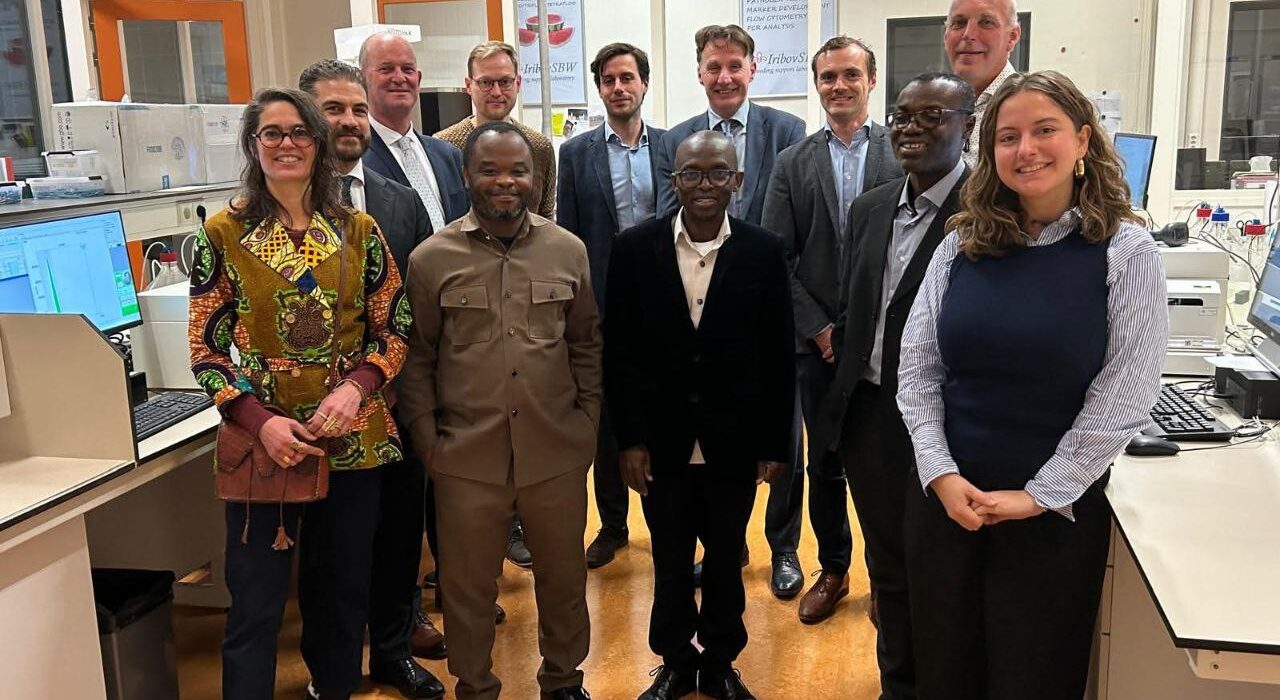
A delegation from the Ghana Cocoa Board (COCOBOD) has travelled to the Netherlands to engage agri-biotechnology firm Iribov and other key partners across the agricultural value chain, as part of efforts to identify sustainable solutions to the Cocoa Swollen Shoot Virus Disease (CSSVD).
CSSVD has emerged as one of the most devastating threats to Ghana’s cocoa sector, destroying an estimated 30 per cent of infected trees and affecting more than 500,000 hectares of cocoa farms nationwide. The disease poses a direct risk to Ghana’s position as the world’s second-largest cocoa producer and continues to undermine production capacity.
The impact on the national economy has been significant. Cocoa remains a backbone of Ghana’s economy, supporting the livelihoods of over 800,000 smallholder farmers and millions more involved in processing, transport, export, and allied services along the cocoa value chain. Persistent losses linked to disease and climate stress have contributed to sharp declines in output in recent seasons.
COCOBOD’s engagement with Iribov is expected to facilitate in-depth technical and strategic discussions on long-term, science-based interventions, including plant breeding, tissue culture, and controlled-environment agriculture. The visit is also aimed at assessing scalable biotechnology solutions that could strengthen disease resistance and restore productivity across affected cocoa landscapes.
The challenges confronting Ghana mirror a broader supply shock across West Africa. Côte d’Ivoire’s annual cocoa production has declined from over two million tonnes a few years ago to about 1.6 million tonnes in the most recent season. Ghana’s harvest, which previously exceeded one million tonnes, fell below 500,000 tonnes last season, driven by a combination of disease pressure and adverse weather conditions. These declines, alongside steady global demand, have contributed to tight global supply and elevated cocoa prices. Early forecasts for the 2025/26 season, however, remain mixed.
At the same time, cocoa production in Latin America is expanding, partially offsetting West African shortfalls. Ecuador, already the world’s third-largest cocoa producer, continues to record steady growth as farmers reinvest earnings from higher prices into productivity-enhancing inputs. The country is projected to produce more than 570,000 tonnes in the 2025/26 season, with a long-term target of 650,000 tonnes or more by 2027, potentially overtaking Ghana as the world’s second-largest producer.
CSSVD is primarily transmitted by several species of mealybugs (Pseudococcidae) that feed on cacao plants. At Ghana’s Cocoa Research Institute (CRIG), researchers have explored multiple mitigation strategies, including mild-strain cross-protection, where cacao trees are inoculated with less severe strains to reduce the impact of more virulent infections. However, experts agree that sustained recovery will depend on a combination of advanced biotechnology, farm-level interventions, and regional coordination.
COCOBOD’s Netherlands engagement signals a renewed push toward science-driven solutions as Ghana seeks to safeguard its cocoa sector and maintain its competitiveness in an increasingly dynamic global cocoa market.
Related Posts