
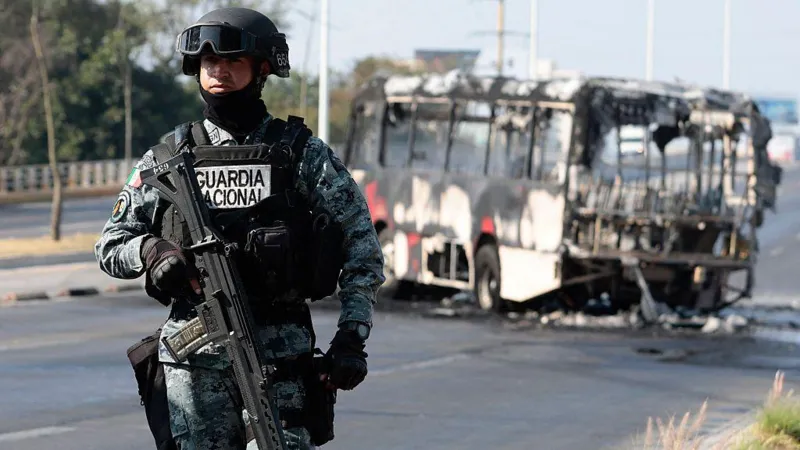
The Ministry of Foreign Affairs has issued a travel advisory urging Ghanaian travellers to avoid non-essential travel to Mexico, while advising Ghanaian residents in the country to restrict their movements following heightened clashes between the Jalisco New Generation Cartel (CJNG) and the Mexican Armed Forces after the reported death of El Mencho.
The security alert forms part of Ghana’s routine diplomatic response to escalating tensions in foreign jurisdictions, aimed at ensuring the safety of its nationals abroad and reaffirming the State’s commitment to protecting its citizens both at home and overseas.
According to the statement, tensions intensified after an operation conducted by Mexican security forces on February 22, 2026, reportedly resulted in the death of Nemesio Rubén Oseguera Cervantes, widely known as El Mencho, the long-time leader of the CJNG. The development is said to have triggered coordinated retaliatory attacks by cartel elements across multiple Mexican states.
“In view of the evolving security situation, the Government of Ghana wishes to advise Ghanaian nationals travelling to or residing in affected cities in Mexico to exercise extreme caution in their movement and refrain from non-essential travel,” the Ministry stated.
Ghanaian citizens currently in Mexico have been advised to remain in constant communication with the Ghana Embassy in Washington, D.C., which is accredited to Mexico, as Ghana does not maintain a resident mission in Mexico City. The Ministry also provided an emergency hotline for consular assistance.
Further unstated advisory in usual tensions includes urging citizens to closely monitor local media updates, maintain a low profile, remain aware of their surroundings, carry fully charged mobile phones with emergency contacts saved, and keep valid identification documents readily accessible. Nationals requiring assistance were encouraged to contact the Embassy promptly.
The Government of Ghana also conveyed solidarity with the Mexican government, expressing confidence in its capacity to restore stability.
“The Government of the Republic of Ghana conveys its solidarity to the Government of the United Mexican States and expresses its confidence in the ability of the Mexican authorities to bring the situation under control,” the statement read.
Mexico has grappled with powerful drug trafficking organisations for over a decade, with major cartels competing for territorial control of lucrative narcotics routes to the United States. The CJNG, in particular, has emerged in recent years as one of the most dominant and violent criminal organisations in the country, expanding rapidly across several states and engaging in armed confrontations with rival groups and federal forces.
Successive Mexican administrations have deployed the military to support civilian law enforcement agencies in combating organised crime. Since 2006, federal authorities have pursued an aggressive security strategy involving high-profile arrests, targeted operations against cartel leadership, intelligence-driven raids, and expanded coordination between federal and state security institutions.
In recent years, the Mexican government has also introduced reforms aimed at strengthening the National Guard, improving inter-agency intelligence sharing, disrupting financial networks linked to organised crime, and enhancing cooperation with international partners in counter-narcotics efforts. Despite these measures, cartel violence remains a persistent security challenge in parts of the country, often escalating in the aftermath of major arrests or leadership disruptions.
Security analysts note that the removal of high-ranking cartel leaders has historically led to temporary spikes in violence, as factions compete for succession and territorial dominance. Authorities in Mexico continue to maintain heightened security deployments in affected regions to prevent further instability and protect civilian populations.
Related Posts