
The International Monetary Fund (IMF) has called on African governments to adopt measures to harness the revenue potential in carbon pricing and invest them in viable development projects.
The Fund noted that it was important to politically manage the taxes and invest them in attestable and human-livelihood improving projects, including, education, healthcare, and infrastructure, as well as climate adaptation and mitigation measures.
“You don’t raise taxes just for the sake of raising taxes; you do it for supporting development agenda,” Mr Roud De Mooij, Deputy Director, Fiscal Affairs Department, IMF said.
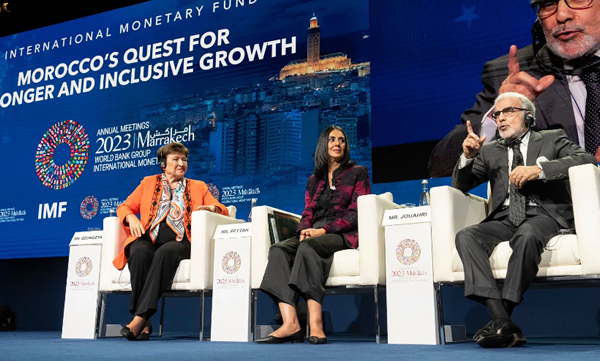
Mr was Mooij responding to questions at a press briefing on the back of the release of the IMF October Fiscal Monitor report at Marrakech, on the theme: “Climate crossroads: Fiscal policies in a warming world.”
The IMF Assistant Director, Fiscal Affairs Department noted that Africa could realise up to nine per cent of Gross Domestic Product (GDP) in revenue from carbon pricing.
He said IMF’s study found that: “By reform of policies, reform of administrations, they [Africa] can generate seven percent more of GDP as their potential… in addition to that, if they would also be able to change their institutions.”
“If low‑income countries could move to the average level of emerging markets, they could generate another two per cent. So, we arrive at a revenue potential of all these reforms that could generate nine per cent of GDP in revenue,” he noted.
To achieve this, Mr Mooij said it was important to address the bottlenecks in tax exemption and evasion, underreporting of income tax, and implement good revenue administration measures.
“We find that many countries have a huge number of tax concession, income tax, and Value Added Tax (VAT),” the IMF Deputy Director explained.
That, he said were as a result of VAT of tax evasion, relating to failure to register, failure to remit tax, underreporting of income, false claims for refunds, all of which summed up to about two to four per cent of GDP.
He indicated that many of those tax concessions, exemptions for certain industries, certain commodities, and the revenue foregone, were between two and five per cent of GDP.
He also said that “good enforcement and revenue administration can go a long way in mobilising more revenue,” using carbon tax, which was relatively easy to administer.
Ms Era Dabla‑Norris, Assistant Director, Fiscal Affairs Department, IMF also said it was important for African governments to be keen on carbon pricing as a critical part of climate mitigation toolkit.
She explained that the polluter-pays principle of carbon pricing could be an effective instrument to encourage energy preservation and incentive a shift towards clean energy and technologies, catalyse private adoption.
“Carbon taxation, in particular, can be particularly easy to administer because many countries already have fuel taxes; so, this is essentially a top-up,” the IMF Assistant Director said.
She noted that carbon taxes could be unpopular, as it raised energy prices, but were also critical in increasing revenue to compensate vulnerable households and individuals from higher energy prices.
“That said, carbon taxation alone is not enough because it may not necessarily be the optimal policy in hand-to-abate sectors such as buildings, where other types of incentives may be required,” she said.
“It’s important to note that a range of complementary policies, sectoral mitigation policies, such as fee bates, public subsidies for incentivising private investment may be needed,” Ms Dabla‑Norris said.
Source: GNA
Related Posts