

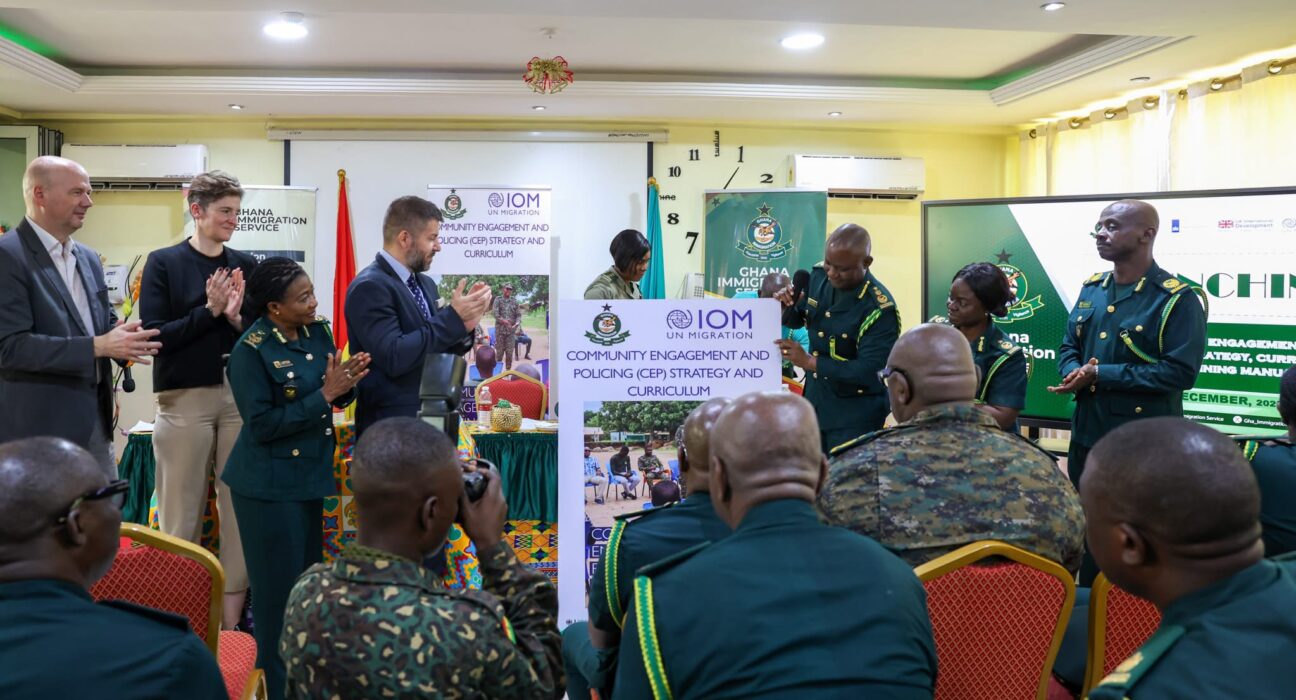
The Ghana Immigration Service (GIS), in partnership with the International Organization for Migration (IOM) and other stakeholders, has launched a new Community Engagement and Policing (CEP) Strategy, alongside an accompanying Curriculum and Training Manual, marking a significant shift toward people-centred border security and migration governance in Ghana.
The initiative places communities, particularly those in border and high-mobility areas, at the heart of security and migration management. By formalising collaboration between residents, informal community leaders and law-enforcement agencies, the CEP framework seeks to build trust, strengthen safety and ensure that migration contributes to social cohesion and local development.
Implemented under IOM’s Immigration and Border Governance (IBG) portfolio, the CEP framework represents a move away from enforcement-led border control toward a preventative, trust-building model. It recognises the central role of local communities, migrants and informal leaders in promoting safety, stability and social cohesion, especially in border regions where mobility is high and vulnerabilities are more pronounced.
The strategy advances a preventative model of policing that prioritises dialogue, respect for human rights and shared responsibility. It decentralises engagement, enabling immigration officers to work proactively with communities to avert cross-border crime, identify emerging risks and develop locally owned solutions to regional challenges.
At the core of IOM’s CEP approach is the conviction that effective migration governance depends on community trust. By fostering structured dialogue between law-enforcement agencies and communities, CEP allows authorities to better understand local dynamics, strengthen early-warning mechanisms and co-design responses that are both sustainable and context-specific.
From border towns to national systems, the CEP approach empowers officers and communities alike to co-create safer environments. It also aims to reduce vulnerabilities associated with migration by improving relationships between migrants, host communities and authorities, while safeguarding fundamental rights and enhancing overall quality of life.
Through CEP, IOM supports Member States to institutionalise community-centred practices by assisting with policy and strategy development, including national CEP frameworks, curricula and training manuals. These tools are designed to embed community engagement principles within border institutions and ensure consistent application across national systems.
The programme aligns with key objectives of the Global Compact for Safe, Orderly and Regular Migration, including strengthening transnational responses to migrant smuggling; managing borders in an integrated, secure and coordinated manner; promoting inclusion and social cohesion; eliminating discrimination through evidence-based public discourse; and enabling migrants and diasporas to contribute fully to sustainable development.
Speaking on behalf of IOM, Fatou Diallo Ndiaye congratulated the GIS and its partners, noting that the strategy reinforces community-centred security and resilience, particularly in vulnerable border areas. She emphasised that integrating community perspectives into border governance reduces risks, addresses protection gaps and supports broader regional stability.
The launch, supported by the United Nations in Ghana and IOM’s IBG Division, reflects Ghana’s commitment to a rights-based, collaborative approach to migration, one that recognises communities as essential partners in safeguarding borders while fostering unity and development
Related Posts