

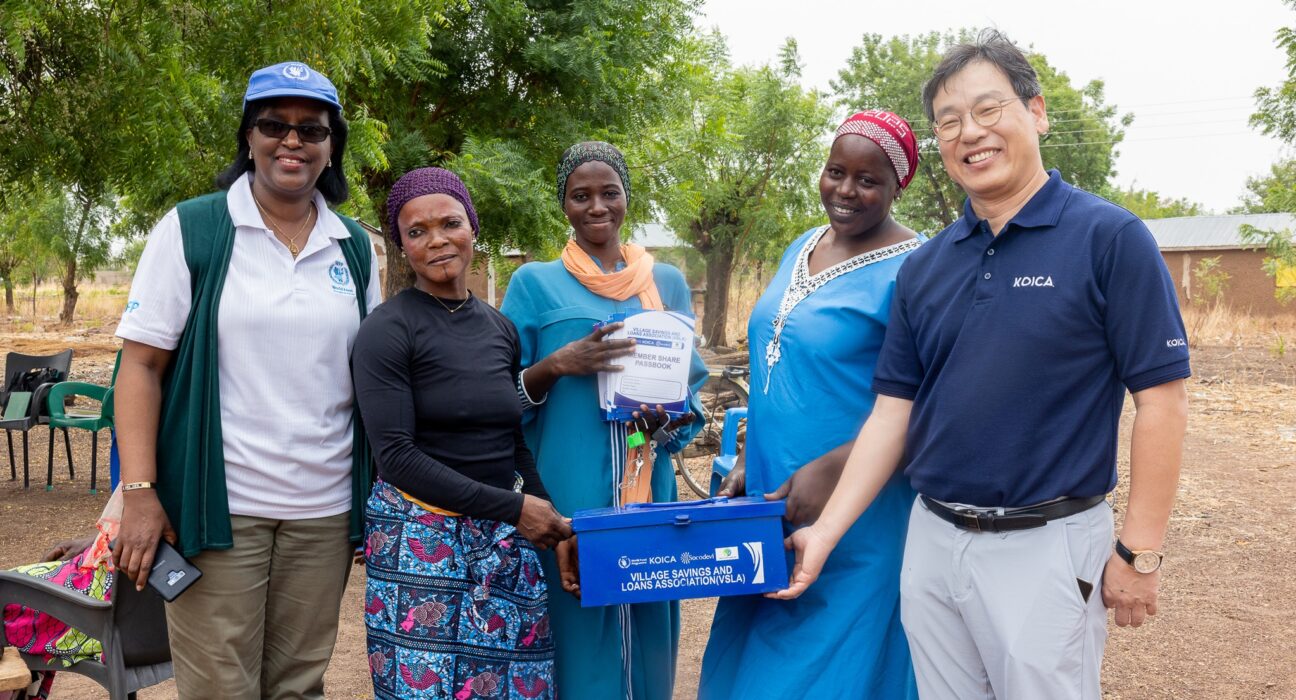
The Korea International Cooperation Agency (KOICA), in collaboration with the World Food Programme (WFP), has conducted a field visit to the Borimaga Women’s Village Savings and Loan Association (VSLA) to assess the progress of a joint initiative aimed at empowering young people with digital skills to improve economic opportunities, food security, and healthier livelihoods.
The visit forms part of a broader US$9.3 million programme titled “Youth Economic Empowerment through Digitalization for Resilience in Food and Nutrition Security and Improved Livelihoods.” The initiative seeks to strengthen food and nutrition security while promoting environmentally sustainable agricultural practices and improving livelihoods across rural communities.
The five-year programme, launched in February 2025, will be implemented across 56 districts in six regions of Ghana. It aims to equip young Ghanaians with essential digital tools and skills — including mobile technologies, precision farming systems, and digital agricultural platforms — to promote the adoption of climate-smart farming practices and encourage healthier lifestyles.
The project reflects the commitment of international development partners to support Ghana’s increasing investment in youth-centred agricultural transformation. By strengthening young people’s participation in agriculture through technology, the programme seeks to expand economic opportunities in rural areas while enhancing food systems resilience in the face of climate change.
The initiative also aligns with national agricultural development priorities, including programmes such as “Nkoko Nkitinkiti,” which aims to reduce Ghana’s reliance on imported poultry while strengthening domestic food production and advancing the country’s broader food security agenda.
As part of the field mission, the KOICA–WFP delegation paid a courtesy call on the District Department of Agriculture in Savelugu, held discussions with a Ministry of Food and Agriculture (MoFA) Extension Officer, and received a briefing from the Ghana Statistical Service (GSS) district and regional office in Tamale on the mobile Vulnerability Analysis and Mapping (mVAM) system, one of the project’s key digital monitoring tools used to track food security conditions in real time.
Through collaboration with national and local partners, KOICA and WFP continue to support Ghana’s efforts to strengthen food and nutrition security while promoting resilient livelihoods through digital innovation and data-driven agricultural systems.
The Village Savings and Loan Association (VSLA) model has proven to be an effective financial inclusion mechanism, particularly for women in underserved rural communities. The model enables members to pool savings and access small loans that can be invested in farming inputs and other income-generating activities. Such financial buffers also help farmers better withstand climate-related shocks.
Similar approaches have previously demonstrated strong results. Under the Ghana Agricultural Development and Value Chain Enhancement (ADVANCE) Project, funded by USAID and implemented by ACDI/VOCA, groups of women farmers formed savings collectives to mobilize capital and invest in improved farming practices introduced through demonstration programmes.
By combining digital innovation with community-based financial systems such as VSLAs, development partners aim to create more resilient agricultural economies while expanding economic opportunities for young people and women across Ghana’s rural landscape.
Related Posts