
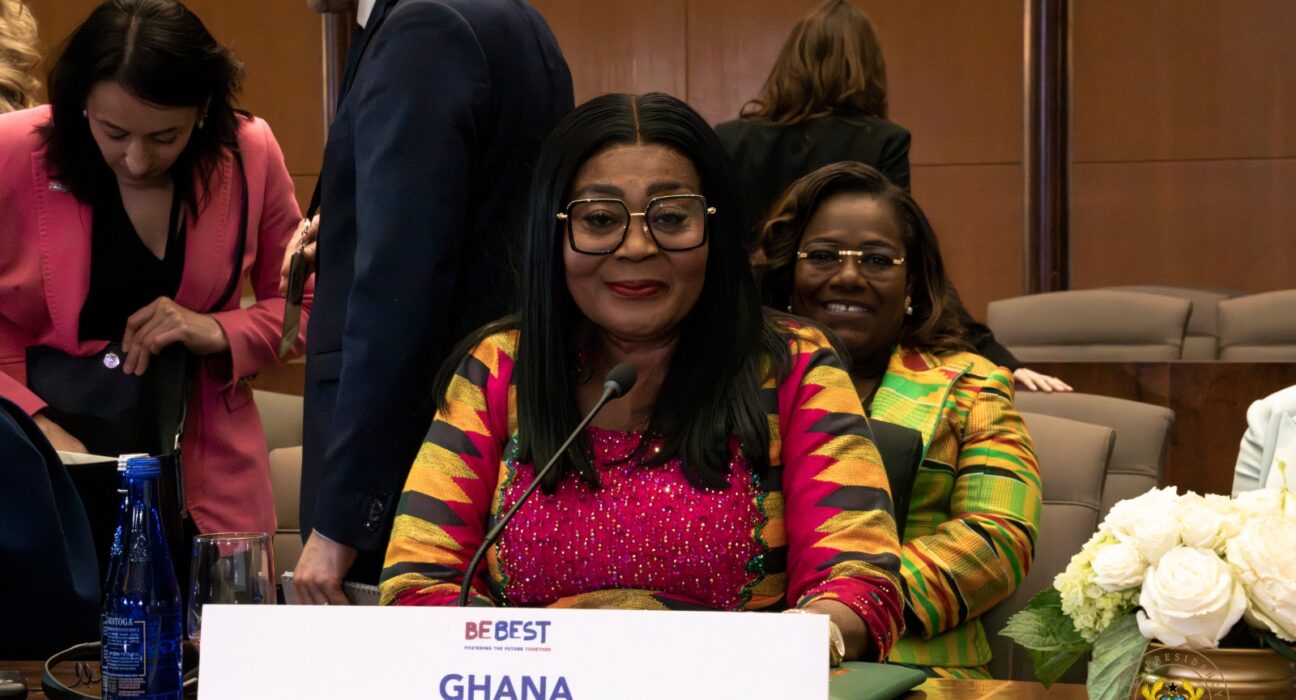
Ghana’s First Lady, Lordina Mahama, has called for stronger oversight to safeguard children in the use of artificial intelligence and technology, highlighting the need to protect minors from vulnerabilities in generative AI systems.
Speaking at the Fostering the Future Together Global Coalition Summit in Washington, D.C., Lordina acknowledged the vast benefits of generative AI in education, but described it as a ‘double-edged sword’ whose capabilities also pose risks to children’s safety.
She stressed the importance of oversight and protection for minors using generative AI models and other technology applications, particularly as the digital divide slowly narrows. In Ghana, between 8 and 15 million internet users are largely young people, while globally, seven in ten people are active on social media.
Lordina referenced President John Dramani Mahama’s Independence Day address, noting the unique opportunities available to this first generation of children exposed to AI. “Our children belong to a generation equipped with tools that earlier generations could scarcely imagine. In their hands, a smartphone serves as a classroom, a business hub, a creative space, and a gateway to the global economy,” she quoted.
Studies show that children are increasingly using AI for homework and entertainment, raising psychological and physiological risks such as cyberbullying, exposure to synthetic realities, reduced critical thinking, and access to erotic content.
Yesterday, a California jury found Meta and YouTube liable in a case alleging that the platforms intentionally fostered addiction in a 20-year-old woman, harming her mental health despite being aware of these risks and failing to provide adequate warnings.
A similar case involves 16-year-old Adam Raine, whose parents sued OpenAI in the Superior Court of California for wrongful death, claiming that its chatbot, ChatGPT, encouraged and provided guidance on committing suicide.
In response to such growing concerns, the European Union is preparing to enforce the Digital Services Act (DSA), which will require digital platforms to prioritize children’s safety and privacy and protect them from illegal and harmful content.
The summit brought together dignitaries from 45 countries and representatives from 28 leading technology companies, including Google, OpenAI, Meta, xAI, Adobe, Microsoft, and Zoom. Discussions focused on leveraging education and technology to empower children while establishing safeguards for the responsible use of AI.
Ghana has already implemented initiatives to integrate AI into education and strengthen digital literacy. In 2025, the International Community School partnered with the Ghana Association for Supervision and Curriculum Development and the Good Future Foundation to roll out a digital literacy program.
Google also announced a $37 million investment in Africa, including AI and speech recognition tools for Ghanaian languages such as Twi, Ewe, and Dagbani, aimed at improving accessibility for learners across diverse backgrounds.
The Ministry of Education further collaborated with Playlab.ai, Transforming Teaching, Education & Learning, and the Mastercard Foundation to develop AI-powered tools aligned with Ghana’s national curriculum. Support from Amazon Web Services and Anthropic enables teachers to access AI applications free of charge, with training programs, teacher manuals, and learning materials provided under an existing grant agreement to advance digital transformation in classrooms nationwide.
Related Posts