
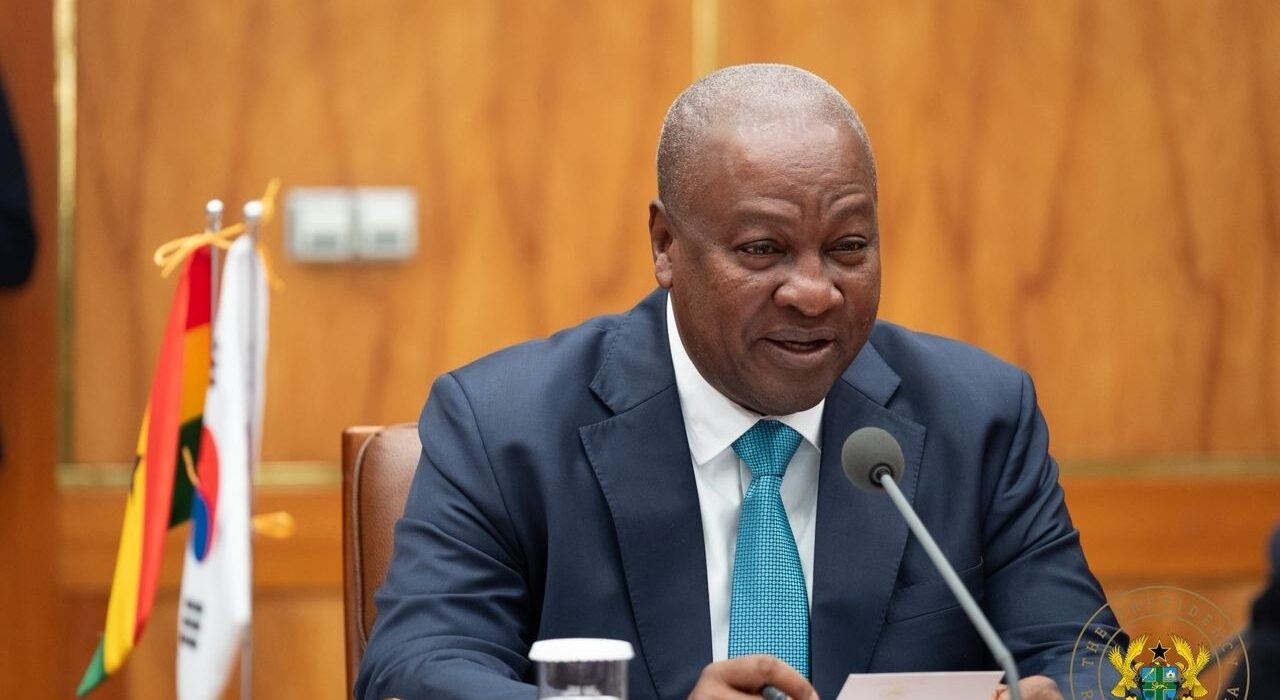
President John Dramani Mahama has called for a partnership with South Korea to leverage advanced Korean technology to refine rare earth minerals mined in Ghana, as the country pursues value addition to boost export revenue.
The appeal was made to President Lee Jae-Myung of the Republic of Korea during a high‑level meeting, where President Mahama highlighted the shared values between the two countries in culture and multilateral cooperation.
President Mahama noted that Ghana possesses vast deposits of critical minerals and is already exploiting bauxite, manganese, and gold, while recent discoveries of lithium and other rare minerals present new opportunities for value addition
“Ghana like other african countries has a potential for critical minerals and so currently we’re exploiting bauxite, manganese, and gold, and we’ve discovered vast reserves of lithium, and some nickel, and other rare minerals.” he said
President Mahama reiterated that Ghana seeks partners with the technical know‑how to build value‑adding industries for these minerals.
“Korea has the technology, and we believe that we can explore these minerals together and not export them in their raw form, but add value to their critical minerals and export them both to Africa and other countries.,” he said.
The call for collaboration comes amid Ghana’s introduction of a new sliding‑scale mineral royalty regime, which replaces the previous flat 5% royalty rate on gold and lithium with a scale that ranges from 5% up to 12% depending on global commodity prices.
Under this framework, gold miners will pay the higher rate when prices exceed thresholds such as $4,500 per ounce, while lithium royalties will shift to the same 5–12% sliding band based on spodumene price ranges. The policy aims to ensure Ghana captures a fairer share of revenue during commodity price surges, even as some foreign governments and mining firms have opposed portions of the reform.
Ghana recorded total export earnings of US$31.1 billion in 2025, a significant increase from US$19.1 billion in 2024, according to the Summary of Economic and Financial Data released by the Bank of Ghana on 27 January 2026. The surge reflects strong performance in the country’s commodity exports, particularly gold, which remained the dominant driver of foreign exchange earnings for the economy.
In addition to gold, Ghana’s mining sector gained international attention with the discovery of lithium in commercial quantities, particularly at the Ewoyaa Lithium Project in the Central Region. This project, led by Atlantic Lithium Ltd., comprises significant spodumene‑bearing mineral resources and is poised to support Ghana’s emergence as a contributor to the global lithium supply chain, used in batteries for electric vehicles and other clean‑energy technologies.
The Ewoyaa deposit has been estimated to contain tens of millions of tonnes of lithium‑bearing ore, and government policy has geared toward ensuring that a portion of these resources are processed locally rather than exported solely as raw concentrate.
The President’s appeal aligns with broader national efforts to transform Ghana’s extractive sector into a value‑addition‑oriented engine for sustainable economic growth, attract foreign investment, and enhance bilateral cooperation with strategic partners like South Korea.
Related Posts