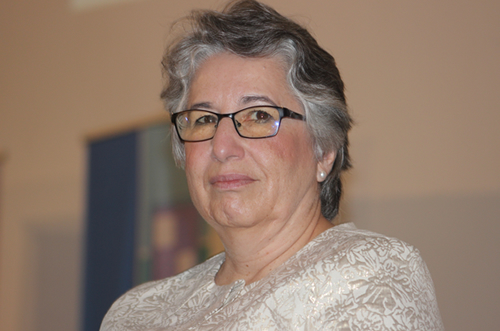

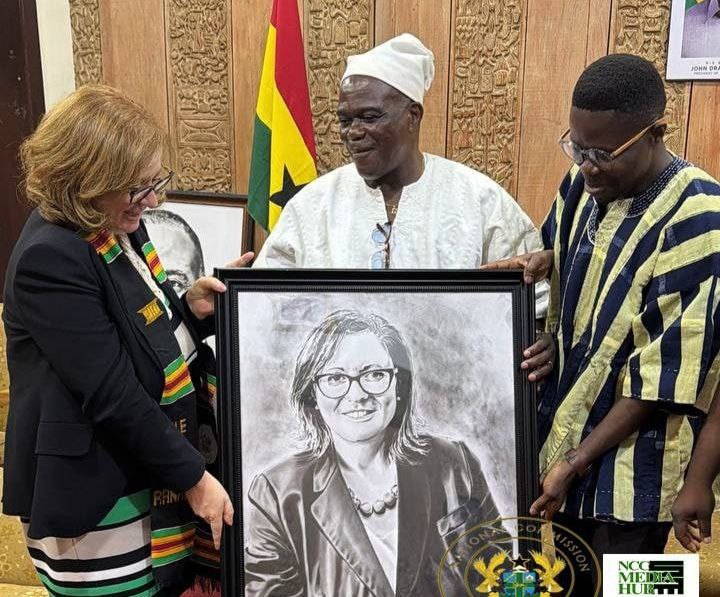
The National Commission on Culture (NCC) and the Italian Ambassador to Ghana, Her Excellency Laura Ranalli, have held high‑level discussions focused on exploring expanded cultural collaboration, knowledge exchange, and international partnerships to bolster Ghana–Italy ties while strengthening both countries’ cultural sectors.
The head of the Italian mission expressed strong appreciation for Ghanaian cultural values, noting how they are expressed in elements such as the timeless Adinkra symbols, which find expression in various aspects of Ghanaian life.
According to the Commission, the discussions highlighted foundational cultural elements like the storytelling traditions behind Kente weaving and the cultural importance of traditional attire such as Batakari (Fugu).
The engagement also featured Ghanaian artists and designers who draw inspiration from cultural traditions and heritage to produce expressive creative works, while training younger generations and contributing to community development.
The Commission and Ambassador Ranalli exchanged ideas and experiences on culture, heritage preservation, and strategies for developing the creative economy. The Italian consular delegation commended the Commission for its work in preserving centuries‑old heritage through documentation, conservation, and the promotion of Ghana’s valuable cultural assets.
The engagement further explored opportunities for deeper cultural collaboration, knowledge sharing and international partnerships that will strengthen ties between Ghana and Italy in the arts, culture, and creative industries. The NCC reaffirmed its commitment to fostering global cultural partnerships that promote Ghana’s heritage, creativity and identity on the international stage.
Concrete examples of such collaboration were highlighted during recent Italy–Ghana cultural programmes, including the Unfolding Cultural Heritage (UCH) project – a structured cooperation involving Italian and Ghanaian cultural institutions, artists and communities.
UCH connects the Salento region of Italy with Greater Accra through art residencies, training workshops, co‑design activities and cultural exchanges, aimed at uncovering and reimagining intangible heritage through contemporary artistic languages and dialogue between cultural professionals and local communities.
Under this initiative, the Tutu Wɔ Bi Ka Heritage Centre was launched in the Eastern Region of Ghana. Funded by the Italian region of Puglia and coordinated with Ghanaian partners, the centre serves as a living cultural archive and hub for community heritage documentation, oral storytelling traditions, soundscapes and murals celebrating local identity. The initiative reflects a shared commitment to preserving and revitalising intangible heritage and strengthening global cultural cooperation.
Following the engagements, the Commission presented the Ambassador with a large pencil portrait, appreciating the symbolic role Italy plays in supporting Ghana’s cultural promotion while enhancing bilateral ties and mutual understanding in the arts and creative industries.
Related Posts