

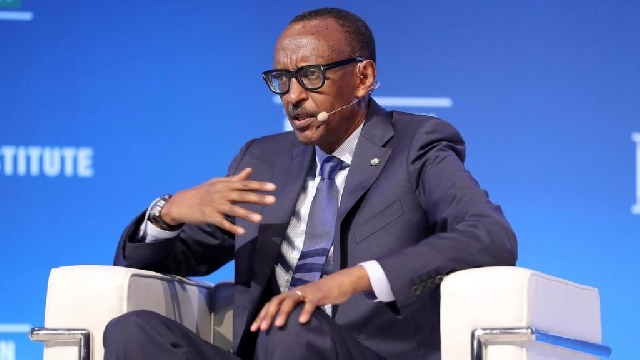
Rwanda’s President Paul Kagame on Monday said he was concerned by what he saw as the failure of the United States to characterise the 1994 massacres as a genocide against the country’s minority Tutsis.
His comments came after US Secretary of State, Anthony Blinken, in a post on the social platform X, failed to specify that the Tutsi ethnic group was targeted.
Many Rwandans have criticised Blinken’s comment on Sunday which read: “We mourn the many thousands of Tutsis, Hutus, Twas, and others whose lives were lost during 100 days of unspeakable violence.”
The 7 April marks the start, 30 years ago, of a 100-day killing spree by extremists from the Hutu ethnic group in which members of the Tutsi minority and Hutu moderates were slaughtered.
Kagame said he believed he’d reached an agreement with US authorities for them not to voice any criticism on the day of the anniversary.
“There are 365 days in a year. Give us that day, 7 April, commemorate with us and then you can have the rest 364 days blaming us every day for everything you do not like about us,” he said.
Rwandan authorities say any ambiguity on who the genocide victims were is an attempt to distort history and disrespects the memory of the victims.
Questions over how to mark the genocide stems from allegations that the Rwandan Patriotic Front militia, led by Kagame, which stopped the massacres and has ruled Rwanda unchallenged since 1994, carried out its own revenge killings during and after the genocide.
He has previously said that his forces showed restraint. In a speech on Sunday, Kagame said Rwandans are disgusted by what he described as the hypocrisy of Western nations that failed to stop the killings.
Kagame is under growing pressure over Rwanda’s military involvement in eastern Congo, where tensions have flared recently as the two countries’ leaders accuse one another of supporting armed groups.
United Nations experts have said they had “solid evidence” that members of Rwanda’s armed forces were conducting operations there in support of M23, whose rebellion has caused the displacement of hundreds of thousands of people in Congo’s North Kivu’s province.
Rwandan authorities say they want to deter rebels, including Hutu extremists responsible for the genocide, who fled to eastern Congo.
On Monday, Kagame said the M23 are fighting for the rights of Congolese Tutsis, with at least 100,000 of them now seeking refuge in Rwanda after fleeing attacks in eastern Congo.
“Why are we being accused as Rwanda of supporting M23 and I am saying even those who accuse us, actually we should accuse them of not supporting M23, because it is as if they agree with the injustice that is being done to this community,” he said.
Source: africanews.com
Related Posts