
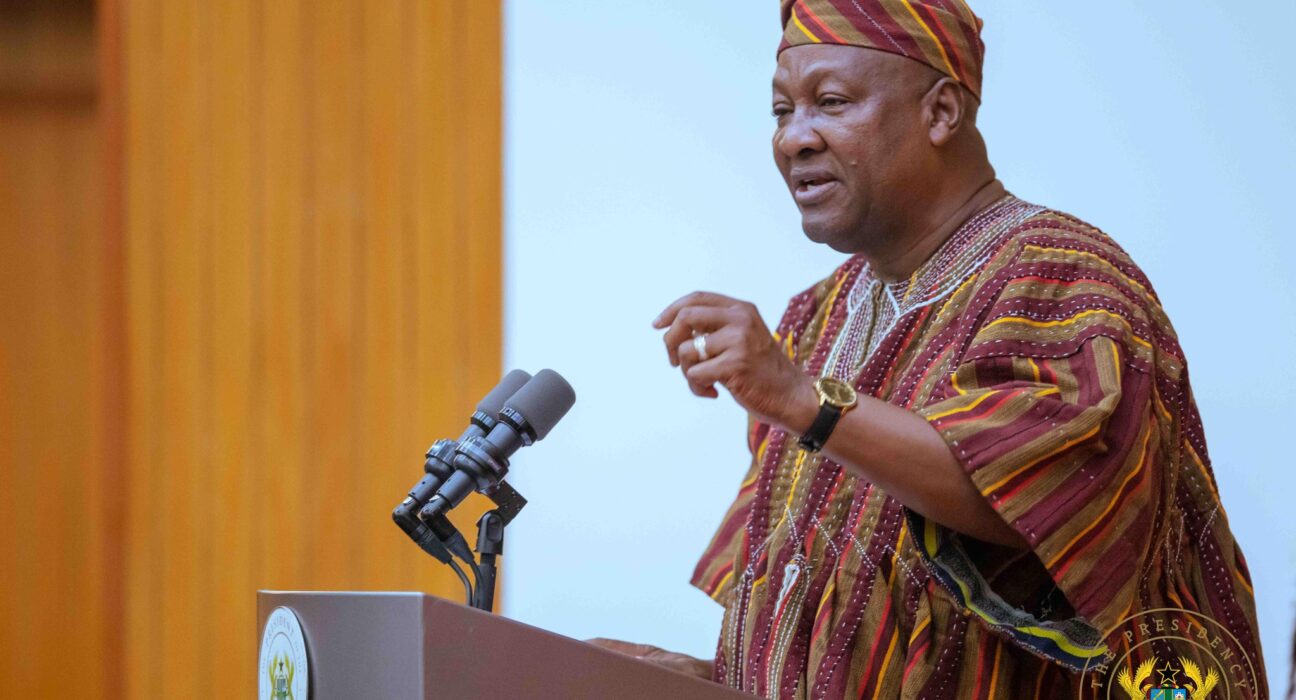
President John Dramani Mahama today delivered his State of the Nation Address to Parliament, speaking for two hours and eighteen minutes.
While the address devoted substantial time to domestic economic recovery, the substantive segment on Foreign Affairs lasted just nine minutes and nine seconds, yet within that brief window, the President outlined the philosophical direction, strategic priorities, and operational outcomes of Ghana’s foreign policy under his administration.
The address was delivered in fulfilment of Article 67 of the 1992 Constitution, which mandates the President to present a message on the state of the nation at the beginning of each parliamentary session. Parliament was at full capacity, with Members from both sides of the aisle present. The Minority appeared in black attire with protest sashes drawing attention to falling cocoa prices, while the Majority dressed in white, waving miniature national flags.
The full chamber reflected the full spectrum of Ghana’s governance architecture, bringing together the Executive, Judiciary and Legislature, alongside party executives, traditional authorities, and members of the Diplomatic Corps, underscoring the constitutional and diplomatic weight of the occasion.
While much of the address focused on the country’s economic condition, the fulcrum of the SONA given that the Mahama administration inherited a nation in economic distress, the foreign policy segment outlined seven strategic focus areas spanning the sub-region, the African continent, and the global stage.
President Mahama opened by stressing that Ghana’s foreign policy remains the compass guiding the country’s relations with external partners, carefully aligned with domestic development priorities. He noted that foreign policy plays a critical role in safeguarding Ghana’s sovereignty within a rapidly evolving global order marked by geopolitical shifts, climate-related pressures, and rising insecurity in the West African sub-region.
“Mr Speaker, Ghana’s foreign policy remains a central instrument for advancing our national development, safeguarding our sovereignty and projecting our values on the global stage,”
“At a time when the global environment is characterised by profound geopolitical shifts, economic uncertainty, climate-related challenges, and evolving security concerns within our sub-region, the Government has taken deliberate steps to ensure that Ghana’s engagement with the world is purposeful, strategic, and responsive to the needs of our people.”he stated
West Africa
At the sub-regional level, the President reaffirmed Ghana’s policy of good neighbourliness, solidarity, and constructive cooperation. Despite West Africa increasingly being described as an epicentre of terrorism, Ghana continues to pursue dialogue rather than isolation, particularly with members of the Alliance of Sahel States (AES), which have withdrawn from ECOWAS.
This approach persists despite the security threats posed by instability in the Sahel, including the recent jihadist attack in Titao that claimed the lives of Ghanaian tomato traders. Accra, he said, remains committed to diplomatic engagement and cooperative counter-terrorism strategies.
“We must sustain engagement and deepen relations with the AES member states, particularly following their withdrawal from the Economic Community of West African States,” he told Parliament, adding that disengagement only deepens regional vulnerabilities.
Africa
On the continental front, President Mahama underscored Ghana’s strong commitment to advancing the African Union’s strategic priorities through what he described as a principled and forward-looking approach. Ghana, he noted, remains a continental reference point due to its stable democracy, adherence to the rule of law, open civic space, tourism appeal, and long-standing commitment to African sovereignty, ideals championed by Ghana’s first President, Dr Kwame Nkrumah.
Ghana currently holds several continental responsibilities, including AU Champion on Reparations, AU Champion for African Financial Institutions, and AU Champion for Gender Equality and Women’s Empowerment. The President also highlighted his unanimous election as First Vice Chairperson of the African Union at the 39th Ordinary Session of the AU Assembly in Addis Ababa.
He disclosed that Ghana is positioned to assume the AU Chairmanship in 2027, following two consecutive unanimous endorsements by the ECOWAS Council of Ministers and Heads of State.
Global Stage
At the global level, President Mahama reflected on his address to the United Nations General Assembly in September 2025, where he spoke against the genocide in Gaza, criticised mass deportations of migrants, and called for the recognition of the Transatlantic Slave Trade as the gravest crime against humanity.
The proposed UN resolution, titled “Declaration of the trafficking in enslaved Africans and racialised chattel enslavement of Africans as the gravest crime against humanity”,is currently undergoing intensive diplomatic consultations with CARICOM, the Non-Aligned Movement, the G77, and the European Union.
The process includes formal consultations between February 23 and March 12, a high-level side event at the UN, a wreath-laying ceremony at the African Burial Ground, and final tabling before the UN General Assembly on March 25, 2026.
He also reiterated his call for a comprehensive reform of the United Nations to better reflect Africa’s role in global governance and fairness in international financial systems.
Passport Services and Mobility
Turning to consular reforms, President Mahama announced the establishment of seven new Passport Application Centres in the Upper East, Oti, Ahafo, Bono East, North East, Savannah and Western North Regions. With this expansion, all sixteen regional capitals now host passport application centres — a major milestone in decentralising passport services.
To resolve systemic delays, the Ministry of Foreign Affairs implemented a 24-hour passport production system at its headquarters, clearing an inherited backlog of over 40,000 applications. Ghana’s passport administration now operates with zero backlog, guaranteeing delivery within 15 working days nationwide.
To further ease mobility, the Ministry introduced a five-day visa processing service across Ghana’s missions abroad. Significant progress has also been made towards rolling out a national electronic visa (e-Visa) platform in 2026. In addition, Ghana has secured new visa waiver agreements with 11 countries to boost trade, tourism, and people-to-people exchanges.
Labour Mobility, Humanitarian Diplomacy and Diaspora
In strengthening bilateral relations, the President disclosed that Ghana has signed labour mobility agreements with several countries, expanding employment opportunities for Ghanaians abroad under regulated and protected frameworks.
He further highlighted Ghana’s commitment to international solidarity, noting that the country made humanitarian donations to Jamaica, Cuba, Sudan and Palestine in response to disasters and conflict-related crises. These donations, amounting to millions of cedis, included food supplies, medicines, clothing, and cocoa products.
President Mahama also announced that remittances from Ghanaians abroad reached a historic high of $7.8 billion in 2025, the largest annual inflow ever recorded. He described the diaspora as one of Ghana’s most dependable development partners, whose contributions support households, finance education, build homes, seed businesses, and stabilise the country’s foreign exchange position.
The President expressed personal support for the bipartisan bill before Parliament seeking to allow dual citizens to hold public office, arguing that citizenship not place of residence should determine one’s right to serve the Republic, subject to safeguards ensuring loyalty and accountability.
Despite the country’s state of foreign affairs not consuming much space, it spoke volumes of clarity n Ghana’s foreign policy underpin by constructive diplomacy, upholding global order vis-à-vis its national priorities
Related Posts