

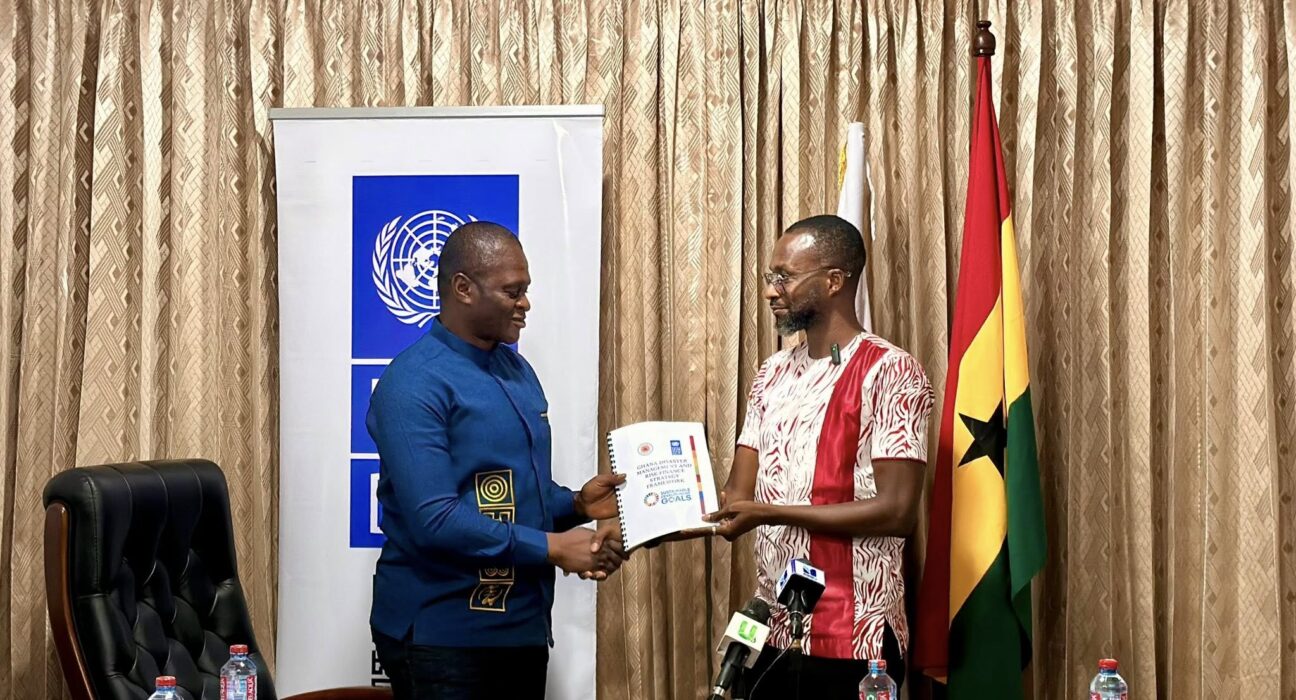
The United Nations Development Programme (UNDP) has formally presented Ghana’s National Disaster Management and Risk Financing Strategy Framework and Implementation Plan (2025–2030) to the National Disaster Management Organisation (NADMO), aimed at strengthening the country’s disaster preparedness through improved access to cost-effective and cost-effective financing for emergency response and recovery.
The framework, developed in collaboration with UNDP’s Insurance and Risk Finance Facility, is designed to equip NADMO with advanced data, technical expertise, and risk assessment tools to reduce Ghana’s fiscal vulnerability to disasters. It seeks to shift national disaster management from a largely reactive approach to a proactive, prevention-driven system grounded in evidence-based forecasting and financial planning.
At the core of the five-year strategy is the prevention of avoidable disasters and the mitigation of risks from unavoidable hazards, with the objective of reducing loss of life, destruction of property, disruption of livelihoods, and the poverty shocks that often follow poorly managed disasters. The framework emphasizes early action and preparedness as critical tools for protecting development gains.
According to estimates contained in the strategy, Ghana loses approximately US$200 million annually to disaster-related impacts, affecting nearly two million people each year, either directly or indirectly. The framework outlines measures to significantly reduce these losses while improving access to climate finance and supporting emission-reduction efforts in alignment with Ghana’s national climate action plans.
The strategy prioritizes Ghana’s most prevalent disaster risks, fires, floods, and droughts, which continue to displace communities and reverse socio-economic progress. By addressing these hazards systematically, the framework aims to safeguard livelihoods and enhance long-term resilience across vulnerable regions.
Implementation of the framework is anchored on eight key pillars, including comprehensive identification and mapping of disaster-related fiscal risks; integration of disaster risk analysis into national and sub-national planning and budgeting processes; and the establishment of sovereign and sub-sovereign disaster risk financing instruments.
Additional pillars focus on developing private risk transfer solutions such as insurance for households, businesses, and agriculture; strengthening coordination and institutional capacity for effective disaster risk governance; improving legal and regulatory frameworks; enhancing community and industry resilience; and adopting a layered risk management approach aligned with the severity and frequency of disaster events.
Beyond immediate disaster response, the framework also addresses broader cross-cutting issues, including equity, gender sensitivity, participation, and quality assurance in disaster risk financing. Robust monitoring, evaluation, and communication mechanisms are embedded to ensure transparency, accountability, and knowledge sharing throughout implementation.
The strategy aligns with Ghana’s international commitments under the Sendai Framework for Disaster Risk Reduction (2015–2030), the Paris Agreement, and the Sustainable Development Goals (SDGs). UNDP and NADMO say the framework represents a significant step toward strengthening Ghana’s resilience by ensuring financial readiness for disasters and protecting the country’s most vulnerable communities.
Related Posts