
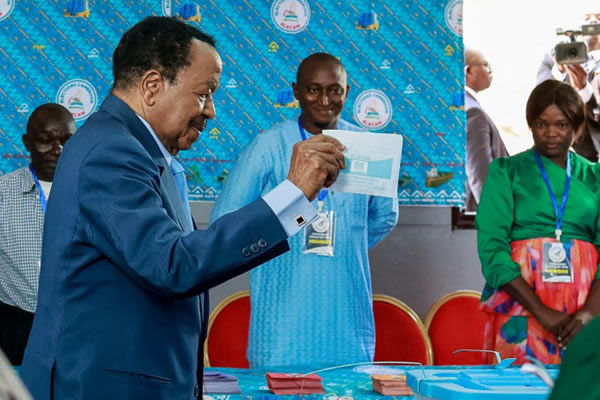

Voters in Cameroon went to the polls on Sunday in a presidential election that is widely expected to see 92-year-old Paul Biya, Africa’s longest-serving leader, extend his 42-year rule for another seven years. If victorious, President Biya would be 99 years old by the end of his new term, continuing his reign in a nation grappling with profound security and economic challenges.
Political experts anticipate a win for Biya, who cast his ballot amid tight security at a primary school in the nation’s capital, Yaounde.
Having ascended to power in 1982 following the resignation of Cameroon’s first president, he has since been declared the victor in seven consecutive elections.
Since gaining independence from France in 1960, the Central African nation has had only two leaders.
Biya’s health and frequent, extended stays in Europe have long been subjects of speculation, with daily governance often delegated to senior officials and family members.
A crowded field of familiar faces
President Biya faces a field of nine opposition candidates, though the electoral system heavily favors the incumbent.
Cameroon employs a single-round voting process, where the candidate with the most votes wins, eliminating the possibility of a runoff that could unite opposition support.
His challengers include several former allies and appointees, such as Bello Bouba Maigari, a former tourism minister, and Issa Tchiroma Bakary, who until recently served as the employment minister.
This fragmentation of the opposition is seen as a key factor in securing Biya’s anticipated victory.
A nation beset by crises
The election unfolds against a backdrop of escalating national crises.
In the western regions, a violent secessionist conflict rages between predominantly English-speaking separatists, who claim marginalization by the French-speaking majority, and government forces.
Meanwhile, in the far north, the spillover of the Boko Haram insurgency from neighboring Nigeria continues to plague border towns with frequent attacks.
These security challenges are compounded by deep-seated socioeconomic issues.
According to United Nations estimates, at least 43% of Cameroon’s population lives in poverty, measured by fundamental standards of income, education, and health.
A young population and an elder leader
With a population of over 29 million that is predominantly young, the election highlights a stark generational contrast.
Approximately 8 million registered voters, including over 34,000 from the diaspora, were eligible to cast their ballots at more than 31,000 polling stations across the country.
As polls officially closed at 6 p.m., the nation now awaits the official results, which are expected no later than October 26.
For many, the outcome seems a foregone conclusion, promising a continuation of the Biya era amidst a complex web of political stability, international scrutiny, and domestic turmoil.
Source: africanews.com
Related Posts