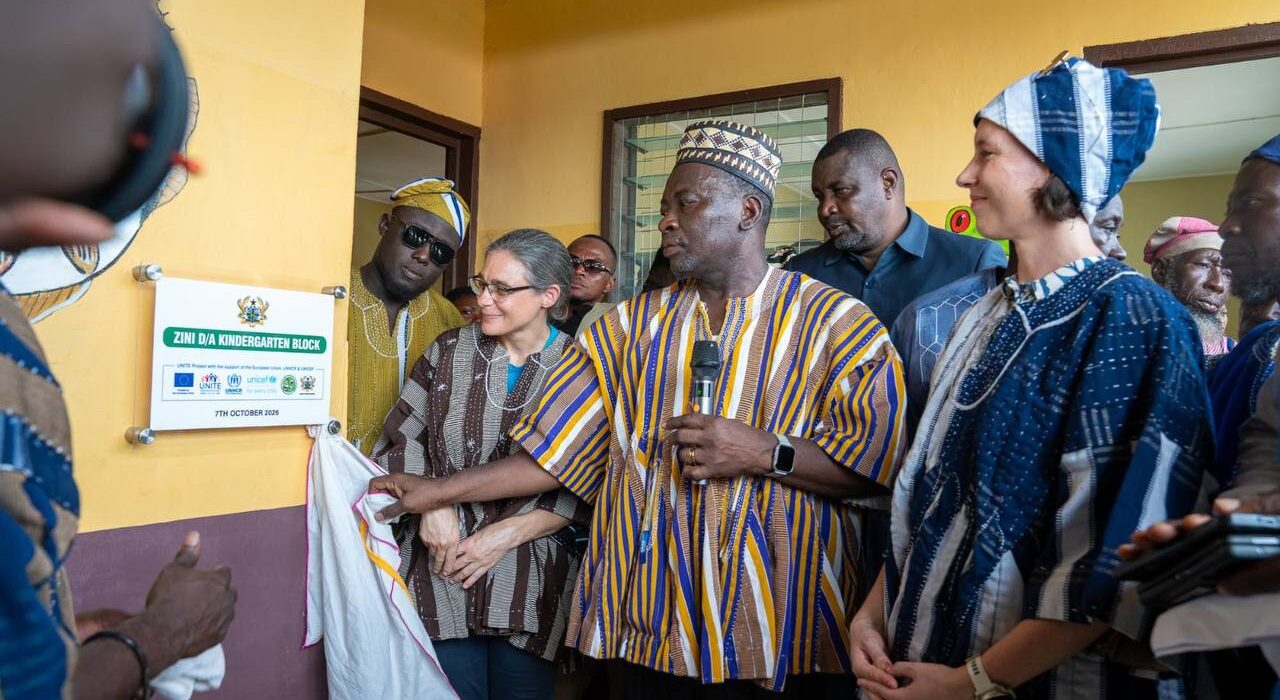
The European Union, in partnership with UNICEF, UNHCR has handed over a rehabilitated kindergarten block, improved sanitation facilities and a solar-powered water system in Zini to expand access to essential services for displaced people and their host communities.
The handover, held on October 7, 2026, was attended by Gisela Spreitzhofer, Head of the Governance and Security Section of the EU Delegation to Ghana, alongside representatives of the UN agencies and the Ghana Refugee Board.
The intervention forms part of the two-year Supporting the Resilience of Forcibly Displaced People and Host Communities in Northern Ghana project, known as UNITE, which seeks to improve access to education, healthcare, water, sanitation and social protection while promoting peaceful coexistence in communities hosting people displaced by conflict.
The rehabilitated kindergarten block has been equipped with furniture and supporting facilities to provide a safer learning environment for young children. The wider handover also included improved water and sanitation infrastructure and essential supplies for the Zini Health Centre to strengthen local healthcare delivery.
Zini, located in the Sissala West District, is among the northern Ghanaian communities hosting people who have fled insecurity and violence in neighbouring Burkina Faso. The influx has increased demand for basic services and placed additional pressure on existing community infrastructure, including schools and health facilities.
The UNITE project also covers Tarikom in the Upper East Region, where displaced populations and host communities face similar challenges in accessing essential services.
According to the UN Refugee Agency, Ghana hosted approximately 17,300 registered refugees and asylum-seekers as of December 2024, including people from Burkina Faso, Togo, Liberia and Sudan. The northern regions have been particularly affected by arrivals from Burkina Faso, where persistent insecurity has forced families to seek safety across the border.
The project is intended to ensure that both displaced people and their host communities benefit from improved public services, rather than leaving local populations to shoulder the additional demand alone.
Beyond education and water infrastructure, UNITE interventions include healthcare improvements, child protection, social protection, legal identity and access to the National Health Insurance Scheme. UNICEF and UNHCR have also supported housing and other essential services for displaced families in northern Ghana.
In the Widnaba community in the Upper East Region, UNICEF has completed water, sanitation and hygiene upgrades at the Widnaba Basic and Junior High Schools and the Widnaba Health Centre. These include solar-powered mechanised boreholes and gender-sensitive sanitation facilities designed to improve hygiene and safety for pupils, patients and community members.
The project is part of a broader regional initiative addressing the effects of displacement from the Sahel into coastal West Africa. The wider programme covers Ghana, Benin, Côte d’Ivoire and Togo and is financed through €10 million from the European Union and €2 million from four UN agencies: UNICEF, UNHCR, the International Organization for Migration and the World Food Programme.
In Ghana, the €2.7 million UNITE project is implemented by UNICEF and UNHCR with support from the EU and collaboration with government ministries, district authorities and other national institutions.
The initiative reflects a shift towards linking humanitarian assistance with longer-term development by strengthening the public services on which displaced populations and host communities depend.
For communities such as Zini and Tarikom, where displacement is creating sustained pressure on infrastructure, the provision of safe classrooms, reliable water systems and improved healthcare is intended to support social cohesion while helping local institutions respond to growing needs.
Related Posts