
Minister for Foreign Affairs, Samuel Okudzeto Ablakwa, has announced a series of significant reparatory measures to be undertaken by the Netherlands, Germany, and Denmark, describing them as tangible outcomes of the growing global movement for reparatory justice.
Presenting the outcome document of the Next Steps Conference on Reparatory Justice in Accra, the Minister revealed that the Dutch government has committed to returning approximately 2,000 Ghanaian artefacts currently held in its museums and cultural institutions.
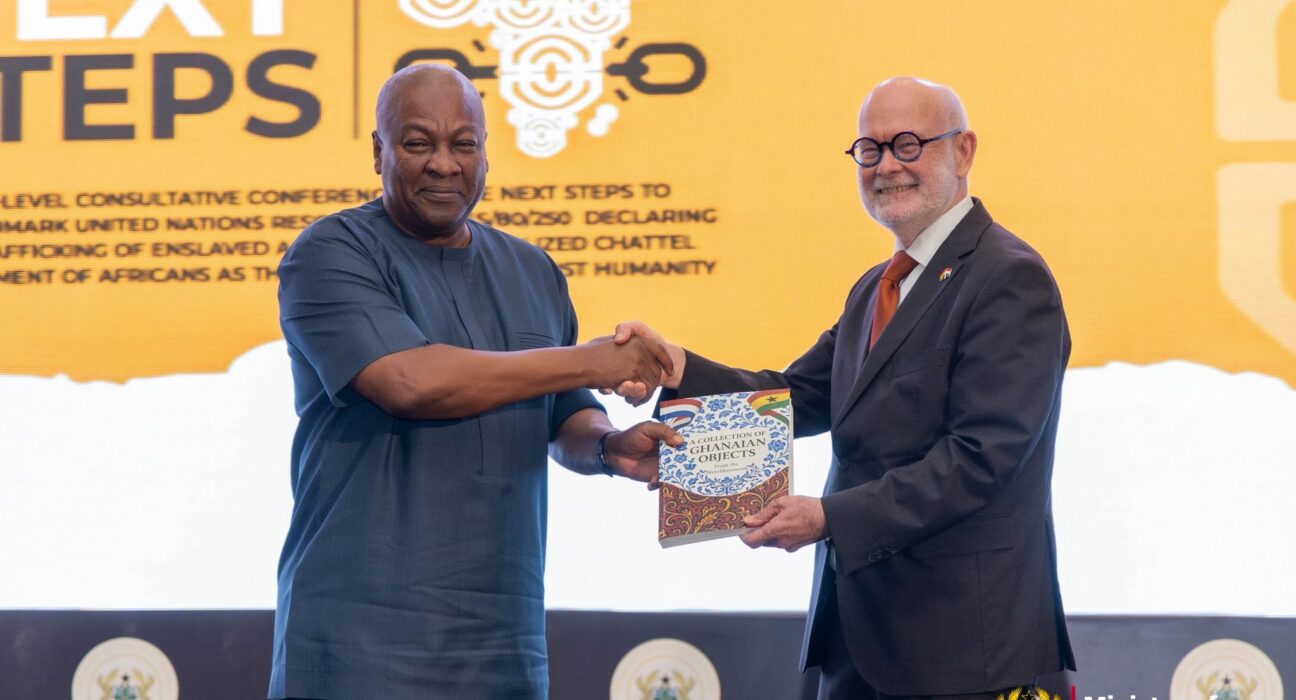
“At this conference, we received great news from the Dutch government that they have catalogued about 2,000 artefacts and have decided to return them to their motherland. They also carried out a symbolic presentation to President John Dramani Mahama last night,” Ablakwa said.
The announcement follows the formal handover of an inventory of Ghanaian cultural artefacts held by the Wereldmuseum in the Netherlands to Ghana’s Minister for Tourism, Culture and Creative Arts, Abla Dzifa Gomashie. The handover is being viewed as a major milestone in Ghana’s ongoing efforts to secure the restitution of cultural property removed during the colonial era.
Among the artefacts identified in the Wereldmuseum collection is a gold ceremonial pipe presented in 1837 by the Asantehene to King Willem I of the Netherlands. The gift was received on behalf of the Dutch monarch by Major-General Jan Verveer and subsequently became part of the Royal Cabinet of Rarities before being incorporated into the Wereldmuseum collection in Leiden. The pipe is one of several historically significant objects that reflect diplomatic and cultural exchanges between the Asante Kingdom and European powers during the nineteenth century.
The development forms part of broader restitution efforts being pursued by the Netherlands across Africa. In November 2025, Dutch authorities returned 119 Benin Bronzes to Nigeria, a move described by Nigeria’s National Commission for Museums and Monuments as the largest single repatriation of Benin antiquities. The artefacts had been looted during the British invasion of Benin City in 1897 before eventually entering Dutch museum collections.
Ghana has also made progress in recovering cultural artefacts from other countries. In 2025, more than 130 gold and bronze artefacts, some dating back over a century, were returned from institutions in the United Kingdom and South Africa. The items were officially presented to the Asantehene, Otumfuo Osei Tutu II, at the Manhyia Palace Museum in Kumasi and included royal regalia, ceremonial drums, ornaments, and gold weights that embody Asante history, governance, spirituality, and cultural identity.
Both Ghanaian and Dutch officials have expressed optimism that the restitution process will deepen bilateral cooperation in heritage preservation, museum development, cultural exchange, and capacity building. They noted that the engagement reflects a shared commitment to historical accountability and the responsible stewardship of cultural heritage.
The announcements were made during the Next Steps Conference on Reparatory Justice, a high-level international gathering convened in Accra to advance the global reparations agenda. The conference brought together African leaders, Caribbean representatives, diplomats, academics, civil society organizations, and descendants of enslaved peoples to deliberate on pathways for redress, accountability, and healing.
The event culminated in the adoption of the 46-point Accra Next Steps Commitment on Reparations, a framework that outlines strategies for restitution, economic justice, cultural restoration, education, and international cooperation aimed at addressing the enduring legacies of slavery, colonialism, and racial exploitation.
Related Posts