
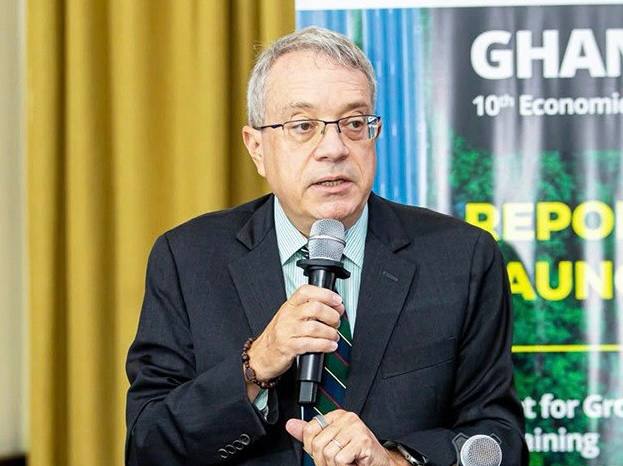
The World Bank Country Director for Ghana, Robert Taliercio O’Brien, has described the country’s State-Owned Enterprises (SOEs) as Ghana’s “Achilles’ heel,” citing persistent challenges in their financial management, fiscal impact and service delivery.
The comparison suggests that while Ghana may demonstrate strength in other areas of its economy and governance, the persistent weaknesses of some SOEs represent a major vulnerability that could undermine broader economic progress.
Speaking at the Ghana-World Bank Group engagement with Civil Society Organisations on the Country Partnership Framework, Mr Taliercio singled out the Electricity Company of Ghana (ECG), the Ghana Cocoa Board (COCOBOD) and Ghana Water Limited as among the most significant underperformers within the state-owned sector.
“On the SOE point, I think you could easily argue that SOEs are the Achilles’ heel of Ghana, both from a financial perspective, fiscal perspective, service delivery perspective, and so on,” he said.
“We know about ECG, we know about Cocoa Board, we know about Ghana Water. Those are the top three kind of offenders, if you will. But then we go down the list.”
The latest State Ownership Reports by the State Interests and Governance Authority (SIGA) illustrate the scale of the challenges. In 2024, ECG recorded a net loss of GH¢8.26 billion, while COCOBOD posted a loss of GH¢4.06 billion. Ghana Water Limited also recorded a significant loss, driven partly by rising production costs.
ECG’s audited performance showed some improvement in 2025, with its loss after tax narrowing to GH¢2.52 billion from GH¢8.26 billion in 2024. However, the company continued to face major financial pressures, including electricity purchase costs that exceeded its revenue. ECG’s liabilities also remained substantial, accounting for GH¢82.31 billion of the total liabilities recorded across the SOE sector in 2025.
The broader SOE sector nevertheless recorded a significant turnaround in 2025. Total revenue increased to GH¢176.43 billion, while the sector posted a net profit after tax of GH¢19.80 billion, compared with a net loss in 2024. However, SIGA identified ECG as one of five SOEs that recorded losses in every year from 2021 to 2025, underlining the continuing fiscal risks associated with some state entities.
Mr Taliercio noted that the World Bank was working with the State Interests and Governance Authority (SIGA) to improve transparency and strengthen performance measurement across the SOE sector.
“And one of the things we’re doing now, we are working with SIGA on transparency, measurement, helping the SOEs and helping SIGA put out a scorecard on all these dimensions of performance. How are they doing? How are they doing compared to last year? And so on,” he said.
The proposed scorecard is expected to provide a clearer basis for assessing the financial and operational performance of state-owned entities and enable the public to track whether their performance is improving or deteriorating over time
He added that greater transparency and public scrutiny could help strengthen accountability within SOEs, particularly those whose financial difficulties continue to pose risks to the national budget.
He also identified local government as another area requiring stronger performance monitoring, particularly in revenue mobilisation, the quality of public expenditure and service delivery.
The comments come as the World Bank Group continues to deepen its engagement with Ghana under its Country Partnership Framework. As of August 2026, the World Bank Group’s active portfolio in Ghana included US$4.17 billion under the International Development Association (IDA), covering 16 national and five regional operations.
The International Finance Corporation (IFC) programme reached US$726 million in fiscal year 2026, while the Multilateral Investment Guarantee Agency (MIGA) had an active exposure of approximately US$300 million.
Related Posts