
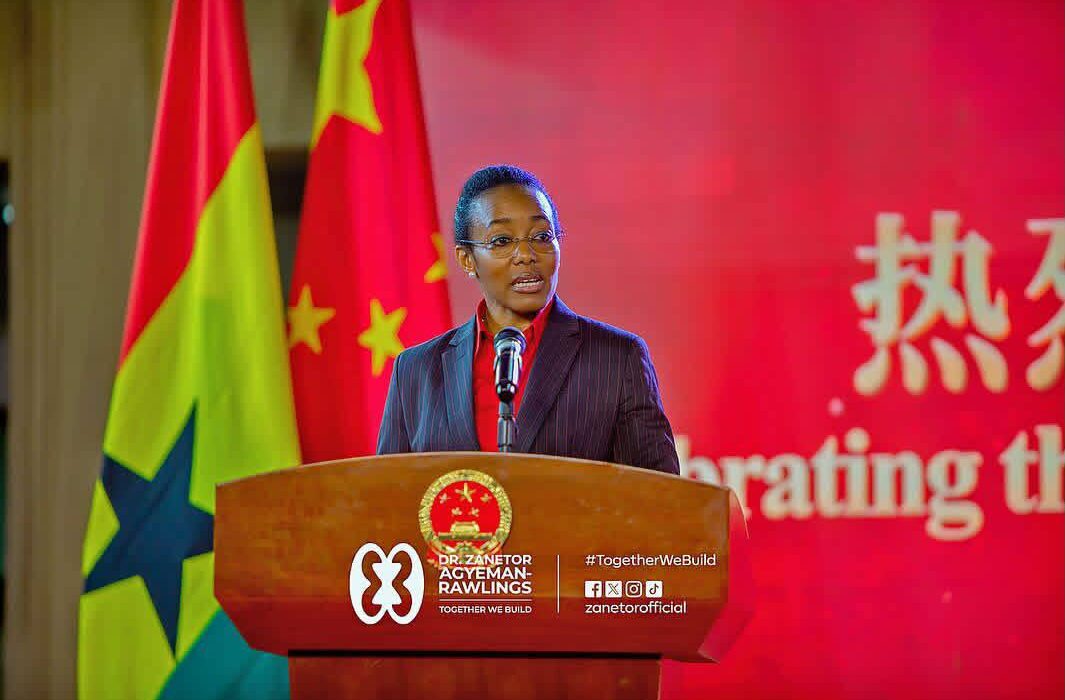
Ghana’s Minister for Environment, Science and Technology, Dr Zanetor Agyeman-Rawlings, has pressed China to ensure its investments and development partnerships in Ghana comply with the country’s laws and protect the environment and public health.
She made the call while representing President John Dramani Mahama at the 77th National Day reception of the People’s Republic of China in Accra, where she stressed the need for responsible and sustainable development in Ghana-China relations.
The event brought together government officials, members of the diplomatic corps, Chinese business leaders and members of the Chinese community in Ghana to commemorate the anniversary of the founding of the People’s Republic of China.
Dr Agyeman-Rawlings said Ghana valued its longstanding relationship with China and remained committed to strengthening cooperation across areas including infrastructure, trade, investment, education, health, agriculture, energy, security and culture.
She strongly called for respect for the rule of law to remain the fulcrum of China’s partnership with Ghana, promoting environmental sustainability and economic growth without compromising the health and well-being of the people.
”As we pursue these opportunities, I emphasised that respect for the rule of law must remain central to the partnerships and investments we build. Development must also be responsible and sustainable. Economic growth cannot come at the expense of the health and well-being of our people or the protection of our environment.” She stated
The Minister’s call comes against the backdrop of the environmental damage associated with illegal mining, including the involvement of some Chinese nationals in galamsey.
Illegal mining has heavily impacted Ghana’s forest reserves. A Forestry Commission survey found that 8,923.8 hectares had been affected across 45 forest reserves and one national park as of December 31, 2024. The Ashanti Region recorded the largest affected area, with 4,948.9 hectares.
The environmental impact also extends to Ghana’s water bodies, with illegal mining contributing to severe pollution and increased turbidity in rivers used as sources of raw water for treatment. The deterioration has raised concerns about the sustainability and cost of producing potable water for affected communities.
At the Daboase Water Treatment Plant in the Western Region, raw water turbidity reached 11,955 NTU on August 14, 2026, according to a report on the impact of illegal mining along the River Pra. The level was significantly above the plant’s permitted raw-water threshold of 500 NTU, placing additional pressure on treatment operations.
The problem has also increased the cost and difficulty of treating water. Ghana Water Company Limited has previously reported that pollution from illegal mining had deteriorated water quality in the Western Region, requiring additional treatment and contributing to equipment breakdowns.
The involvement of some Chinese nationals in illegal mining has become a sensitive issue in Ghana-China relations.
One of the most prominent cases is that of Chinese national Aisha Huang, who was sentenced by an Accra High Court in December 2023 to four and a half years in prison and fined GH¢48,000 after being convicted of offences including undertaking mining operations without a licence and facilitating illegal mining activities. She was also ordered to be deported after serving her sentence.
Ghana’s Ambassador to China, Kojo Bonsu, has said the Chinese government is deeply concerned about the involvement of some of its nationals in illegal mining and is working with Ghana to address the problem.
He noted that recent discussions between Ghana and China had produced commitments to promote responsible mining and ensure Chinese companies operating in Ghana comply with the country’s mining and environmental regulations.
The latest cooperation includes a three-point strategy agreed between Ghana’s Ministry of Lands and Natural Resources and China’s Ministry of Natural Resources covering efforts to tackle illegal mining, strengthen geological surveys and promote responsible investment.
The two sides also agreed to cooperate on green mining technology, environmental protection and technology transfer, while establishing a technical team to support implementation.
China remains Ghana’s largest trading partner. According to the Chinese Ambassador, Cong Song, bilateral trade reached a record US$14.1 billion in 2025, representing a 19.3% increase over the previous year. Hundreds of Chinese enterprises and members of the Chinese community operate across sectors including infrastructure, energy, mining, manufacturing, the digital economy and green agriculture..
Related Posts