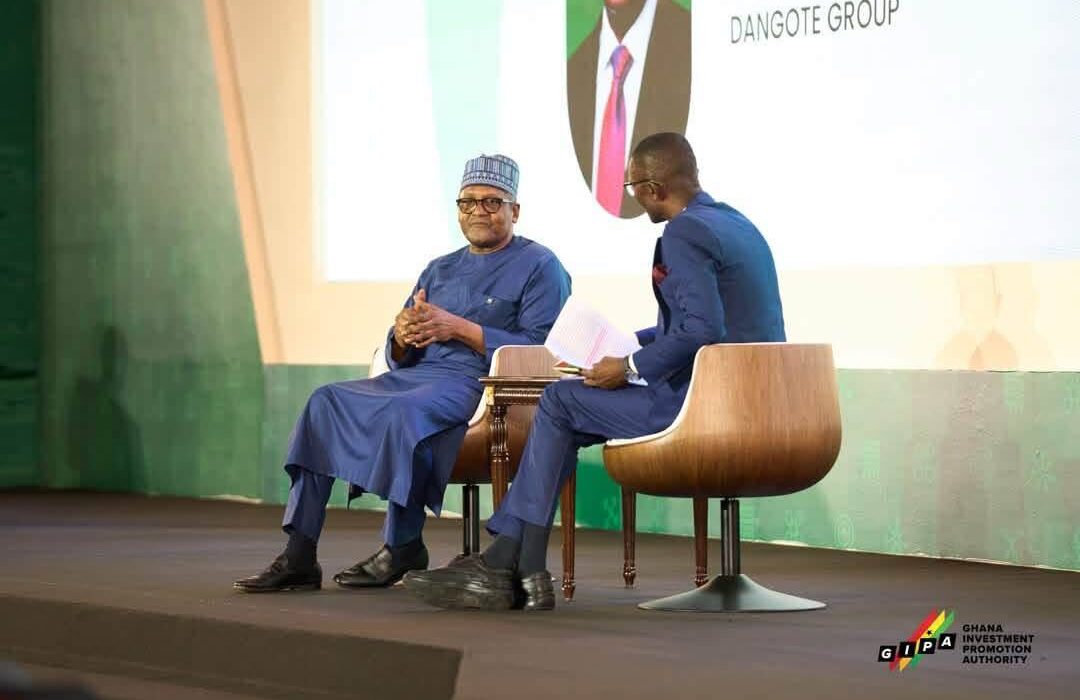
African industrialist Aliko Dangote has cast doubt on whether the global energy transition will be realised within his lifetime, arguing that the continued demand for oil and the wide range of products derived from crude petroleum will sustain the industry for decades.
Speaking at the Invest in Ghana Summit in Accra, Dangote pointed to approximately 6,800 products and essential materials that he said could be derived from crude oil, arguing that the resource would remain relevant to the global economy.
He cited plans to expand the capacity of his Lagos-based refinery from its current 700,000 barrels per day to 1.4 million barrels per day by 2029, arguing that the investment reflects his assessment of sustained demand for petroleum products.
Although the proposed expansion would represent a significant increase in output, Dangote said the additional capacity should be viewed against the scale of demand in major markets, including the United States, as well as opportunities in South America and Europe.
“I don’t believe it will happen in my lifetime. So that’s why we are very bullish. We are putting off our refinery in Lagos by 2029. We are going to be at about 1.4 million barrels. It might sound small, but it’s over 10% of the total refining capacity of the United States of America. So we’ll end up being the supplier not only in Africa, but also Europe” he stated.
He also pointed to demand from countries such as Brazil and Argentina, suggesting that growing markets for refined petroleum products would create opportunities for major refining economies to increase their market share.
The industrialist’s position comes as governments and international institutions intensify efforts to accelerate the transition from fossil fuels to cleaner energy sources in response to climate change.
The shift is already producing measurable changes in the global energy mix. According to the International Energy Agency’s (IEA) Global Energy Review 2026, renewable sources accounted for 34 per cent of global electricity generation in 2025, up from 23 per cent a decade earlier.
Solar and wind power together accounted for 17 per cent of global electricity generation, compared with approximately five per cent ten years ago. Renewable electricity generation also came close to matching coal-fired generation for the first time.
The transition is equally evident in the automotive industry, where electric vehicle adoption continues to expand.
The IEA estimates that global electric car sales exceeded 20 million in 2025, representing one in every four new cars sold worldwide. The growing electric vehicle fleet displaced approximately 1.2 million barrels of oil per day in the same year.
However, the transition has not eliminated dependence on fossil fuels. The IEA reports that demand for oil, natural gas and coal all increased in 2025, although at slower rates than in the preceding year, reflecting the continued role of conventional energy sources in meeting global demand.
The debate has featured prominently at the ongoing 31st United Nations Climate Change Conference (COP31) in Antalya, Türkiye, where countries are negotiating measures to accelerate the global energy transition.
One of the major initiatives under discussion is Türkiye’s 35-by-35 electrification pledge, which seeks to increase electricity’s share of global final energy consumption to 35 per cent by 2035, from approximately 23 per cent currently.
Addressing a high-level dialogue on clean energy transition and electrification on November 11, United Nations Secretary-General António Guterres called for accelerated investment in clean electricity, warning that dependence on fossil fuels exposes countries to international price shocks and energy insecurity.
He argued that expanding access to clean electricity could reduce import bills, improve air quality, create jobs and cut greenhouse gas emissions, while urging financing partners to support developing countries in building the infrastructure required for the transition.
However, negotiations at COP31 have exposed continuing disagreements over the pace and scope of the transition. An 18-page draft agreement released on November 16 revealed divisions over whether countries should commit to transitioning away from fossil fuels or phasing them out, alongside disagreements over climate finance.
The competing positions highlight the challenge of reconciling global climate commitments with the economic and energy-security interests of countries that continue to depend on fossil fuels.
For Dangote, the planned expansion of his refinery reflects a business outlook that anticipates continued demand for petroleum products even as renewable energy technologies gain a larger share of the global market.
Related Posts