
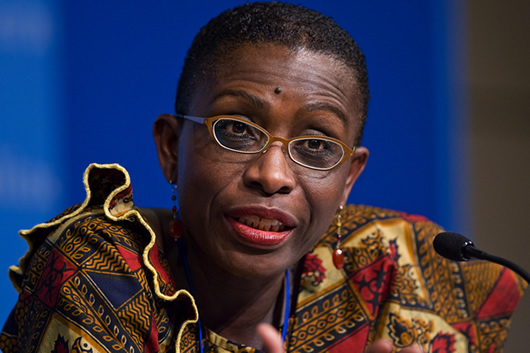
Ms Antoinette Sayeh, Director of the International Monetary Fund (IMF) African Department, says sub-Sahara Africa has experienced rapid growth and better macro-economic performance.
She said sub-Sahara Africa’s Gross Domestic Product per capita growth accelerated toward the end of the 1990s to average 4.3 per cent per year over the 2000s, compared with 2.9 per cent a decade earlier.
Ms Sayeh attributed the growth to increased political stability, better micro-economic management and access to financing, as well an improved business climate, supported investment efforts, which has improved the capacity in the region.
Speaking at the launch of IMF Africa Regional Outlook on Tuesday in Accra, Ms Sayeh said increased trade integration also played a role not only via higher demand for exported goods, but by fostering competition and enabling some transfer of technology and efficiency gains from imported goods.
Highlighting on the outlook, she said the current global environment and the risks of global financial volatility would be more challenging than in the recent past and the environment provided an opportunity to refocus policies on economic diversification and fostering structural transformation.
Ms Sayeh noted that despite the strong growth in trade flows, Sub-Sahara Africa still trades below its potential, both in terms of total flows and of positioning in global value chains.
She said some countries have started to leverage their comparative advantage either in agriculture and agro-business or in some cases in manufacturing.
She said addressing the barrier to trade, could therefore unlock untapped productivity gains, bringing with it more jobs, higher income levels, more diversified economies and more sustainable growth.
Ms Sayeh said supporting the development of regional trade flows would better shelter the region from exogenous external shocks stressing that insufficient infrastructure comes out as one of the most important impediments to trade flows.
“Efforts should be sustained and accelerated to leverage the region’s remarkable assets, including sound macro-economic policies, improving economic institutions and a young and growing workplace,” she added.
Source: GNA
Related Posts