
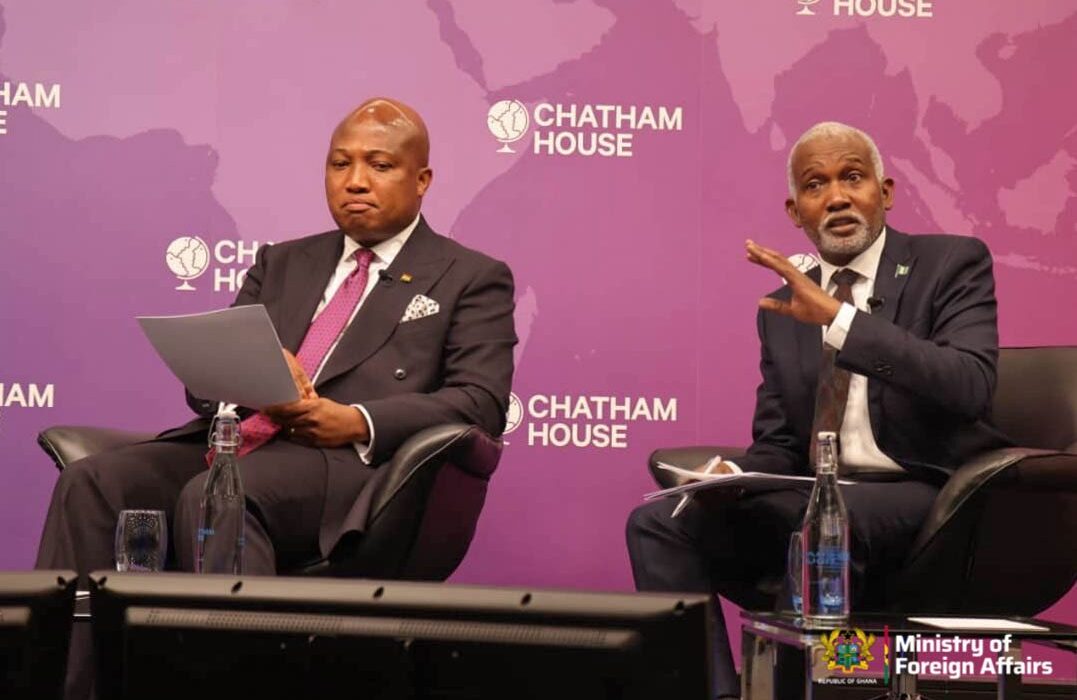
Ghana’s Minister of Foreign Affairs, Samuel Okudzeto Ablakwa, has confirmed that Nigeria and the United States reached out to Ghana to collaborate in the Christmas Day strikes on ISIS targets in Sokoto State.
The Minister explained that the coordinated defence support Ghana provided forms part of its existing security cooperation with the United States, which operates within Ghana’s strategic national interest and under clearly defined parameters to avoid actions that could trigger geopolitical tensions.
The United States carried out strikes on terrorist targets in northwestern Sokoto State on Christmas Day. In the lead-up to the operation, U.S. aircraft reportedly conducted surveillance flights over parts of Nigeria, with some of the intelligence missions believed to have been flown from facilities in neighbouring Ghana as part of broader counterterrorism coordination.
Ablakwa said Ghana was invited by both Nigeria and the United States to collaborate in the operation, noting that the scope of the intervention was clearly defined to avoid excesses that could undermine national sovereignty or escalate into wider geopolitical conflict.
“So the recent attacks in Nigeria, the Nigerians will confirm to you that they invited the Americans and they also reached out to Ghana to collaborate,”
“Sovereignty has to be respected, territorial integrity has to be respected, you must be invited, and we must all agree on the scope of the intervention because we do not want this to lead to another Venezuelan situation or some other geopolitical matter.”he said.
He further urged Nigeria to draw lessons from Ghana’s counterterrorism strategies, noting that Ghana has not recorded a terrorist attack despite the threats of spillover from neighbouring Sahel states such as Burkina Faso and Niger, where extremist groups continue to carry out frequent attacks.
According to him, strong democratic institutions and inclusive governance play a critical role in preventing insurgencies, as they help close gaps that terrorist groups could exploit for recruitment, radicalisation, or rebellion.
Using Ghana as an example, Ablakwa said the presence of the state is felt across the country through security installations, decentralised governance structures and coordinated local security mechanisms.
“There is no district in our country where you don’t feel the presence of the state. There are police stations in communities, you have amenities, utilities and functioning local government structures. You also have the District Security Councils and the Regional Security Councils, which ensure that security coordination takes place at the decentralised level.” he said.
He added that such structures ensure that no part of Ghana becomes a vacuum for extremist groups to exploit, unlike some areas in the Sahel where weak state presence has allowed terrorist networks to flourish.
The Christmas Day strikes targeted suspected camps of the Islamic State’s Sahel Province operating in the Bauni forest area of Sokoto State, a region that has increasingly become a corridor for militants moving between Nigeria and neighbouring Sahel countries. The strikes reportedly involved precision-guided munitions and intelligence gathered through joint surveillance operations aimed at disrupting planned attacks by extremist groups.
Nigeria has faced a worsening terrorism crisis for over a decade, driven by insurgent groups such as Boko Haram and factions linked to the Islamic State operating across the northeast and parts of the northwest. Analysts say the spread of militant networks from the wider Sahel region has compounded Nigeria’s security challenges, with extremist groups exploiting porous borders, weak governance in rural areas and longstanding communal tensions to expand their operations.
Related Posts