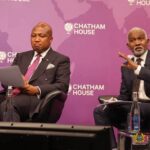

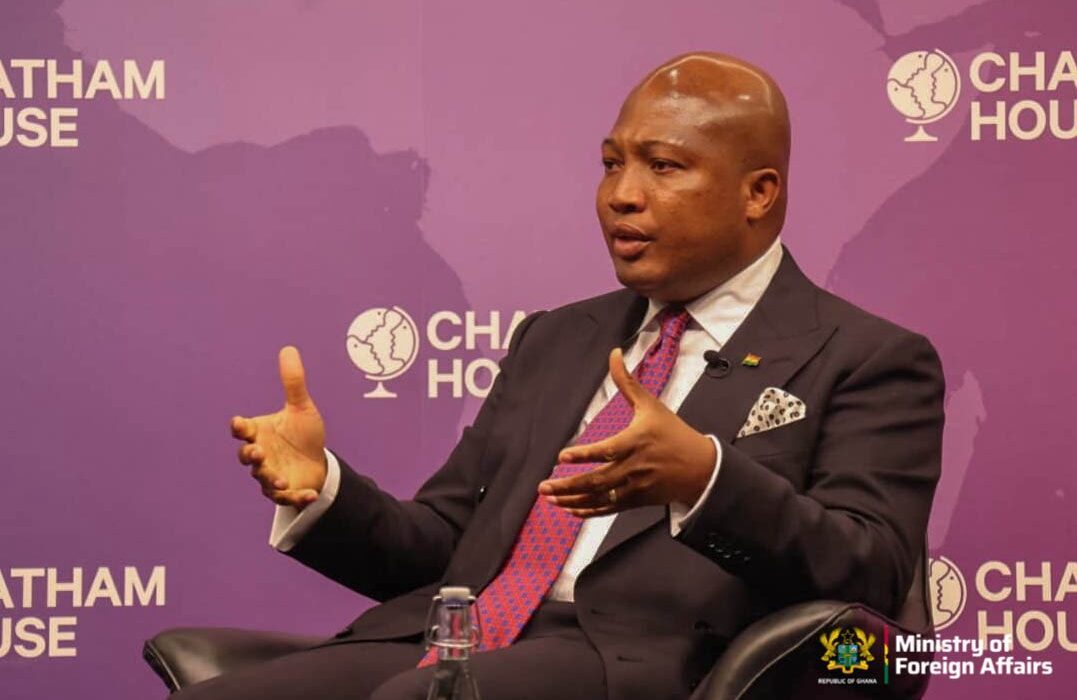
Ghana’s Minister for Foreign Affairs, Samuel Okudzeto Ablakwa, has stated that the recent retaliatory attacks on Gulf nations underscore Ghana’s longstanding position against hosting foreign military bases on its soil.
He made the remarks during a high-level discussion with his Nigerian counterpart, Yusuf Maitama Tuggar, Nigeria’s Minister of Foreign Affairs, at Chatham House, where both diplomats shared government-level insights on the theme “Strategies for Rebuilding Regional Order and Strengthening Security in the Sahel.”
Mr. Ablakwa noted that the escalating hostilities in the Middle East, in which Iran reportedly struck U.S. military assets located in several Gulf partner states, illustrate the potential risks associated with hosting foreign military installations. The strikes were reported in countries including Kuwait, the United Arab Emirates, Bahrain, and Cyprus, in what was described as a direct response to joint U.S.–Israeli military operations targeting Iranian positions.
“We do not accept military bases in our country and I’m sure that what is happening in the Middle East now vindicates Ghana’s position. We have historically prevented Western powers from establishing military bases in our country and I believe that those who initially were not sure why Ghana was very stern about this position now appreciate that.” he said.
Although Ghana does not host a U.S. military base, the country maintains a Defence Cooperation Agreement with the United States, signed in Accra on 9 May 2018 and entering into force on 31 May 2018 after ratification by Ghana’s Parliament. The agreement generated public debate at the time, with some critics speculating that it could effectively create a de facto U.S. military base in Ghana.
However, both Ghanaian authorities and the United States government rejected those claims. Officials, including the U.S. Embassy in Accra and Major General Kenneth P. Ekman, Director of the United States Africa Command Coordination Element, clarified that the agreement was designed to strengthen defence cooperation, facilitate training, and improve Ghana’s capacity to address rising security threats emanating from the Sahel.
Ghana and the United States have since reaffirmed their security partnership, particularly following recent security concerns in the region. One such incident involved a terrorist attack on a truck carrying tomato traders in Titao, which resulted in eight fatalities and three injuries.
The attack has prompted Ghana to further strengthen border surveillance and security operations to prevent a spillover of violent extremism from the Sahel, a region increasingly described by security analysts as the epicentre of global terrorism. The area has witnessed frequent attacks by insurgent groups, alongside growing political instability marked by successive military coups in several West African states.
Hosting foreign military bases, can expose host nations to heightened geopolitical risks. Countries that host major foreign military facilities may become potential targets during international conflicts, particularly when those bases are used to project military power or support operations against adversaries.
In such situations, the host country’s territory may inadvertently become part of a broader conflict theatre, increasing vulnerability to retaliatory strikes, cyberattacks, or asymmetric warfare.
Recent developments in the Middle East illustrate these risks. Iranian retaliatory operations reportedly targeted multiple U.S. military assets and installations across the Gulf region, including Naval Support Activity Bahrain, Ali Al Salem Air Base, Al Dhafra Air Base, Camp Arifjan, and facilities linked to Western military operations in RAF Akrotiri.
Related Posts