

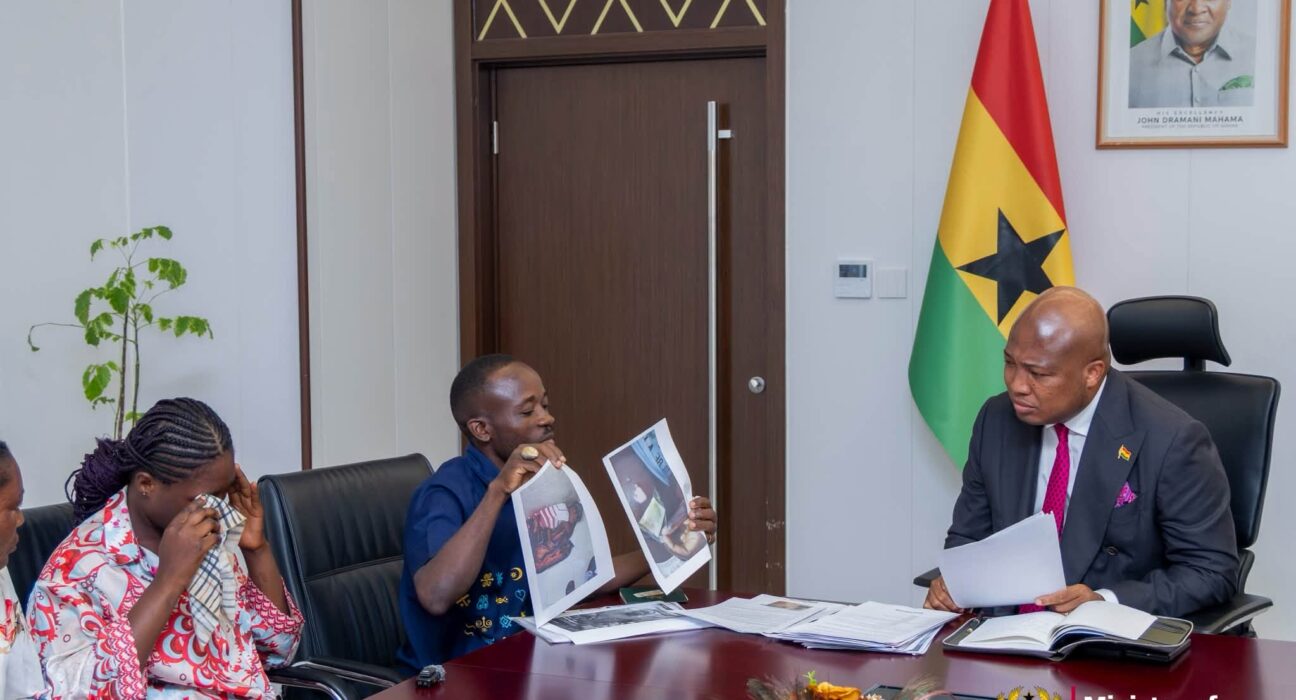
Foreign Affairs Minister Samuel Okudzeto Ablakwa says the government has authorised Ghana’s diplomatic missions abroad to settle the medical bills of Ghanaian domestic workers hospitalised overseas, facilitate their discharge and arrange their return to Ghana.
The intervention forms part of measures to protect Ghanaians working in vulnerable employment conditions abroad, following growing concerns about the treatment of domestic workers, particularly in Iraq and Syria.
The directive follows the return of Stephanie Nkrumah, a Ghanaian domestic worker who suffered alleged physical assault and degrading treatment at the hands of her employer in Iraq. Her ordeal was captured in a video that went viral on social media, triggering public concern and renewed scrutiny of the conditions under which some Ghanaian women are recruited for domestic employment overseas.
Ablakwa subsequently met Stephanie and her family at the Ministry of Foreign Affairs on November 23, assuring them of government support in pursuing justice. He also announced a personal donation of GH¢50,000 as initial financial assistance towards establishing a small business, alongside commitments to provide medical and psychological support and facilitate her return to formal education.
The Minister has also indicated the government’s intention to impose restrictions on the recruitment and deployment of Ghanaian domestic workers to destinations where their safety cannot be guaranteed, particularly Iraq and Syria. Following Stephanie’s case, he said a moratorium on recruitment for domestic employment in Iraq was being considered.
The concerns are supported by documented cases of exploitation in Iraq. A 2024 Trafficking in Persons Report by the US Department of State identified an increase in Ghanaian domestic workers being referred to organisations as potential trafficking victims.
The report also documented foreign workers being subjected to forced labour, with employers and recruitment agents withholding salaries, confiscating passports and threatening workers with deportation or arrest. Other reported abuses included physical and emotional mistreatment, underpayment and food deprivation, particularly in the Kurdistan region.
A separate investigation published by Raseef22 on August 12, 2025, exposed disturbing accounts of the treatment of African domestic workers in Iraq through a Facebook recruitment group with more than 10,000 members.
The journalist examined over 500 posts and thousands of comments, documenting employers’ accounts of wage deductions, isolation, restricted communication and intimidation. One employer reportedly admitted keeping a Nigerian worker’s passport for six months before offering to return it for US$4,000, while another advertised an Ethiopian domestic worker for sale, claiming to have purchased her for US$6,000.
The Business and Human Rights Resource Centre subsequently documented the investigation and Meta’s response, in which the company confirmed removing multiple posts for violating its human exploitation policies.
The scale of exploitation has also been highlighted by the US government’s anti-trafficking programme, which cited the International Organization for Migration’s facilitation of the repatriation of 13 Kenyan women from Iraq in March 2022.
The women had reportedly been deceived through fraudulent employment offers before being subjected to forced labour as domestic workers. Their experiences included confiscation of travel documents, psychological coercion, physical confinement and sexual, verbal and physical abuse.
Grants.gov
In Syria, a 2015 study by the International Centre for Migration Policy Development, titled Targeting Vulnerabilities: The Impact of the Syrian War and Refugee Situation on Trafficking in Persons, documented cases involving Filipino and Indonesian domestic workers who were deceived into travelling to the country after being promised employment in Gulf states.
Upon arrival, some had their passports confiscated and were compelled to sign new contracts with lower salaries and worse working conditions. The study also documented restrictions on movement, denial of adequate food and rest, and accounts of verbal, physical and sexual abuse by employers and recruitment agents.
icmpd.
The documented cases reinforce concerns about the vulnerability of migrant domestic workers whose employment arrangements can leave them dependent on employers and recruitment agents for their salaries, accommodation, legal status and ability to return home.
Related Posts