
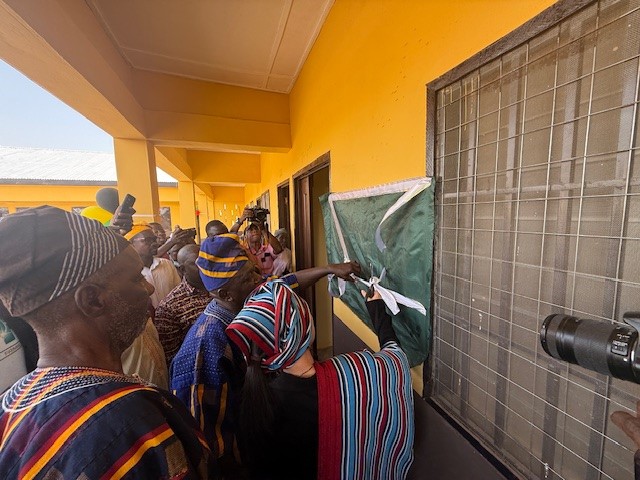
The Embassy of Japan in Ghana has reaffirmed its commitment to supporting grassroots development in Ghana with the commissioning of a new six-classroom school building at Nwodua in the Kumbungu District of the Northern Region.
The handover ceremony was attended by Secretary Yuze, who represented the Embassy and underscored Japan’s continued partnership with local communities to improve access to quality education.
The school, which caters to pupils from Grades One to Six, was established by the local non-governmental organisation, the Center for Active Learning and Integrated Development (CALID), with funding support from the Government of Japan under its Grant Assistance for Grassroots Human Security Projects (GGHSP). The initiative is part of ongoing efforts to address infrastructural deficits in underserved communities across the country.
Beyond the six classrooms, the newly completed facility includes an ICT room, an administrative office, a storage room, and outdoor toilet facilities. The improved infrastructure is expected to significantly enhance teaching and learning conditions, replacing previous arrangements that limited access to formal education for many children in the community.
The project will directly benefit 180 currently enrolled students and seven teachers, while also creating opportunities for 77 children who were previously unable to attend school due to inadequate facilities. Additionally, six newly assigned teachers will now have a conducive environment to deliver lessons, further strengthening the quality of education in the area.
In his remarks, Secretary Yuze highlighted the importance of education as a foundation for sustainable development, noting that safe and accessible learning spaces are essential to unlocking the potential of young people. He expressed hope that the new facility would inspire both pupils and teachers to strive for excellence while contributing to the long-term development of the Kumbungu District.
The Grant Assistance for Grassroots Human Security Projects (GGHSP) is a funding scheme introduced by the Government of Japan to support small-scale, community-based initiatives that directly improve human security at the grassroots level. The programme focuses on critical sectors such as education, healthcare, water and sanitation, and livelihood development, particularly in vulnerable and underserved communities.
Under the GGHSP framework, financial support is extended directly to local authorities, schools, hospitals, and non-profit organisations to implement practical and high-impact projects. Over the years, the programme has funded numerous community infrastructure projects across Ghana, reinforcing Japan’s philosophy of people-centred development and ensuring that assistance reaches those who need it most.
The Nwodua school project also highlights the strong and enduring relations between Ghana and Japan. Educational and community-based interventions such as this not only address immediate development needs but also deepen bilateral ties rooted in mutual respect and cooperation
By investing in the future of Ghanaian children, Japan continues to strengthen diplomatic goodwill and people-to-people connections, reinforcing a partnership that spans decades and contributes meaningfully to Ghana’s national development agenda.
Related Posts