
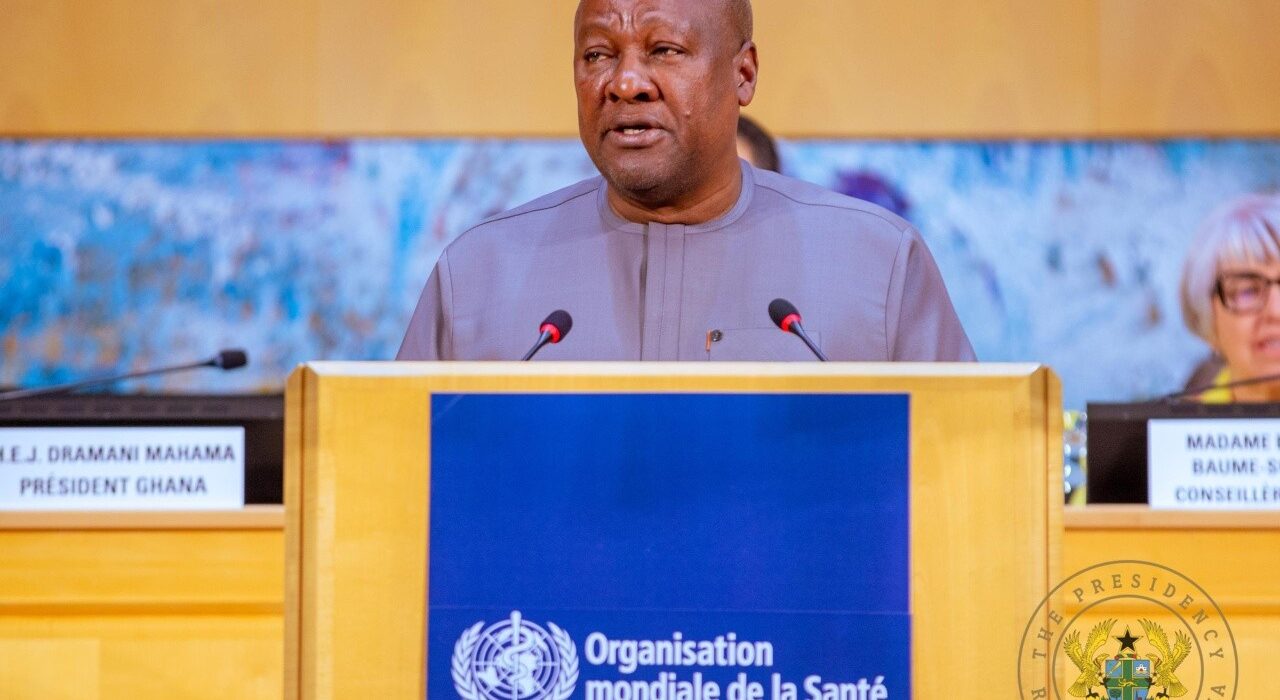
President John Dramani Mahama has proposed three operational pillars to help i the implementation of the Accra Reset initiative prioritizing the achievement of a sovereign health sector in AFRICA
Speaking at the 79th World Health Assembly, he said global health governance is under pressure from declining aid flows, institutional duplication, and weakening multilateral coordination frameworks which is a last wake up call for Africa to prioritise its health sovereignty.
He noted that more global health organisations exist today than ever before, yet delivery at country level, particularly in low- and middle-income countries, has become more fragmented and inefficient.
Mahama said Africa must transition from being a passive recipient of global health policy to an active architect of its own health systems under a new paradigm of health sovereignty. He however, stated that the quest for sovereignty is not isolation, but as the practical ability of states to finance core health services, regulate quality standards, and develop local manufacturing capacity for essential medicines and vaccines.
He referenced the fact that Africa currently produces less than 1% of its vaccines despite carrying approximately 25% of the global disease burden, a disparity widely cited in global health equity reports. We are advocating the practical capacity of a nation to finance its own core functions, regulate its own quality, produce its own medicines, and govern its own data.
“A continent that manufactures less than 1% of its vaccines, while carrying 25% of global disease burden, is not sovereign. It is vulnerable. It is at best a ward of the international system. And by sovereignty, we do not mean isolationism.” He said.
As part of the Accra Reset initiative, Mahama proposed three major institutional reforms aimed at improving coherence and delivery efficiency in global health governance.
The first is a High-Level Panel on Reform to independently assess global health institutions and recommend structural changes where necessary.
This body is expected to serve as an impartial expert mechanism, drawing on global health, governance, and financing specialists to evaluate the effectiveness, relevance, and efficiency of existing multilateral health institutions, while identifying areas requiring consolidation, mandate realignment, or operational reform
The second measure he underscored is a Reform Interlock and Observatory designed to coordinate the work of major global health funds and agencies such as WHO, Gavi, and the Global Fund to reduce duplication at country level.
The mechanism is intended to improve policy coherence and operational alignment among global health actors, ensuring that programmes implemented in countries do not overlap or create administrative fragmentation for national health systems, particularly at district and primary healthcare levels.
The third is the Health Investment National Gateway (HING), a mechanism intended to channel political commitments into bankable investments for local pharmaceutical production, biotechnology, and health innovation ecosystems.
The platform is designed to translate high-level policy pledges into structured investment pipelines by connecting governments, development finance institutions, and private sector actors to scalable health infrastructure projects, with a focus on strengthening domestic manufacturing capacity and reducing dependency on imported medical products.
He urged global partners to shift focus from policy declarations to implementation, stating that success must ultimately be measured by health outcomes at the clinic level rather than institutional outputs or conference resolutions.
Mahama described the current moment as a transition phase in global health governance, warning that while the old system is weakening, a new model rooted in agency, resilience, and partnership is emerging
Related Posts