
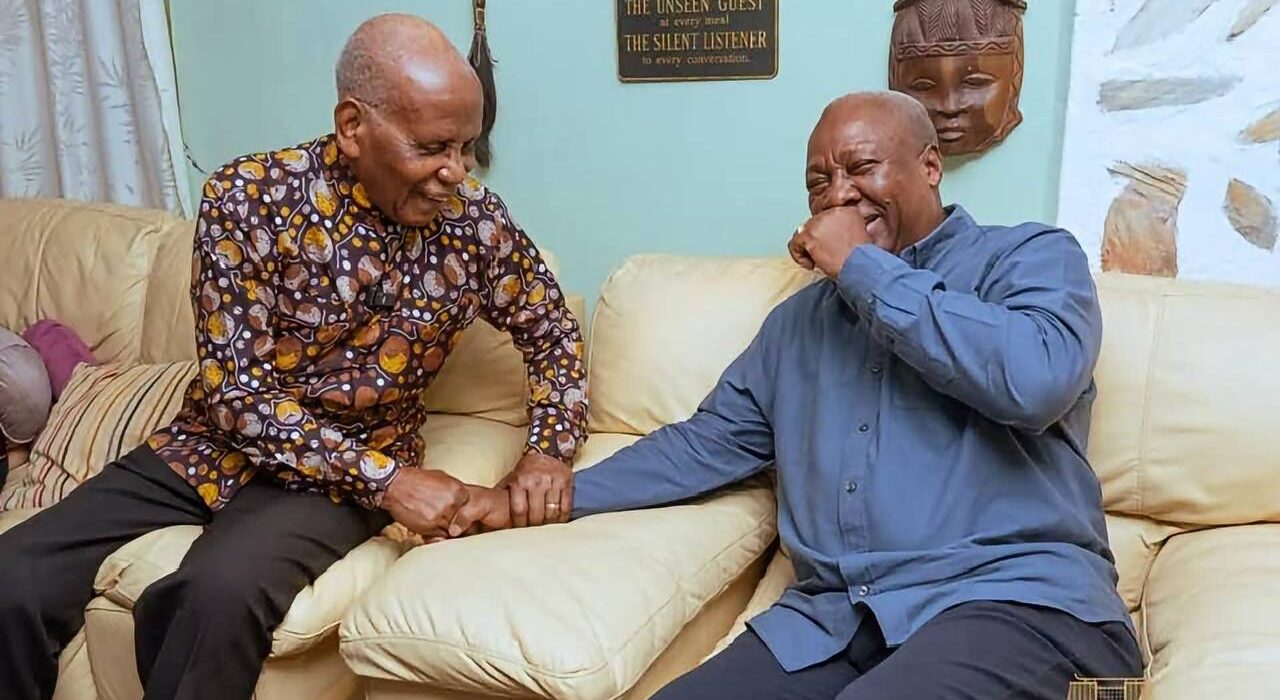
President John Dramani Mahama has visited veteran Ghanaian cinematographer Rev. Dr Chris Tsui Hesse, whose work as the personal cameraman to Ghana’s first President, Dr. Kwame Nkrumah, is at the centre of the documentary The Eyes of Ghana.
Photographs from the visit showed President Mahama and Hesse meeting at the veteran filmmaker’s home, where they discussed Ghana’s history and shared light moments.
The documentary, directed by two-time Academy Award-winning filmmaker Ben Proudfoot, revisits a defining period in Ghana’s political history through the lens of Hesse, who recorded key moments during Nkrumah’s leadership and the wider African independence movement of the 1950s and 1960s.
The 90-minute film follows Hesse’s efforts to preserve and restore an extensive collection of historical footage that had remained largely unseen for decades.
At the heart of the documentary is an archive of more than 1,300 reels of film preserved by Hesse. The footage captures Ghana’s independence, Nkrumah’s presidency and the wider struggle for African liberation, providing a rare visual record of events that shaped the continent’s political history. Much of the material had remained out of public view for decades.
The film recounts how Hesse protected the footage after the February 1966 coup that overthrew Nkrumah. While the films were believed to have been destroyed, Hesse had secretly arranged for the negatives to be sent to London, preserving material that could otherwise have been lost. The documentary follows his efforts, alongside young Ghanaian filmmaker Anita Afonu, to restore the archive and bring it back to public attention.
One of the film’s revealing details is the working relationship between Nkrumah and his cameraman. Nkrumah reportedly used his walking stick to discreetly signal to Hesse what to film, when to record and when to stop, offering a glimpse into how the former president managed the visual documentation of his leadership.
Beyond recounting Hesse’s work with Nkrumah, The Eyes of Ghana draws attention to his longstanding appeal for government support to preserve the country’s historical film archive. For years, the veteran cinematographer had sought funding to digitise the more than 1,300 reels documenting Ghana’s independence era and the wider African liberation struggle. The concern was that the fragile films could deteriorate, depriving future generations of an important visual record of the country’s history.
The appeal appears to have secured a breakthrough. In an interview with POV Magazine published on November 17, 2026, Proudfoot disclosed that the Ghanaian government had funded the digitisation of the remaining archive after an earlier commitment had not been implemented.
He said the work was underway in London, describing the development as the achievement of one of the filmmakers’ original objectives in making the documentary.
The film also makes a case for ensuring that the restored material reaches Ghanaians, particularly younger generations. Proudfoot has expressed the hope that The Eyes of Ghana will be screened free of charge in schools across the country, allowing students to encounter the country’s history through original footage.
The documentary is executive-produced by former United States President Barack Obama and former First Lady Michelle Obama through their production company, Higher Ground Productions.
For Hesse, the significance of the project extends beyond the preservation of old film reels. It is about safeguarding the visual memory of a country and ensuring that the people whose struggles shaped Ghana’s independence and early political history are not forgotten.
Through the archive, The Eyes of Ghana places the work of a cameraman who stood behind the lens at the centre of a national conversation about history, memory and cultural preservation.
Related Posts