
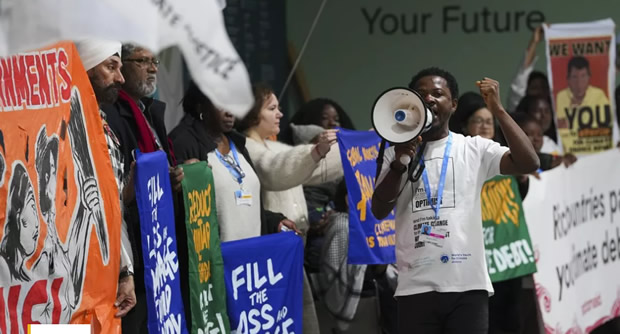
Around 50 demonstrators gathered at the entrance of the COP29 venue this morning, urging wealthy nations to uphold their financial commitments for climate change adaptation and mitigation in the Global South. As COP29 negotiations continue, activists emphasize the need for fair and just climate finance that addresses historical emissions and avoids deepening debt for developing nations.
Teresa Anderson, representing ActionAid International, highlighted the severe financial and environmental burden on the Global South, which is disproportionately affected by climate-induced disasters. Her powerful message resonated with the urgency of climate finance reform, stating, “It’s the global South that are paying for the floods… for the droughts… rising sea levels… and they’re trying to adapt to future impacts. On top of that, they’re somehow supposed to pay to mitigate and adopt green technologies, but they can’t because they’re drowning in debt.”
The demonstrators argue that rich countries—responsible for the bulk of historical greenhouse gas (GHG) emissions—must do more than offer loans or private investments disguised as climate finance. Anderson criticized the financial burden that more loans place on the Global South, saying, “It’s really important that rich countries stop trying to prop up the global South with yet more loans or private investment… pretending that is climate finance. That’s complete rubbish. The global South is already drowning in debt thanks to the climate crisis.”
Climate Colonialism and Climate Apartheid
Activists at COP29 have emphasized issues of “climate colonialism” and “climate apartheid.” Climate colonialism refers to how wealthy nations use their resources to implement climate solutions abroad, often prioritizing profit over the well-being of local communities. The Global North’s push for reforestation projects or renewable energy in the Global South sometimes displaces indigenous communities, exacerbating historical inequities.
Climate apartheid highlights how wealth disparity affects resilience to climate impacts. Resource-rich countries are better equipped to adapt to climate threats, while poorer nations bear the brunt of the climate crisis with fewer resources to rebuild and protect their communities. This disparity leads to increasingly frequent and severe poverty, displacement, and infrastructure losses in the Global South.
Calls for Just Climate Solutions
Protesters demand that the COP29 negotiations focus on “loss and damages” funding to support countries that lack the resources to adapt to or recover from climate disasters. Last year, the establishment of a Loss and Damage fund was a significant step forward, yet only around USD 700 million has been pledged, far short of the estimated USD 580 billion needed by 2033.
Climate justice advocates insist that a solution to the climate crisis must include voices from the Global South, indigenous communities, and frontline defenders of the environment. They argue that these groups, who have contributed the least to GHG emissions, possess invaluable knowledge for climate adaptation.
Source: africanews.com
Related Posts