
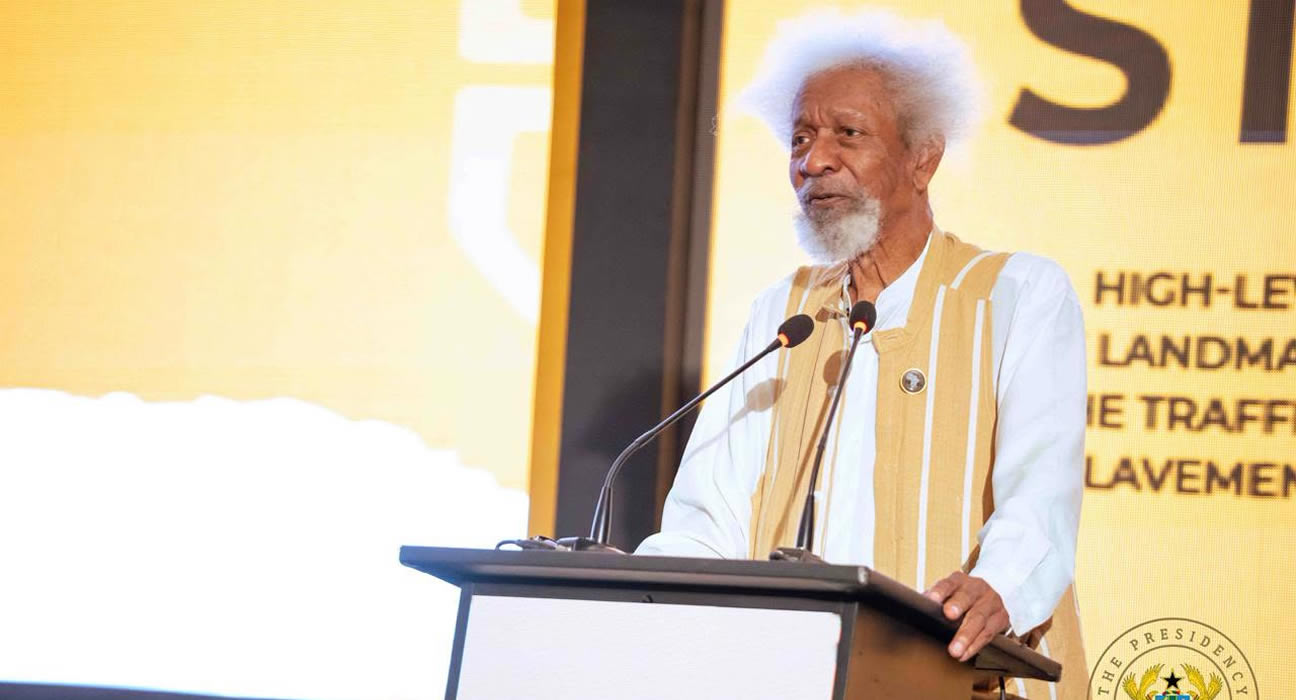
Prof. Wole Soyinka, Nobel Laureate and renowned Nigerian playwright, has cautioned against viewing slavery solely as a historical injustice, arguing that modern forms of enslavement continue to exist and must form part of ongoing conversations on reparatory justice.
He said while the transatlantic slave trade remained one of the greatest crimes against humanity, contemporary manifestations of slavery, including human trafficking, forced labour and the exploitation of vulnerable people, continued to deprive millions of their freedom and dignity.
Addressing the High-Level Next Steps Conference on Reparatory Justice in Accra, Prof. Soyinka said the global movement for reparations must not only seek justice for past atrocities but also confront present-day injustices rooted in the same dehumanising practices.
“When I addressed the United Nations last year, I made a point to tell my audience that the slave trade is not over. It is indeed very active,” he stated.
The conference, convened under the auspices of President John Dramani Mahama in his capacity as African Union Champion for Reparatory Justice, is bringing together Heads of State, diplomats, scholars, legal experts, civil society leaders and members of the African diaspora to discuss the next phase of the global reparations agenda.
The High-Level Next Steps Conference on Reparatory Justice follows the adoption of the landmark United Nations General Assembly Resolution A/RES/80/250 on March 25, 2026.
The Ghana-led resolution, supported by 123 member states, declared the trafficking and racialised chattel enslavement of Africans as the gravest crime against humanity and called for sustained international engagement on reparatory justice.
The resolution is widely regarded as a significant milestone in global efforts to secure recognition, accountability and redress for the historical injustices suffered by Africans and people of African descent.
Prof. Soyinka said evidence of modern slavery could be found in the trafficking of women and children, forced labour and the existence of slave markets in parts of Africa and elsewhere.
He cited cases of schoolchildren being kidnapped and trafficked across borders, describing the situation as a painful reminder that the struggle for human dignity remained unfinished.
According to him, the continued exploitation of vulnerable people demonstrated that societies had not fully overcome the structures and mind sets that sustained slavery for centuries.
“The most pernicious of these inequities are the children and the youth who to this day are kidnapped and sent to slave markets,” he said.
The Nobel Laureate stressed that calls for reparatory justice should not be dismissed as attempts to dwell on the past but rather recognised as efforts to address historical wrongs whose consequences continue to shape contemporary realities.
He criticised attitudes among some countries that have resisted or ridiculed calls for reparations, arguing that such positions reflected a poor understanding of history and humanity.
Referring to reports that some countries were considering restrictions on supporters of reparatory justice initiatives, Prof. Soyinka described such reactions as unfortunate and counterproductive.
“If ever there was a justification for this gathering, it is that mental state of retrogressive understanding of history and of human relationships,” he said.
The celebrated writer noted that Africa’s landscape itself bears enduring reminders of slavery through the numerous forts, castles and other historical sites associated with the transatlantic slave trade.
He cited Ghana as an example, noting that the country hosts some of the largest concentrations of slave forts and castles on the continent, serving as permanent reminders of one of humanity’s darkest chapters.
Prof. Soyinka, who spent part of his political exile in Ghana, said remembrance alone was not enough.
He urged governments, institutions and civil society organisations to move beyond symbolic commemorations and develop practical measures aimed at restoring human dignity, addressing inequality and promoting historical justice.
“We have to move now beyond discussions and rhetoric,” he said, adding that the reparations movement should focus on rebuilding lives and restoring humanity.
The Nobel Laureate also highlighted the importance of engaging the African diaspora in reparatory justice efforts.
He described initiatives aimed at reconnecting Africans in the diaspora with the continent as essential steps towards healing the psychological and cultural wounds inflicted by slavery.
According to him, reparatory justice should not be limited to financial compensation but should encompass the restoration of identity, memory and human dignity.
Prof. Soyinka commended President Mahama and the Government of Ghana for championing the reparatory justice agenda and for hosting what he described as a historic conference.
He said the gathering represented an important opportunity to transform decades of advocacy into practical action and meaningful outcomes.
In recent years, calls for reparations have gained momentum across Africa, the Caribbean and the diaspora, with advocates seeking measures ranging from formal apologies and restitution of looted artefacts to economic investments, institutional reforms and educational initiatives.
Ghana has emerged as a leading voice in the movement, leveraging its historical significance in the transatlantic slave trade and its diplomatic influence within the African Union and the wider international community.
The country is home to some of the world’s most significant slave heritage sites, including Cape Coast Castle and Elmina Castle, which continue to attract descendants of enslaved Africans seeking reconnection with their ancestral roots.
The Accra conference is expected to adopt recommendations and frameworks aimed at advancing the global reparations agenda while promoting justice, dignity and equity for Africans and people of African descent.
Source: GNA
Related Posts