
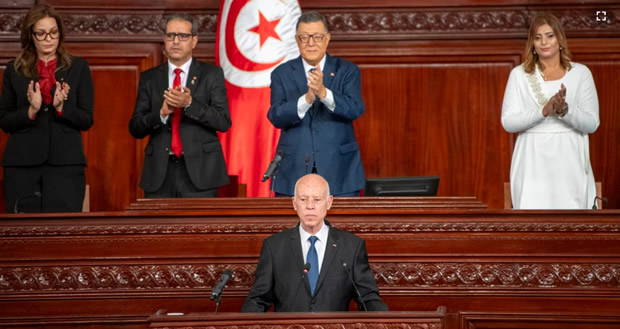
Tunisian President Kais Saied was inaugurated for a second term following a tumultuous first term in which he suspended parliament, jailed his critics and rewrote the country’s constitution.
In his inaugural address Monday before parliament, Saied called for a “cultural revolution” designed to fight terrorism, reduce unemployment and erase corruption.
“The aim is to build a country where everyone can live in dignity,” he said.
Saied won a little more than 90% of the votes, but that triumph was spoiled by a reported low voter turnout of 28.8%.
Out of 14 presidential hopefuls, only three ended up on the ballot: One was in prison, one was a close acquaintance of Saied, and the third was Saied.
Saied rose to power in 2019 when he mounted a presidential campaign with very little money and a populist message of rooting out cronyism and returning power to the people, a notion that resonated with an electorate fed up with years of dysfunctional governance.
However, in 2021, Saied suspended parliament, rewrote the North African country’s constitution, increased presidential powers and reduced legislative ones.
A crackdown on the opposition followed. Under his presidency, authorities detained or imprisoned dozens of opposition politicians, activists and journalists, dismissed judges and prosecutors, and weakened free expression and judicial independence. Even though the president also cracked down on corruption, analysts say new forms found root and flourished.
Earlier this year, Tunisia renewed the crackdown on protesters who denounced what they said was their country’s deteriorating economic and political state.
Meanwhile, Bassam Khawaja, deputy Middle East and North Africa director at Human Rights Watch, said Tunisian officials have “systematically” placed “obstacle after obstacle in the way of a fair election and opposition candidates being able to campaign for president freely.” Khawaja said that “after mass arrests and targeting prospective contenders,” Tunisian authorities changed “the electoral law just days before the election, cutting off avenues for meaningful oversight and appeal.”
On Tuesday, the lawyer for imprisoned opposition presidential candidate Ayachi Zammel told Agence France-Presse that Zammel has received more time, increasing his sentence to more than 30 years.
After Zammel’s arrest, the European Union condemned what it called “a continued limitation of democratic space in Tunisia.”
The EU’s criticism also came after Tunisia’s election board ignored a court decision that granted the appeals of three other presidential candidates to have their names in the race.
Source: voanews.com
Related Posts