

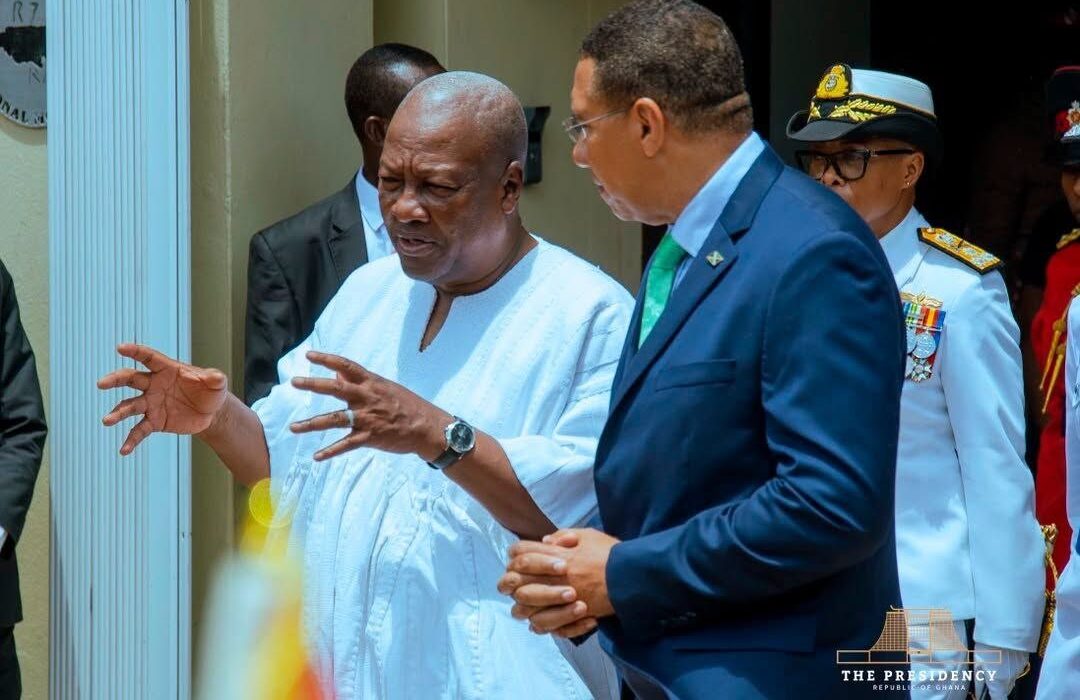
President Mahama has outlined two major initiatives he intends to champion during his tenure as Chairperson of the African Union, both aimed at accelerating African integration and strengthening institutional links between the continent and the global African diaspora.
He made the disclosure during separate engagements in Jamaica as part of his four-day state visit to the Caribbean nation, where discussions focused on deepening Ghana-Jamaica relations and strengthening cooperation between Africa and the Caribbean.
The first major initiative is his proposal to expand the scope of the African Continental Free Trade Area (AfCFTA) to include the Caribbean Community (CARICOM), creating a broader economic partnership between Africa and Caribbean nations.
Addressing bilateral discussions with Jamaica’s Prime Minister, Dr. Andrew Holness, on August 4, 2026, President Mahama described the existing cooperation between the African Union and CARICOM as a foundation for deeper economic integration between the two regions.
He argued that extending the AfCFTA framework to CARICOM would create new opportunities for trade, investment, and industrial cooperation by connecting the Caribbean’s approximately 18 million people to Africa’s market of more than 1.4 billion people and a combined continental GDP of about US$3 trillion.
“One of the things I will champion when I become AU Chair next year is to expand the remit of the African Continental Free Trade Area to include the Caribbean. We set up the African Continental Free Trade Area that allows us to export goods duty-free and tariff-free into each other’s markets,” President Mahama stated.
Such an expansion would represent a significant step towards building a wider Africa-Caribbean economic bloc, potentially covering more than 70 countries across both regions. The proposal comes as the AfCFTA continues efforts to boost intra-African trade and industrialisation. However, implementation challenges remain, including infrastructure deficits, non-tariff barriers, limited productive capacity, and slow progress in harmonising trade regulations.
Although intra-African trade has recorded growth, it remains below the levels achieved by other regional blocs. The 2025 African Trade Report by Afreximbank indicated that intra-African trade increased by 12.4 per cent to reach US$220.3 billion, reflecting progress but also highlighting the need for stronger mechanisms to fully realise the AfCFTA’s ambition of transforming Africa into a single market.
The second proposal President Mahama intends to advance is the recognition of the right of people of African descent in the diaspora to return, reside, and contribute to Africa’s development.
He announced that Ghana is preparing legislation to establish a legal pathway for members of the African diaspora to obtain permanent residence and potentially citizenship, arguing that return to the continent should be viewed as a right rather than an act of charity.
“The rights of persons of African descent in the diaspora to return to the mother continent is not an act of charity or compassion. Repatriation is a right of all persons of African descent to return to the mother continent and settle or reside if they wish,” President Mahama said.
He added that this would form part of the agenda he intends to promote when he assumes the AU Chairmanship, with the aim of strengthening the relationship between Africa and what he described as the “global African family.”
The African Union formally recognised the African diaspora as its sixth region following amendments to its Constitutive Act in 2023, expanding the Union’s vision beyond its 55 member states to include people of African origin living outside the continent who are willing to contribute to Africa’s development.
Beyond cultural and historical connections, greater diaspora engagement could unlock significant financial resources for Africa. While official data does not separately classify foreign direct investment made by members of the African diaspora, diaspora remittances remain one of the most significant financial links between Africans abroad and the continent.
According to the World Bank, remittance flows to Sub-Saharan Africa reached approximately US$54 billion in 2023, demonstrating the economic importance of diaspora contributions to household incomes, businesses, and local economies. Ghana remains one of the leading recipients in the region, with remittances serving as an important source of foreign exchange and private investment.
President Mahama’s proposed diaspora agenda therefore seeks not only to strengthen cultural ties but also to transform the global African diaspora into a strategic partner in Africa’s economic development, investment mobilisation, and integration efforts.
He is expected to assume the rotating position of Chairperson of the African Union in 2027, when leadership of the Union returns to the West African region under the AU’s rotational arrangement among Africa’s five geographic regions. President Mahama will succeed Angola’s President João Lourenço, who is expected to serve as AU Chairperson for 2026.
The AU Chairperson serves a one-year term, during which the holder provides political leadership to the Union, chairs the Assembly of Heads of State and Government, represents the continent at major international engagements, and helps drive consensus on Africa’s key priorities, including peace and security, economic integration, and sustainable development.
Related Posts