
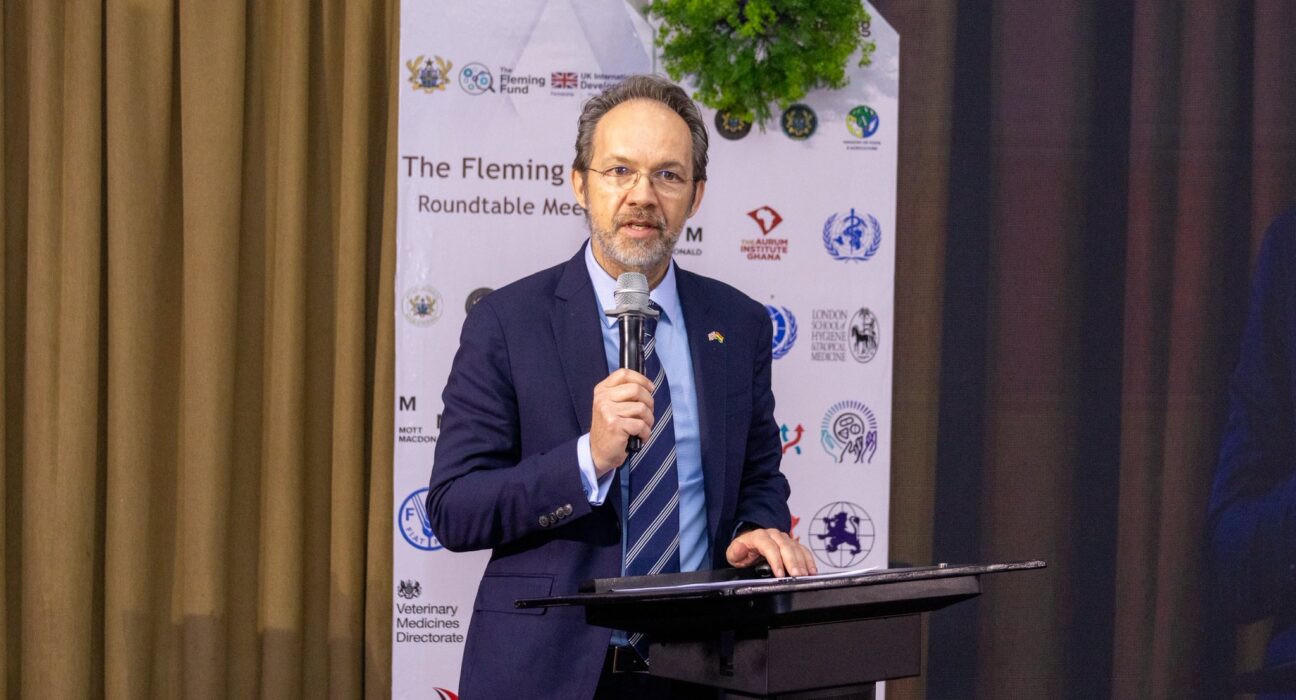
The British High Commissioner to Ghana, Christian Rogg, has called for increased domestic investment in Ghana’s National Action Plan to tackle antimicrobial resistance (AMR), warning that sustained local commitment will be critical as external support gradually declines.
He made the appeal while stressing the urgent need to maintain laboratories, ensure a steady supply of reagents, retain skilled personnel, and strengthen unified health coordination systems to confront what he described as a growing public health threat. Without sustained intervention, Ghana risks recording an estimated 27,600 deaths associated with AMR by 2030.
High Commissioner Rogg delivered the remarks while commending the United Kingdom’s substantial support to Ghana through the Fleming Fund over the past seven years. The programme has supported the establishment of 17 AMR surveillance sites, upgraded 11 laboratories, trained nearly 1,000 health experts, and generated critical data that is now improving patient care and informing national decision-making.
Funded by the United Kingdom’s Department of Health and Social Care (DHSC) as a UK Aid programme, the Fleming Fund was established in 2015 to support between 25 and 30 low- and middle-income countries across Africa and the Asia-Pacific region in strengthening surveillance systems to combat AMR.
In Ghana, the Fleming Fund Country Programme has been a key partner in supporting the government’s National Action Plan on AMR. Its objectives include strengthening a well-functioning One Health governance structure for antimicrobial resistance and antimicrobial use (AMU) surveillance, establishing a government-led system for collecting, analysing, and reporting AMR and AMU data, aligning national reporting with the requirements of the Global Antimicrobial Resistance and Use Surveillance System (GLASS), and expanding surveillance in the animal health sector.
The Fund has disbursed two major grants to Ghana, coordinated through its management agent, Mott MacDonald, with The Aurum Institute serving as the lead grantee in the current phase.
The second phase of funding, active from 2024 to 2025, delivered £2,533,789 to support Ghana’s health system in implementing its National Action Plan on AMR. An earlier grant, which ran from December 2018 to May 2020, injected £1,842,668 into the fight against antimicrobial resistance.
The lead grantee during that phase was the University of Ghana Office of Research, Innovation and Development (ORID), working alongside sub-grantees including the Noguchi Memorial Institute for Medical Research, the University of Ghana Department of Medical Microbiology, the School of Veterinary Medicine, Hope for Future Generations, and Mangel Klicks.
Ghana continues to face a significant AMR burden. Since 1990, over 5,000 lives have been lost annually in the country due to antimicrobial resistance. In 2021 alone, an estimated 4,910 deaths were directly attributable to AMR, while 23,100 deaths were associated with the condition.
Globally, efforts to contain AMR remain challenging. The path to achieving the 2024 United Nations General Assembly target of a 10 percent reduction in AMR-related deaths by 2030 — from 4.9 million to 4.45 million globally, remains uncertain, underscoring the need for sustained political and financial commitment at the national level.
The Fleming Fund Country Programme previously supported the development of Ghana’s National Policy on Antimicrobial Use and Resistance in 2016, built on a strong One Health and multi-sectoral framework. The policy and the accompanying National Action Plan received Cabinet approval in 2017, laying the foundation for coordinated national action.
High Commissioner Rogg’s call signals a shift toward greater domestic ownership of the AMR agenda, urging Ghana to consolidate the gains made through international partnerships and ensure long-term sustainability in safeguarding public health.
Related Posts