
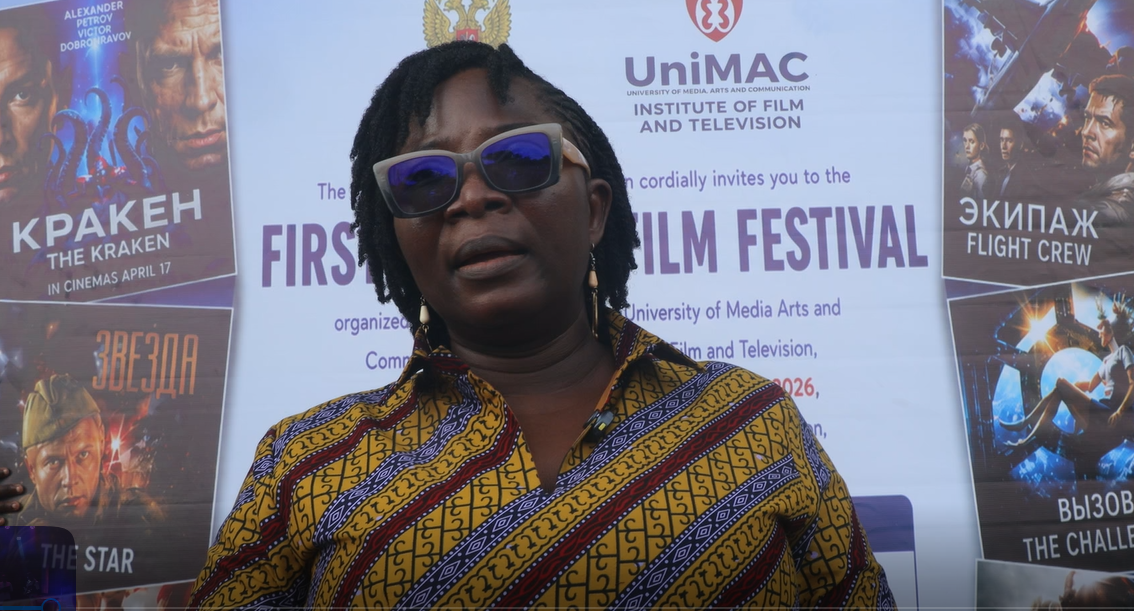
The Dean of the Faculty of Digital Media and Design at UniMAC-IFT, Dr. Rebecca Ohene Asah, has highlighted Russia’s significant contribution to the evolution of global cinema, describing its influence on film history as foundational.
She made the remarks during the First Russian Film Festival, organized by the Russian Embassy in Ghana in collaboration with UniMAC-IFT. The two-day festival featured screenings of four Russian films, The Challenge, Three Seconds, Star, and The Crew, offering students and invited guests exposure to Russian filmmaking techniques, narrative styles, and cinematic aesthetics.
Russia has played a significant and foundational role in the history of global cinema, particularly through its early contributions to film theory, editing techniques, and visual storytelling. Pioneering filmmakers such as Sergei Eisenstein and Dziga Vertov helped shape modern cinematic language, introducing revolutionary concepts like montage and documentary realism that continue to influence contemporary filmmaking worldwide.
Soviet cinema also became a powerful cultural and ideological tool, producing films that combined artistic innovation with social commentary. Over time, Russian and Soviet film traditions have remained influential in shaping global film aesthetics, narrative structure, and editing practices, securing Russia’s place as one of the key contributors to the development of world cinema.
Dr. Ohene Asah noted that the festival provided students with a valuable opportunity to engage with diverse cinematic traditions and broaden their understanding of global film practices.
“Russia played a very important role in film development, film history. And for us to have the opportunity to see films that are coming from Russia, which is a bit different from the films that we are probably used to, we think that will influence our students to see some of the beautiful, the structure, editing, the aesthetics of it.” she said.
A key highlight of the festival was The Challenge, a Russian space drama directed and co-written by Klim Shipenko. Released in 2023, the film made history as the first feature-length production filmed aboard the International Space Station.
The film follows a Russian surgeon who is unexpectedly sent to space to perform an emergency operation on an injured cosmonaut, after he develops life-threatening complications while on a mission. Blending realism with high-stakes medical drama, the story explores themes of human endurance, responsibility, and collaboration under extreme conditions.
Its production marked a historic milestone in global cinema, combining professional filmmaking with actual spaceflight environments to deliver an authentic and technically groundbreaking viewing experience.
Sharing his impressions after the screening, Alfred, a student of UniMAC-IFT currently enrolled in a Russian language programme, said the festival created a practical link between his language studies and film culture.
Reflecting on The Challenge, he noted that the film offered valuable lessons on teamwork, innovation, and problem-solving, particularly in its portrayal of collaboration between medical experts on Earth and astronauts in space during a high-risk surgical mission.
“I learned a lot from it, but what I will share is that, it was her point, the surgeon, when she was in space, she realized that she was out of options. Then her mates texted her what to do, and that is telling me that there could be teammates playing part of the role, but the role they are bringing on board is actually an innovation which is not part of the actual plan. So, I’m so grateful I’m part of this, and looking forward to having more of it.” he said.
The Russian Film Festival forms part of a broader partnership between the Russian Embassy and UniMAC aimed at strengthening cooperation in media, culture, and education. Previous initiatives under this collaboration include a Memorandum of Understanding with Sputnik, Russian Language Day celebrations, and other cultural exchange programmes.
University officials are also exploring additional areas of collaboration, including partnerships with the Russian Institute of Theatre Arts (GITIS), support from Kuban State University, engagement with BRICS TV, participation in educational forums in Russia, as well as scholarship and professional training opportunities for UniMAC students.
Related Posts