
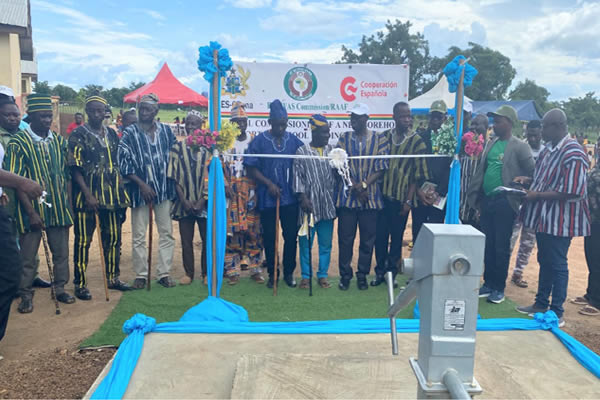
The Economic Community of West African States (ECOWAS) has handed over a hand-pump borehole to the Dakuma/Hiel Basic School in the Sissala West District as part of efforts to boost enrolment in the school, especially among girls.
The water facility is expected to reduce water-related absenteeism and the burden associated with water collection, especially on girls as well as improve sanitation and hygiene practices among the school children.
A similar facility had earlier been handed over to the Kanee Basic School in the Jirapa Municipality.
The intervention under the “Promoting Academic Success among Underprivileged Schoolchildren at Rural Areas through School Feeding Programme in Ghana” project was implemented by the Millennium Child Support Group (MCSG).
The ECOWAS and Spanish Cooperation provided technical and financial support for the regional project through the Regional Agency for Agriculture and Food (RAAF) to promote academic success through school feeding.
Speaking at the commissioning, Mr Francis Dabiré, who represented the Executive Director of RAAF, Mr Mohamed Zongo, commended MCSG for its leadership and community-centred approach in the project delivery.
He said the MCSG had demonstrated how meaningful development must reflect the realities and aspirations of the people it serves.
Mr Dabiré described that intervention as “a symbol of hope, dignity, and shared progress and prosperity.”
Dr. Godfrey Ato Parker, the Chief Executive Officer of MCSG, indicated that, “Ending classroom hunger is an integral part of the ambition of our Group geared towards saving the child, saving the future and saving the world.”
He, therefore, said the Group’s collaboration with ECOWAS on that project was instrumental in helping it to achieve that ambition.
Dr. Parker appealed for greater collaboration, partnership and support from stakeholders, including ECOWAS to reach out to more vulnerable schools and pupils in the near future.
Mr Fuseini Gbene, the Sissala West District Chief Executive (DCE), expressed gratitude to ECOWAS, the Spanish Cooperation and MCSG for their partnership on the project, which he said complemented Ghana’s school feeding policy.
He indicated that the government of Ghana remained committed to improving the educational sector in partnership with the necessary stakeholders including ECOWAS considering the numerous challenges in that sector.
The opinion leaders and people in the community as well as the teachers thanked the benefactors for the intervention and pledged commitment to maintaining the facility to serve posterity.
The integrated nutritional enhancement project also considered the need to improve water resources availability and management, including the development of agro ecological vegetable gardens and livestock to enrich canteens with animal proteins.
Through its regional school feeding programme, ECOWAS continued to invest in human capital development and promoting rural business opportunities for agricultural sector actors across its member states, including Burkina Faso, Mali and Niger.
Source: GNA
Related Posts