

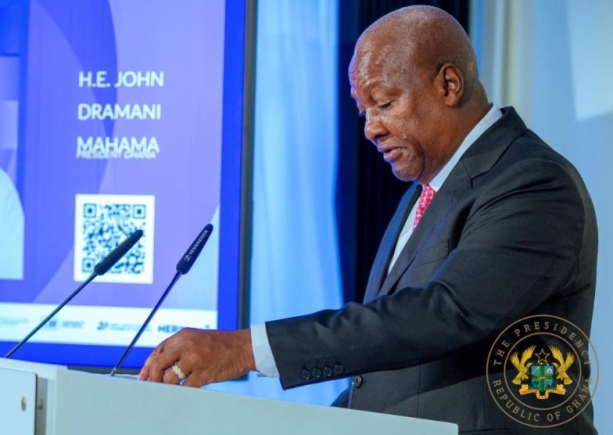
President John Dramani Mahama has been adjudged the fifth most influential figure shaping the global development agenda by Devex, largely on the back of his role in pioneering the Accra Reset, a bold, Africa-led initiative seeking to redefine global development financing, governance, and partnerships.
The Accra Reset, which Mahama co-founded with former Nigerian President Olusegun Obasanjo, has gained international traction as a response to shrinking aid flows, rising debt burdens, and what its proponents describe as the exhaustion of traditional development models. Devex said Mahama’s leadership of the initiative has positioned him as one of the most influential voices calling for a structural reordering of how development is conceived and delivered globally.
Devex, a leading platform providing insider reporting for development professionals, and its annual list recognises leaders driving the most consequential debates around the Sustainable Development Goals (SDGs), development finance, and international cooperation.
President Mahama returned to office in January for a second, non-consecutive term, having previously served as Ghana’s president from 2012 to 2017. He has also served as vice president, a Member of Parliament, and a cabinet minister, and was the first co-chair of the United Nations Advocacy Group on the Sustainable Development Goals.
According to Devex, Mahama’s growing global profile is closely tied to the Accra Reset’s core argument: that Africa must move beyond adapting to declining aid and instead renegotiate its place in the global economic order. The initiative challenges aid dependency and calls for debt restructuring, fairer global trade rules, scaled-up climate finance, and stronger domestic resource mobilisation anchored in national ownership.
The Accra Reset was formally launched in Accra last August during a high-level convening of African leaders, policymakers, development experts, and global health specialists. Initially framed around African health sovereignty, the discussions emphasised local manufacturing, resilient health systems, and equitable global cooperation. The framework was later expanded at the United Nations General Assembly in September to cover development more broadly, positioning the Accra Reset as a global agenda rather than a purely African one.
Devex noted that the initiative has taken on heightened relevance amid significant cuts to U.S. foreign assistance and broader donor fatigue, prompting renewed conversations about alternative development financing models, south-south cooperation, and reforms to multilateral institutions. President Mahama has served as the initiative’s most visible and hands-on political advocate, with Obasanjo providing strategic counsel and continental gravitas.
The recognition places President Mahama came fifth, while Benjamin Black, the Chief Executive Officer of the U.S. International Development Finance Corporation (DFC) came first. Black, one of U.S. President Donald Trump’s early nominees, has become a central figure in reshaping America’s development engagement following the dismantling of USAID. Under his leadership, the DFC has emerged as a cornerstone of the United States’ “America First” development strategy and was recently reauthorized by Congress after months of intense debate over its mandate.
Coming second was Sidi Ould Tah, the newly appointed President of the African Development Bank (AfDB), was recognised for assuming leadership at a pivotal moment for the institution. He takes over from Nigeria’s Akinwumi Adesina, under whom the bank’s capital base tripled.
However, Tah inherits an AfDB facing tighter donor budgets and mounting global pressures, despite successfully raising a record $11 billion during the latest replenishment of the African Development Fund, short of its $25 billion target but still a historic achievement..
Devex noted that the inclusion of Mahama reflects not only his political experience, but his role in shaping one of the most ambitious attempts in recent years to move beyond “development-as-usual” and chart a new course for global cooperation in an era of economic uncertainty.
Related Posts