
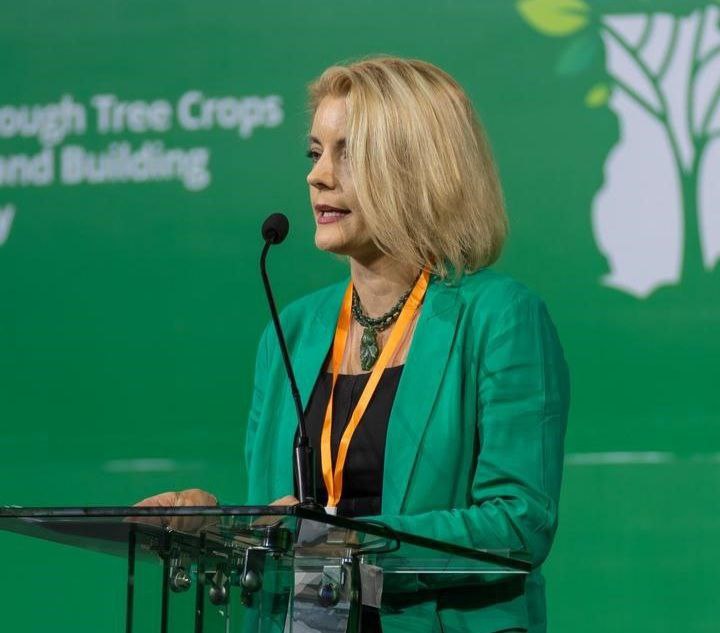
The Swiss Ambassador to Ghana, Simone Giger, has emphasised the importance of local value addition in agricultural commodities, urging deeper investment and cooperation to ensure that wealth generated from Ghana’s tree crop sector remains within the country.
Speaking at the Tree Crops Investment and Exhibition Summit 2026 in Accra, Ambassador Giger highlighted the summit’s role in promoting agribusiness as a driver of jobs, growth and environmental stewardship by adding value to the raw crop produce Ghana exports.
“Our belief is that when value is added locally, wealth stays locally. And let us be clear, many of these value chains are powered by women.” she said
Giger reaffirmed Switzerland’s firm commitment to Ghana’s agenda to transform its agricultural economy to retain value and create jobs especially strenthening rural economies which are the home of most agricultural produce in Ghana.
“Our job is to deepen those roots further so that growth can withstand any wind. Switzerland’s new cooperation program with Ghana focuses strongly on improving the business environment and strengthening value chains like cashew, oil palm, shea and cocoa. Why? Because these sectors create jobs, build skills and anchor rural economies.” she said
The summit, organised under the theme “Sustainable Growth Through Tree Crop Investments: Resetting and Building Ghana’s Green Economy”, brought together government officials, investors and private sector actors to explore opportunities in key tree crop value chains such as cocoa, cashew, shea, rubber and oil palm.
Switzerland has been a partner in Ghana’s development for more than two decades, Ambassador Giger noted, and its cooperation has evolved alongside Ghana’s aspirations for economic diversification and industrialisation. “Lasting prosperity is built by a vibrant private sector, strong institutions and real partnerships,” she said, drawing on Ghanaian proverbs to underline national resilience.
Agriculture remains a cornerstone of the Ghanaian economy. According to the Ghana Statistical Service, cocoa beans, one of the country’s most important tree crop exports, accounted for about GH₵21.5 billion of export revenue in 2024, alongside other commodities such as cashew nuts (GH₵2.65 billion) and shea oil (GH₵1.93 billion). Raw cocoa products, including cocoa beans and paste, together contributed more than 7 per cent of Ghana’s total export earnings in that year.
Despite significant export volumes, much of Ghana’s agricultural output is shipped in raw form, limiting the value retained domestically. Only around 30% of cocoa bean production is processed locally, compared with higher rates in some neighbouring countries, while the vast majority of cashew and shea nuts are exported unprocessed. Analysts note that processed products such as cocoa butter, powder and kernels command substantially higher prices on global markets.
At the summit, Ghana’s President John Dramani Mahama articulated a vision to change that dynamic, announcing plans to end the export of raw cashew, shea and rubber and target 50–60%t annual local processing of these commodities. The government aims to expand agro-industrial parks, introduce incentives for private processors and strengthen regulatory oversight through the Tree Crops Development Authority.
The economic rationale for such a shift is strong. Experts estimate that with sufficient investment and scale, each major tree crop value chain could generate up to $2 billion in annual export revenue by 2030, a significant increase from current figures, which see Ghana earning hundreds of millions of dollars in raw exports. Local processing would allow Ghana to capture a larger share of the value chain, from processing to finished goods marketed internationally.
Ambassador Giger underscored the gender dimension of value addition, noting that many participants in tree crop value chains are women, from farmers to processors and traders. She stressed that quantum investment in the value chain invariably benefits women. The theme of gender in the value chain was strong emphasized during the summit, demonstrating the significant inevitable role women play in the sector.
“When we invest in tree crops, we invest in women farmers, women processors and women traders. When women thrive, households thrive, communities thrive and economies thrive,” she said, urging investors to prioritise inclusive and sustainable engagements.: she said
The Swiss envoy reiterated her country’s commitment to supporting reforms, building investor confidence and attracting capital that unlocks Ghana’s full potential. “The future of Ghana’s tree crop sector is promising,” she said. “With strong governance, clear policies and committed partners, Ghana can build a green economy that benefits farmers, businesses and communities alike.”
Related Posts