

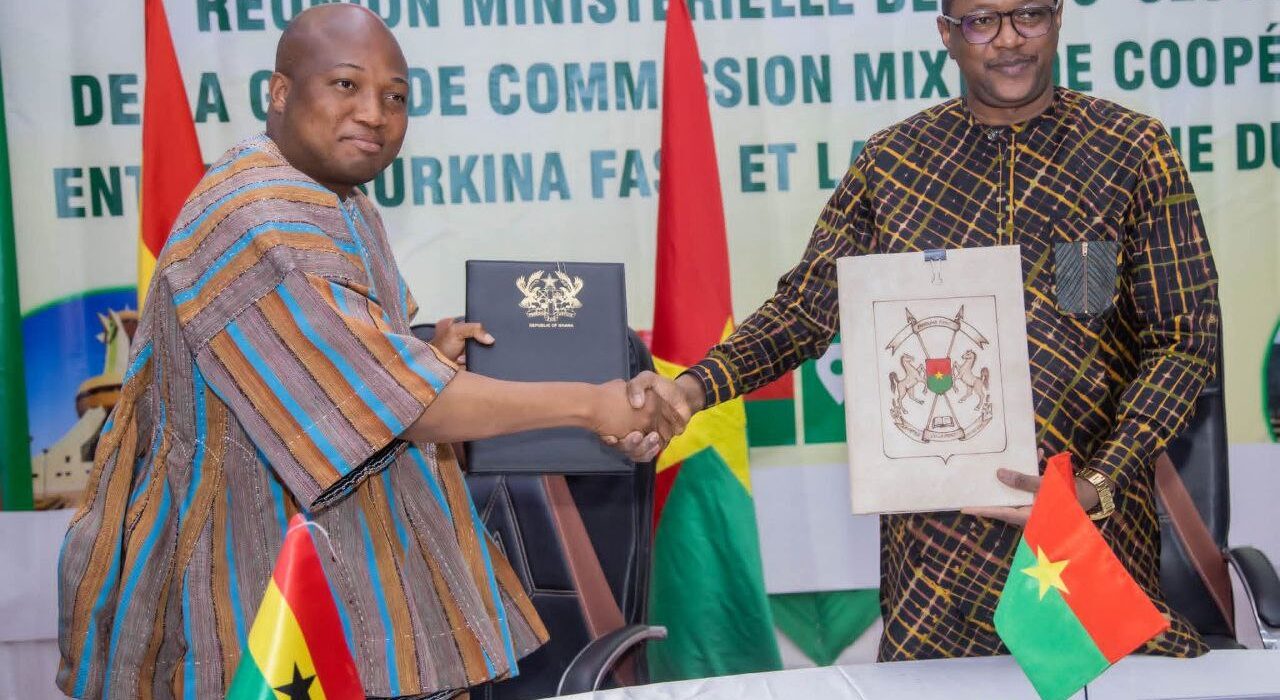
Ghana has signed seven bilateral agreements with Burkina Faso, with the accords expected to collectively address security, humanitarian and cross-border challenges heightened by the recent terrorist attack in Titao that affected Ghanaian traders.
The agreements were concluded during a two-day official visit by Foreign Affairs Minister Samuel Okudzeto Ablakwa, who in a statement on his social media handles said the engagements were substantive and aimed at deepening cooperation in response to emerging regional threats.
Although the agreements span multiple sectors, several of them directly and indirectly respond to the deteriorating security situation in Burkina Faso and the wider Sahel, particularly in the wake of the JNIM attack in Titao that impacted Ghanaian tomato traders.
According to the Minister, the Permanent Joint Commission for Cooperation (PJCC) are the end products of pervious meetings between President Mahama and the junta leader of Burkina Faso, Ibrahim Traore in January and March last year.
At the forefront is the Cooperation Agreement on the Prevention and Management of Disasters and Humanitarian Crises. While primarily focused on natural disasters such as the perennial Bagré Dam spillage, the agreement also strengthens joint humanitarian response capacity, a critical need as terrorist attacks increasingly displace civilians and disrupt livelihoods across border communities.
The Framework Agreement on Cross-Border Cooperation also carries strong security implications. By enhancing collaboration between border communities and state institutions, it creates a coordinated structure for monitoring, early warning and rapid response to cross-border threats, including extremist infiltration.
Similarly, the Memorandum of Understanding on the Establishment of Periodic Consultation Frameworks Between Border Administrative Authorities ensures sustained communication among local authorities. This is vital in volatile areas where intelligence sharing and coordinated action can prevent or mitigate attacks.
The Agreement in the Field of Fighting Illicit Cultivation, Production, Manufacture and Trafficking of Narcotic Drugs and Psychotropic Substances addresses another layer of insecurity. Illicit trafficking networks in the Sahel are often linked to extremist financing, making this agreement a strategic tool in weakening the operational capacity of terrorist groups.
The Agreement on Transport and Road Transit and the Agreement on the Mutual Recognition of National Driver’s Licenses, though economic in nature, also contribute to stability. By formalizing and regulating cross-border movement, they reduce vulnerabilities that can be exploited by criminal and extremist elements.
The Memorandum of Understanding on the Creation of a Joint Commission to Reaffirm the Border Between the Two Countries strengthens territorial clarity and mutual trust, reducing the risk of future disputes that could complicate joint security operations.
In his statement, Ablakwa said Ghana and Burkina Faso condemned the recent terror attacks and agreed to design and adopt a new security framework aimed at neutralizing terrorism and violent extremism, a commitment that underpins many of the signed agreements.
The Titao attack underscores the fragile security climate in Burkina Faso, where insurgent violence has intensified in recent years. The instability poses real spillover risks to Ghana, particularly along its northern frontier, where trade and community ties remain strong.
By signing the seven agreements, Ghana and Burkina Faso are not only deepening diplomatic ties but also building a multi-sectoral shield against the intertwined threats of terrorism, humanitarian crises and transnational crime that define today’s Sahelian security landscape.
Related Posts