
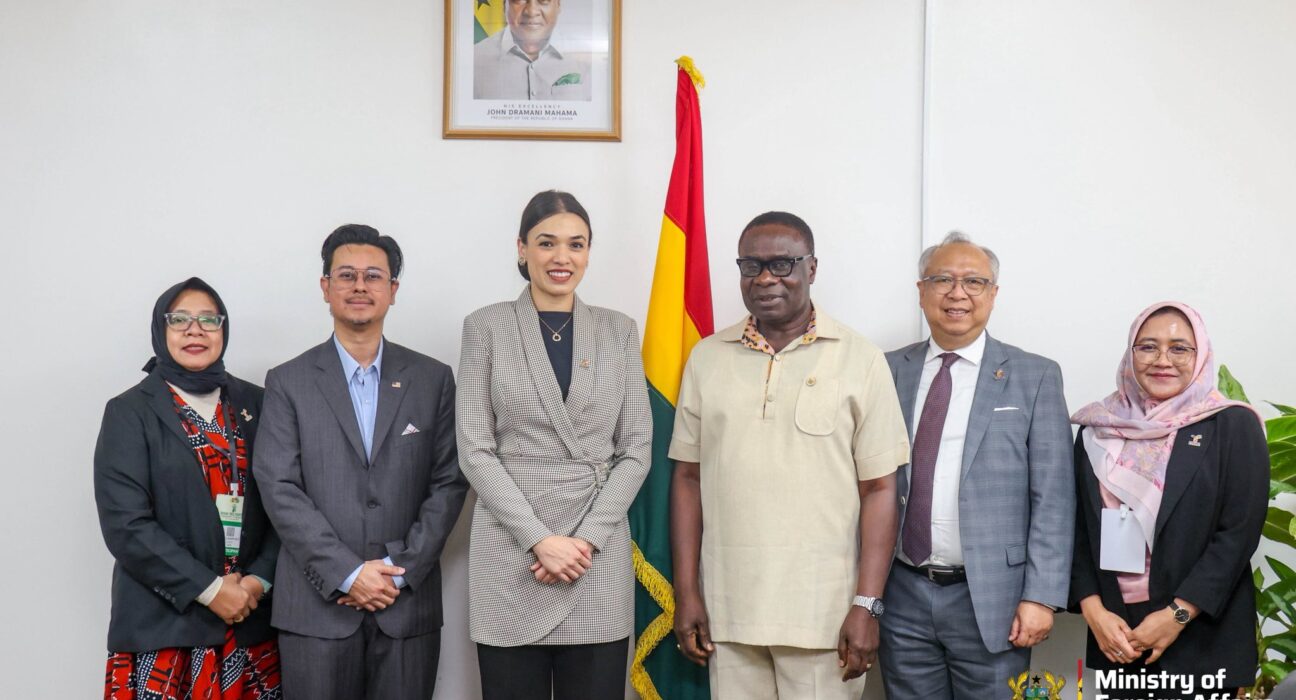
Deputy Minister of Foreign Affairs James Gyakye Quayson has held a high-level delegation from the Council of Palm Oil Producing Countries (CPOPC) to discuss enhanced collaboration on harnessing the economic potential of palm oil for Ghana’s development.
The courtesy visit on Wednesday, 18 February 2026, saw the Minister and the CPOPC delegation examine strategic opportunities for Ghana within the global palm oil landscape.
Palm oil continues to be a significant agricultural commodity in Ghana, relied upon for household use, food processing, and livelihood generation in rural areas. Despite this importance, domestic production has historically struggled to meet national demand, with estimates showing annual consumption far outstripping local output.
Government figures indicate that Ghana consumes upwards of 250,000 metric tonnes of palm oil each year, while domestic production is only a fraction of that level, creating a persistent supply gap.
Deputy Minister Quayson noted that modernisation in agricultural practices, especially through mechanisation, improved planting materials, and stronger value chain linkages, could significantly boost yields in the palm plantation sector.
He explained that such improvements would not only raise production volumes but also create job opportunities, particularly for youth and women engaged in cultivation, processing, and trading. This, he said, could eventually elevate palm oil to the status of a major cash crop akin to cocoa, contributing more substantially to Ghana’s non-oil GDP.
Currently, Ghana’s palm oil industry is the focus of national agricultural strategies aimed at cutting reliance on imported edible oils and reducing the country’s sizeable import bill, a bill that agricultural policy documents estimate at around US$2 billion annually due to the shortfall between domestic output and consumption. These imports place pressure on foreign exchange reserves and undermine the development of local processing industries.
The RedGold palm oil initiative, part of government policy under the Ghana Tree Crops Diversification Project (GTCDP), is central to these efforts. Under this framework, authorities plan to expand cultivation, distribute improved seedlings to farmers, and incentivise large-scale outgrower schemes. By creating a fully integrated palm oil value chain from farm to refinery, the initiative aims to not only boost domestic supply but also stimulate rural economic activity and attract private sector investment.
Leading the CPOPC delegation, Secretary-General Madam Izzana Salleh outlined the organisation’s mandate in supporting member countries to promote sustainable production, engage global institutions on policy issues, and protect smallholder farmers. Drawing on experiences from top palm oil producing countries, she emphasised how strategic coordination and investment in sustainable cultivation models could drive export growth, improve rural livelihoods, and broaden economic benefits.
Also present at the meeting were the Ambassador of Ghana to Malaysia, Mrs. Florence Akonor, and the Chargé d’Affaires of the Malaysian High Commission to Ghana, Mr. Antonius Yudi Triantoro, alongside senior officials from CPOPC and directors from the Ministry of Foreign Affairs. Their presence highlighted the diplomatic and commercial ties linking Ghana’s agricultural priorities with broader international partnerships.
Quayson reaffirmed Ghana’s commitment to strengthening its cooperation with CPOPC and other partners, stressing the need for technology transfer, capacity building, and policy alignment that supports sustainable development of the palm oil sector. Such collaboration, he said, could unlock the latent potential of palm oil to generate employment and drive inclusive economic growth across rural communities.
The meeting concluded with mutual assurances for ongoing dialogue and joint action to support the transformation of Ghana’s palm oil industry. With planned policy interventions and international collaboration, both sides expressed optimism that the sector could evolve into a cornerstone of Ghana’s agricultural economy, contributing to export diversification, rural prosperity, and strengthened food systems.
Related Posts