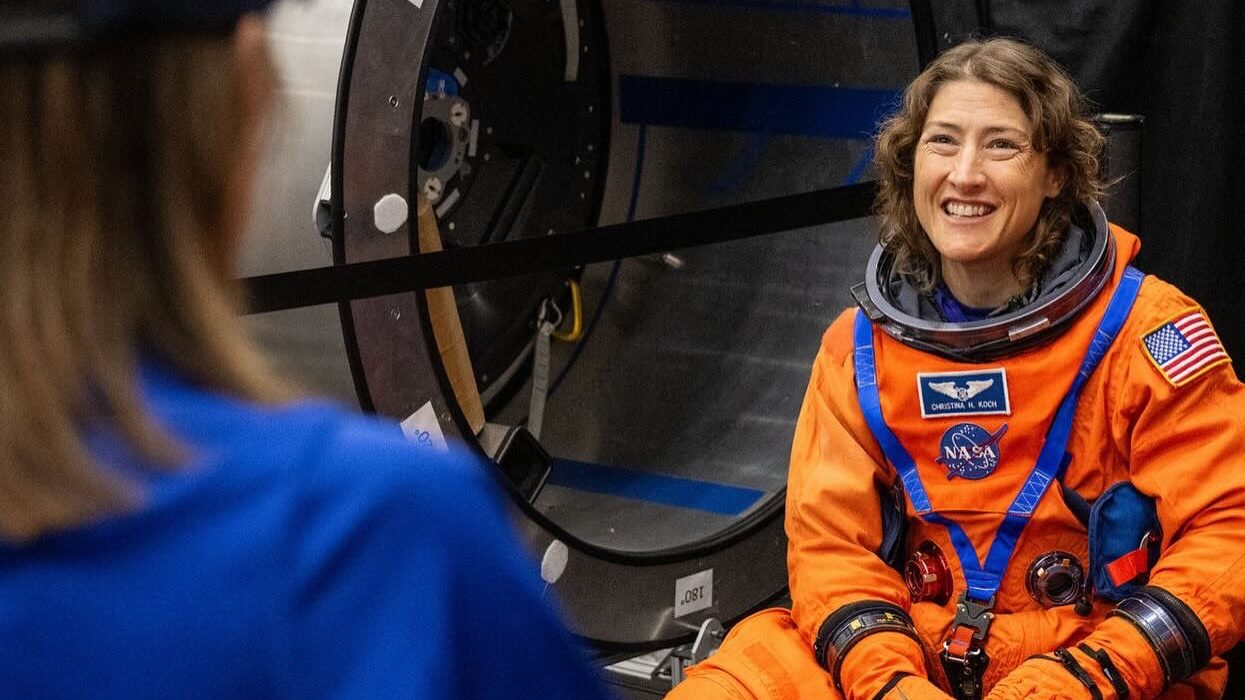
President John Dramani Mahama has congratulated Christina Koch, a crew member of the historic Artemis II, describing her journey as a moment of pride for Ghana following revelations of her academic ties to the University of Ghana.
Koch, who is part of the four-member crew travelling around the Moon, became the first woman to journey beyond low Earth orbit and one of the humans to travel the farthest from Earth in modern space exploration.
Her connection to Ghana dates back to the 1999/2000 academic year when she participated in an exchange programme at the University of Ghana, Legon. During her stay, she pursued courses including History of Ghana, History of Africa, Rural Sociology, Music, and Twi for Beginners — an academic experience the university says helped shape her global outlook and cross-cultural understanding.
Beyond the classroom, Koch’s time in Ghana reflected a deeper immersion into African culture and society. The University of Ghana notes that her academic exposure and cultural engagement during the exchange programme contributed to her development as a global citizen , an attribute that later defined her career in extreme environments, from Antarctica to outer space.
Two decades later, Koch reflected on that experience in a 2019 post while aboard the International Space Station, describing her time in Ghana as “positive, life-changing and perspective-deepening.” She compared studying abroad in Ghana to spaceflight itself, noting that seeing Ghana from orbit reminded her of the people she met and the lessons learned through exploration.
Her inclusion in the Artemis II mission places Ghana indirectly within one of humanity’s most ambitious space programmes. The mission, NASA’s first crewed lunar flyby in more than five decades, is designed to test deep-space capabilities and pave the way for future lunar landings and long-term exploration.
The Artemis II crew includes Commander Reid Wiseman, pilot Victor Glover, mission specialist Christina Koch, and Canadian astronaut Jeremy Hansen. The mission is expected to travel farther from Earth than any human mission since the Apollo era, marking a defining milestone in global space exploration.
President Mahama, also an alumni of the university of Ghana, noted that Koch’s academic journey from Legon to lunar space highlights Ghana’s role in shaping global talent. He described her story as a powerful example of how educational institutions in Ghana continue to influence global innovation and leadership across sectors, including science and technology.
“Christina’s journey from the classrooms of the University of Ghana to the frontiers of space exploration serves as a powerful inspiration to every young Ghanaian. It reminds us that our educational institutions continue to produce and shape global leaders who break barriers and reach for the stars.” he wrote on Instagram.
Her journey also resonates with Ghana’s own growing ambitions in space science and exploration. Ghana entered the space era in 2017 with the launch of GhanaSat‑1, a nanosatellite developed by engineers from All Nations University and launched into orbit aboard a SpaceX mission. The satellite monitored Ghana’s coastline, gathered atmospheric data, and promoted STEM education across the country.
The GhanaSat-1 mission marked the beginning of Ghana’s structured space ambitions and helped position the country among emerging space-capable nations. The satellite orbited the Earth at approximately 400 kilometers above sea level and completed a full orbit every 92 minutes, providing valuable technological training for Ghanaian scientists and engineers.
Koch’s journey strengthens symbolic links between Ghana’s early space ambitions and global space exploration. Her academic footprint in Ghana, combined with Ghana’s satellite programme, underscores Africa’s growing role in the future of space science and innovation.
President Mahama further noted that Koch’s achievement sends a strong message to Ghanaian youth, particularly women, that global scientific leadership is within reach. He emphasised that Ghana’s educational institutions, research programmes, and science initiatives continue to nurture talent capable of shaping the future.
“It is a point of immense pride to learn that Christina, the only woman on this pioneering lunar mission, was once an exchange student at our very own University of Ghana during the 1999/2000 academic year.” he added.
Related Posts