
The meeting point between the Indian and Atlantic Oceans carries a deeper geopolitical significance today as India and Africa continue to strengthen ties built on shared history, mutual interests, and South–South cooperation.
What follows a “Namaste” in Africa is not merely symbolism, but expanding trade volumes, growing educational opportunities through the Indian Council for Cultural Relations (ICCR), rising interest in Ayurveda and traditional medicine systems, and a strategic partnership increasingly shaping the Global South.
Within my few months covering diplomacy and international affairs, one country whose mission has consistently focused on bridging the Global South with the fast-evolving demands of the world is India.
Sharing a colonial history and decades of diplomatic relations, Ghana and India remain connected in many ways. But let’s not take a drive too far. Within just about two years, India has increasingly emerged as a strategic partner in Ghana’s development agenda. So, let us take a short drive through three major lanes of that cooperation: education, health sovereignty, and technological transformation.
The first stop on this drive is health sovereignty.
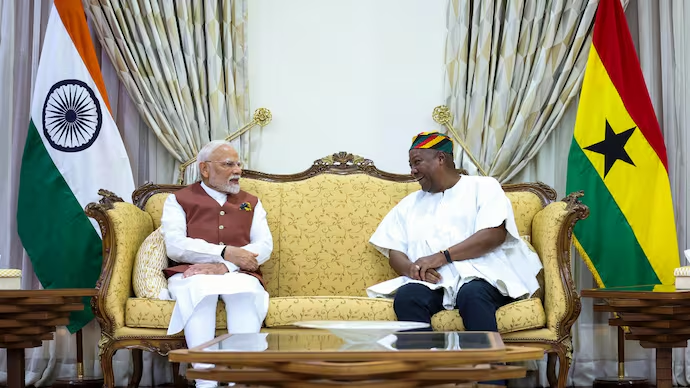
The historic visit of Indian Prime Minister Narendra Modi to Ghana in 2025 injected renewed momentum into more than six decades of bilateral relations, culminating in the signing of four Memoranda of Understanding aimed at expanding cooperation between both countries.
Among the most strategic areas of engagement is health sovereignty, a growing continental agenda championed by President John Mahama under the “Accra Reset” framework, which seeks to build a robust African health system owned, financed, and driven by Africans themselves.
The urgency of this agenda became evident during the COVID-19 pandemic, when Africa was among the last regions to gain access to vaccines. As the continent continues to grapple with limited vaccine manufacturing capacity, Ghana is positioning itself as a leading voice for African pharmaceutical independence.
During Prime Minister Modi’s visit, Ghana pushed for a Memorandum of Understanding on vaccine manufacturing and production, a move considered critical to the country’s ambition of establishing domestic vaccine production capabilities as it prepares for a gradual transition from GAVI support by 2030.
India remains one of the world’s most reliable vaccine producers and previously supported Ghana’s immunization efforts through the donation of 50,000 doses of the AstraZeneca Covishield COVID-19 vaccine.
Ghana’s ambitions for local pharmaceutical production are no longer distant aspirations. Earlier this year, the country produced its first anti-snake venom serum, marking a symbolic but significant step toward strengthening domestic biomedical manufacturing capacity.
Commitment to vaccine access has also remained central to Ghana’s public health diplomacy. The country has contributed more than $67 million to GAVI and is expected to commit an additional $20 million this year to support vaccine access for both Ghanaian children and the broader African continent.
As President Mahama stated at the 79th World Health Assembly: “A continent that manufactures less than one percent of its vaccines while carrying 25 percent of the global disease burden is not sovereign. It is vulnerable. It is, at best, a ward of the international system.”
The statement captures a growing African consensus: that health sovereignty is no longer simply a medical issue, but a geopolitical and economic imperative. As the drive continues, the next stop is education, another cornerstone quietly shaping the India–Ghana partnership.
As the drive continues, we arrive at the second stop, education, the quiet engine of this partnership.
For decades, Ghana has been a consistent beneficiary of the Indian Technical and Economic Cooperation (ITEC) Programme, established in 1964, which continues to strengthen public sector capacity and professional development across multiple fields.
From civil servants to policymakers, the programme has shaped generations of Ghanaian professionals. One notable example is Ghana’s Minister for Fisheries and Aquaculture, an alumna of the programme, who once described herself as “a direct beneficiary of India’s investment in human capital.”
Beyond individual success stories, the numbers tell a broader story: over 200,000 beneficiaries across countries have passed through India’s capacity-building ecosystem, with Ghana accounting for a significant share in Africa.
This year, the partnership extends further through the Indian Council for Cultural Relations (ICCR) and the Ministry of AYUSH, which are sponsoring 55 Ghanaian students to study traditional and holistic medicine systems, including Ayurveda, Yoga, Unani, Siddha, and Homeopathy.
In this stop, diplomacy takes a softer form, not in treaties and communiqués, but in classrooms, scholarships, and the quiet transfer of knowledge.
The final stop on this short drive brings us to the frontier of the future: Technological transformation.
India’s collaboration with Ghana in this space reflects a shared ambition: to move from digital dependence to digital capability. At the centre of this stop is Ghana’s One Million Coders Programme, an initiative aimed at equipping young people with the digital and coding skills needed for a global economy increasingly driven by technology.
Alongside this, Indian technology giants such as Tech Mahindra and Radisys have partnered with the Government of Ghana to support the development and operation of nationwide 4G and 5G network infrastructure.
In the financial technology space, both countries are also exploring the integration of UPI-style digital payment systems, designed to deepen financial inclusion and strengthen e-governance services.
And anchoring this ecosystem is the Ghana-India Kofi Annan Centre of Excellence in ICT (AITI-KACE), a flagship institution built with Indian support, which continues to serve as a regional hub for training, innovation, and software development in West Africa.
At this stop, the partnership is no longer abstract, it is coded, connected, and increasingly digital.
As this short drive through the India–Ghana path comes to a pause, what emerges is not a collection of isolated initiatives, but a connected route of strategic cooperation.
From health sovereignty to human capital development, and from digital transformation to shared diplomatic history, the relationship between Ghana and India is steadily evolving beyond symbolism into substance.
And perhaps the true significance of this journey lies not in the stops themselves, but in the direction of travel, a shared path between two Global South partners navigating a changing world, not as passengers of global systems, but as co-drivers shaping their own future.
Related Posts